artist profile
Marcel Duchamp
Choice, chance and the redefinition of the work of art
Duchamp changed art not by proposing a new style but by moving the centre of the work from the skill of the hand to the act of choice, naming, context and interpretation.
Editorial thesis
Marcel Duchamp's significance rests on a consistent revision of what makes an object a work of art. He replaced the idea of unique mastery with a system of choice, language, reproducibility, chance and viewer participation, creating the basis for conceptual art, institutional critique and contemporary exhibition thinking.
Reader question
How did a single artist manage to change twentieth-century art, almost abandoning traditional painting and turning a found object, a signature, a reproduction and the rules of a game into full artistic instruments?
The core subject is Marcel Duchamp: his works, texts, exhibition projects, chess practice and network of co-authors.
The readymade is treated not as a simple provocation but as a system of choice, context and authorisation.
The dispute over the authorship of Fountain and the role of Elsa von Freytag-Loringhoven are indicated as a discussion not finally closed.
Rrose Sélavy is analysed as an authorial persona and a linguistic mechanism, not only as a mask or costume.
Étant donnés is examined together with the questions of voyeurism, gender, the power of the gaze and the museum installation.
Images of the works are protected by the rights of the Estate of Marcel Duchamp / ARS / ADAGP and require separate licensing.
Short answer
Marcel Duchamp was born in 1887 in Blainville-Crevon, France. After early work with Cubism and the Futurist decomposition of movement, he abandoned the traditional idea of the artist as a producer of pictorial objects.
Nude Descending a Staircase, No. 2, Bicycle Wheel, Fountain, the Large Glass, L.H.O.O.Q., Boîte-en-valise and Étant donnés form not a sequence of styles but an investigation of authorship, the original, the replica, chance, language, desire and the museum context.
1. The Duchamp family and the artistic environment
Marcel Duchamp was born in 1887 in Blainville-Crevon in Normandy. Several members of the family became artists: Jacques Villon, Raymond Duchamp-Villon and Suzanne Duchamp.
The family environment connected the visual arts, music, literature and play. This interdisciplinarity later appeared in Duchamp's refusal to recognise rigid boundaries between the genres.
He studied in Paris and early entered artistic circles, yet distanced himself from the idea of a stable group or a single programme.
2. The early painting and the Puteaux group
In his early works Duchamp passed through Impressionist, Symbolist and Cubist influences.
He took part in the discussions of the Puteaux group, where the artists explored geometry, movement, perception and the relations of art with science.
At the same time Duchamp quickly became critical of the repetition of the Cubist language as a recognisable manner.
3. Nude Descending a Staircase, No. 2
The 1912 painting joins the decomposition of form, the seriality of movement and a mechanical rhythm.
The work was rejected from the Cubist exhibition, because its dynamic subject and title did not match the expectations of the group.
This episode strengthened Duchamp's distance from the collective stylistic discipline.
4. The Armory Show and the production of scandal
In 1913 Nude Descending a Staircase, No. 2 was shown at the Armory Show in New York.
The painting became one of the principal objects of the public polemic about European modernism in the United States.
The scandal formed the image of Duchamp as a provocateur, although his further work was directed rather at the dismantling of habitual categories than at the repetition of a sensation.
5. From painting to the investigation of the conditions of art
After 1912 Duchamp was increasingly less interested in painting as the production of 'retinal' pleasure.
He sought to work with ideas, language, rules and the relations between the object and the viewer.
The rejection of a single style allowed him to use glass, found objects, notes, reproductions, photography, film and the exhibition environment.
6. 3 Standard Stoppages and controlled chance
In 3 Standard Stoppages Duchamp dropped metre-long threads from a set height and recorded the curves they randomly formed.
The work parodies the idea of a universal standard of measurement, replacing the straight metric unit with the individual contours of chance.
Chance here does not mean an absence of method: the artist sets the procedure, the conditions and the way of preserving the result.
7. Bicycle Wheel and the origin of the readymade
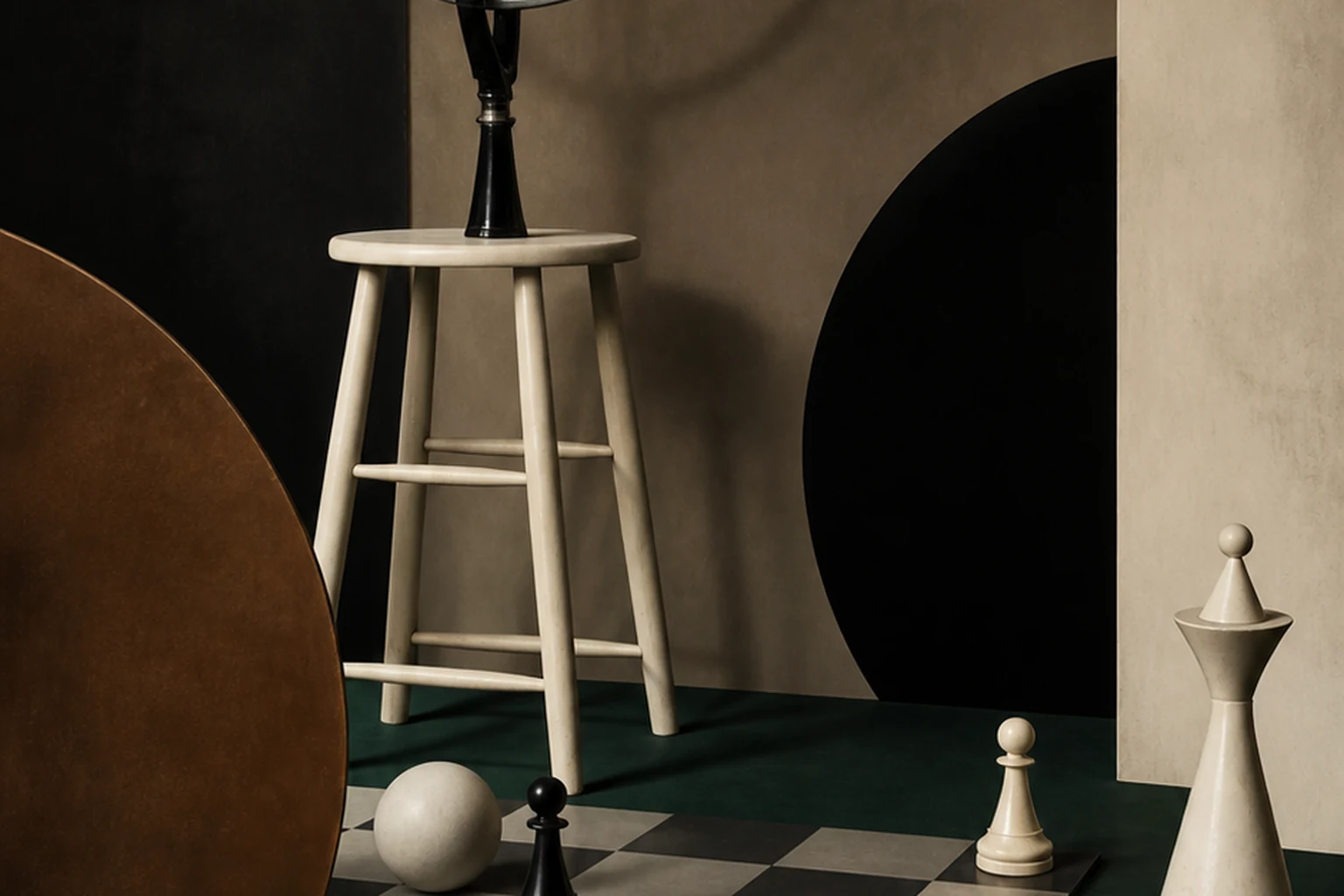
Bicycle Wheel of 1913 joins a bicycle wheel with a kitchen stool.
Duchamp later included the work in the history of the readymade, although he initially perceived the rotation of the wheel as a private visual pleasure.
The original object has not survived; the known museum versions are later authorised replicas.
8. The definition of the readymade
Duchamp introduced the term readymade in 1916 to denote a factory-made object chosen and designated by the artist.
The key operation becomes not manual manufacture but a decision: the choice of the object, the change of its mode of use, the title, date, signature and context of display.
The readymade does not cancel authorship but moves it from the production of form to the production of the conditions of interpretation.
9. Fountain and the Society of Independent Artists
In 1917 a porcelain urinal, turned and signed 'R. Mutt 1917', was submitted to the exhibition of the Society of Independent Artists.
Despite the declared principle of no jury, the object was not shown. The original soon disappeared.
Fountain became the central example of a conflict between institutional rules, authorial choice and the definition of a work of art.
10. Original, replica and photography
Most viewers know Fountain not by the lost original but by Alfred Stieglitz's photograph, the magazine publication and the later replicas.
In the 1950s and 1960s Duchamp authorised the manufacture of several full-size versions of the readymades.
The replica is therefore not a secondary compromise: it becomes part of a work about the instability of the original and of authorisation.
11. L.H.O.O.Q. and intervention in the canon
In 1919 Duchamp added a moustache and beard to a reproduction of the Mona Lisa and gave the work the phonetically ambiguous title L.H.O.O.Q.
A minimal intervention turns the mass reproduction of a museum icon into a new work.
The work joins parody, gender ambiguity, wordplay and a critique of cultural authority.
12. The Large Glass
The Bride Stripped Bare by Her Bachelors, Even was created between 1915 and 1923 on two large glass panels.
The upper zone belongs to the 'Bride', the lower to the system of the 'Bachelors', of machines, forms and processes that do not achieve union.
The work unites drawing, painting, a mechanical metaphor, an erotic drama, perspective and the real effects of transparency.
13. The machine of desire, text and incompleteness
The Large Glass does not offer a single plot: the viewer assembles the relations between the images, terms and notes.
In 1923 Duchamp declared the work definitively unfinished, making incompleteness part of its status.
After the glass was damaged in transport he incorporated the network of cracks into the work, accepting chance as an additional co-author.
14. The Green Box and the work as archive
In 1934 Duchamp issued the Green Box — a box with facsimiles of the notes, diagrams and materials connected with the Large Glass.
The box does not finally explain the work but expands it into a network of documents, puns and technical hypotheses.
In this way the work exists at once as an object, text, process, archive and instruction for interpretation.
15. Rrose Sélavy
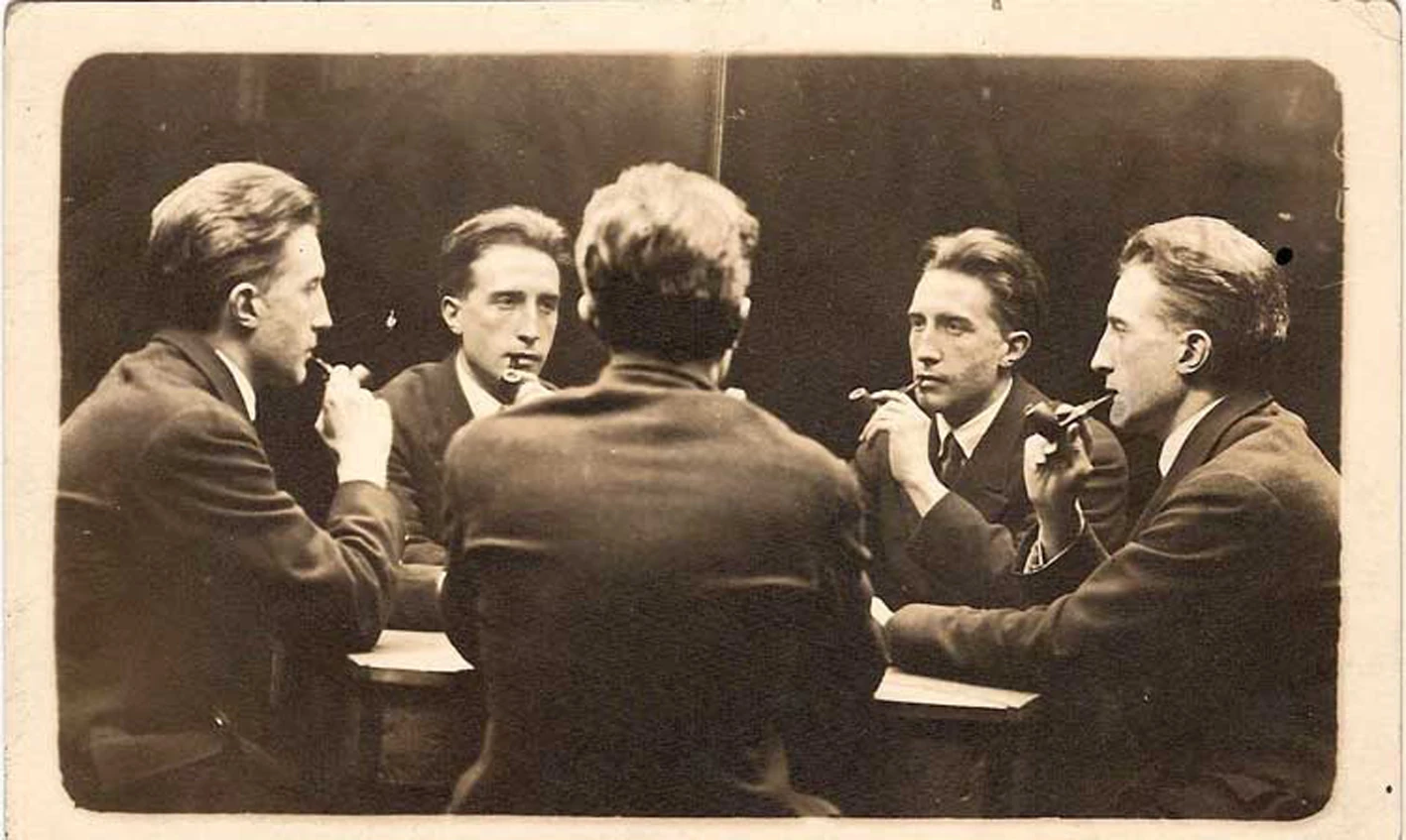
In the 1920s Duchamp created the authorial persona Rrose Sélavy; her name is connected with French phonetic wordplay.
Man Ray photographed Duchamp in the guise of Rrose, and the name appeared as the signature of a publisher, author and owner of works.
The persona disrupts the stability of gender, name and authorship, but it should be analysed in historical context, without automatically attributing to it contemporary identities.
16. The optical machines and Anémic Cinéma
Duchamp created rotating devices in which geometric patterns produce an illusion of depth when set in motion.
In the film Anémic Cinéma of 1926 the rotating discs alternate with circular inscriptions and sexualised puns.
Optics turns into a mechanical and linguistic system in which the visible constantly passes into the readable.
17. Chess as an intellectual practice
From the 1920s Duchamp devoted a significant part of his time to chess, took part in tournaments and wrote about chess problems.
Chess allowed him to join strict rules, calculation, aesthetic decision and the unpredictability of the position.
Its role should not be understood as a simple withdrawal from art: chess thinking is connected with his interest in procedure and hidden structure.
18. The Société Anonyme and work with collections
In 1920 Duchamp, together with Katherine Dreier and Man Ray, founded the Société Anonyme.
The organisation held exhibitions, lectures and collected works of contemporary art, forming an important educational infrastructure in the United States.
Duchamp also helped the collectors Louise and Walter Arensberg and later took part in the transfer of their collection to the Philadelphia Museum of Art.
19. Exhibition design and Surrealism
Duchamp took part in creating the exhibition environments for the Surrealist exhibitions, turning installation into an independent artistic instrument.
In 1938 the ceiling of the Parisian exhibition was filled with sacks, and in 1942 a web of strings crossed the space of the New York display.
Such solutions complicated movement and visibility, making the viewer a participant in a conflicted environment instead of a neutral observer.
20. Boîte-en-valise
Boîte-en-valise, created from the late 1930s, presents a portable archive of miniature reproductions of Duchamp's works.
The artist turned his own legacy into a mobile museum that can be copied, collected and transported.
The work questions the distinction between the original, the reproduction, the catalogue, the collection and autobiography.
21. Replicas and the late publicity
In the 1950s and 1960s Duchamp received new publicity through lectures, interviews, retrospectives and publications.
The authorised replicas made the lost or inaccessible part of his legacy visible again.
The late strategy shows that the preservation of a work can include managed reproduction, not only the protection of a single object.
22. Étant donnés
Étant donnés was created secretly from 1946 to 1966 and installed at the Philadelphia Museum of Art after the artist's death.
The viewer looks through two holes in a wooden door at a diorama with a nude body, a landscape, a waterfall and a lamp.
The work returns figurative illusion and material craftsmanship, while turning the very act of viewing into a strictly controlled procedure.
23. Gaze, body and ethical critique
Étant donnés raises questions about voyeurism, access, the violence of the gaze and the depiction of the female body.
The viewer cannot enter the space or change the angle: the construction fixes the relations between the observing subject and the displayed body.
Contemporary analysis must account not only for the mystery of the work but for the gendered asymmetry of its visual regime.
24. Authorship, co-authorship and contested attributions
Duchamp's works depended on photographers, publishers, makers of replicas, collectors, curators and museum specialists.
The history of Fountain includes an ongoing dispute about the possible role of Elsa von Freytag-Loringhoven; the available documents allow different interpretations and do not permit presenting the question as fully resolved.
An accurate history must distinguish conceptual authorship, manufacture, documentation, publication and institutional authorisation.
25. Influence on contemporary art
The readymade influenced conceptual art, minimalism, Fluxus, institutional critique, appropriation art and instruction-based practices.
Duchamp changed the role of the viewer: interpretation becomes not an addition but part of the production of the work.
His influence is especially visible where art works with rules, the archive, the replica, context and systems of display.
26. The current museum infrastructure
The Philadelphia Museum of Art holds the largest complex of Duchamp's works, including the Large Glass and Étant donnés.
The Duchamp Research Portal unites the digitised archives of the Philadelphia Museum of Art, the Centre Pompidou and the Association Marcel Duchamp and contains tens of thousands of images of documents and museum objects.
In 2026 MoMA and the Philadelphia Museum of Art are holding a major joint retrospective, again treating Duchamp's career as a single system of works, documents, replicas and exhibitions.
27. Conclusion
Marcel Duchamp changed art by showing that a work is defined not only by form and technique but by choice, title, context, rules and viewer action.
His practice destroyed the stable distinction between the original and the copy, the object and the document, the artist and the curator, art and intellectual play.
Duchamp's chief legacy is not a ready formula of provocation but the demand to check anew each time who, where and on what grounds calls something art.