artist profile
Marina Abramović
The body, duration and the institutionalisation of presence
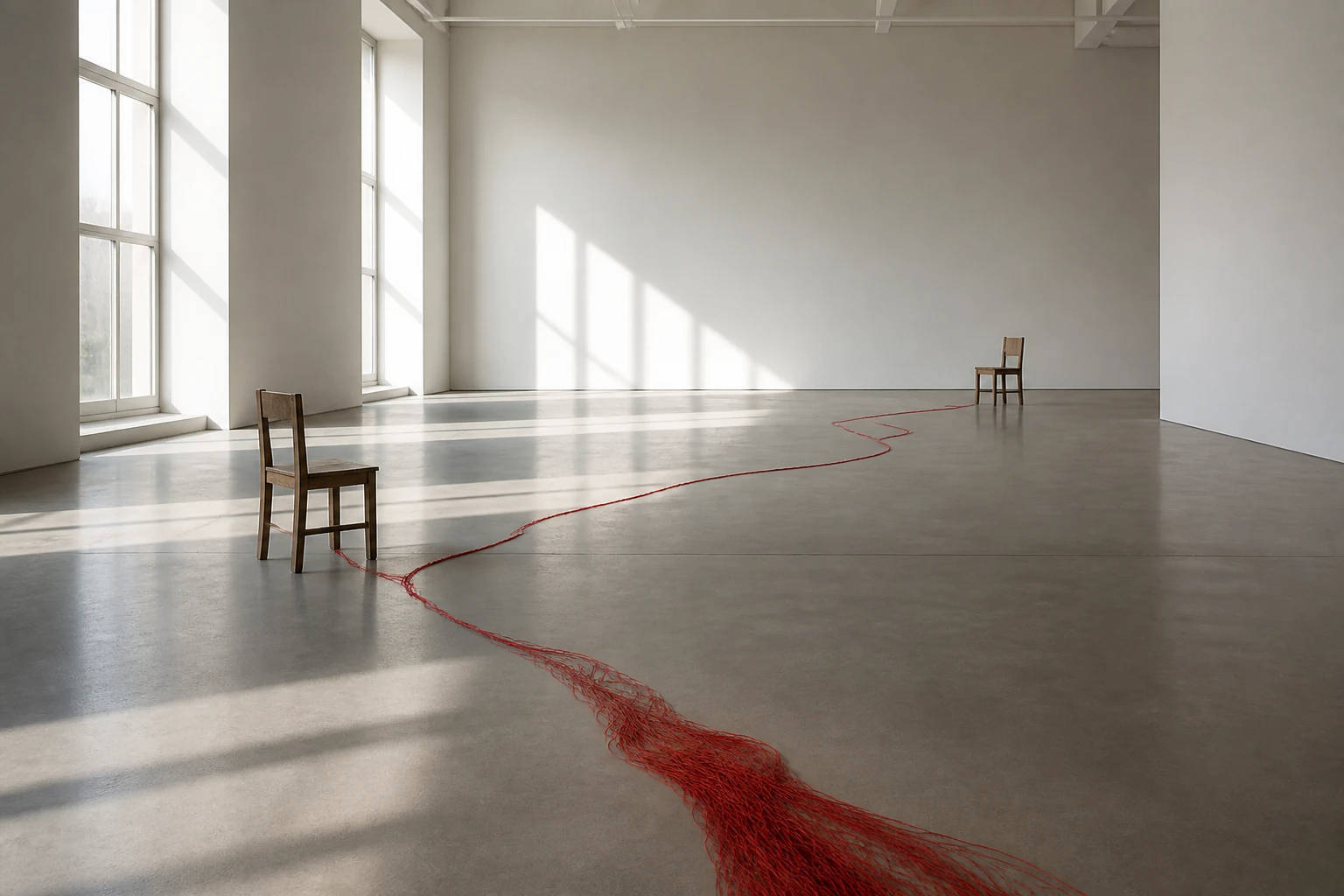
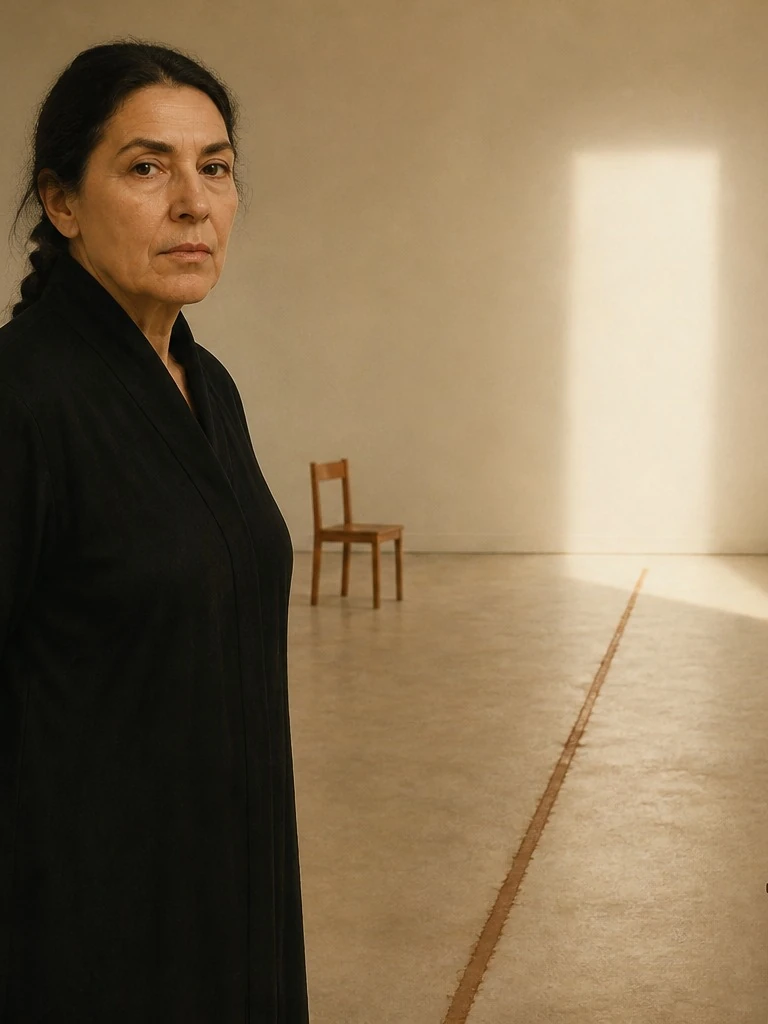
Abramović turned her own body, time, risk and the viewer's attention into artistic material. Her practice both extended the limits of performance and raised difficult questions about ethics, reperformance, authorship, cultural appropriation and the conversion of presence into an institutional brand.
Editorial thesis
Abramović's significance rests on a systematic investigation of the physical and psychological border between performer and audience. Her works show that presence is never neutral: it is organised by rules, risk, documentation, the institution and power.
Reader question
When an artist's body becomes the work, who is responsible for pain, danger, consent, memory and reperformance?
The core subject is Marina Abramović, her solo performances, the collaboration with Ulay, video, photography, theatre and her pedagogical system.
Self-harm is not romanticised and is not offered as a method to be repeated.
Works involving the audience are analysed through consent, risk and institutional responsibility.
Collaborative works from 1976 to 1988 are attributed to Marina Abramović and Ulay.
Reperformance is treated as the labour of performers, not as a transparent substitute for the historical body.
Balkan rituals are analysed together with questions of ethnographic simplification and cultural appropriation.
Performance documentation has authors of its own and separate rights.
Short answer
Marina Abramović was born on 30 November 1946 in Belgrade. She studied at the Academy of Fine Arts in Belgrade and in the 1970s began using sound, fire, knives, breath, stillness and audience reaction as her primary materials.
Between 1976 and 1988 she worked with Ulay, producing the Relation Works. After their separation she developed a solo practice, received the Golden Lion at the Venice Biennale for Balkan Baroque in 1997, and in 2010 performed The Artist Is Present at MoMA for more than 700 hours.
1. Belgrade, family and socialist Yugoslavia
Abramović was born into a family of Yugoslav partisans. Her parents held state positions, and her childhood passed between political privilege and severe domestic discipline.
She later folded family history, communist symbolism and her grandmother's Orthodox religiosity into her own authorial mythology.
The biographical material matters, but it should not be used as an automatic explanation for every act of pain or control.
2. Academic training and early sound work
Abramović studied painting in Belgrade and continued her education in Zagreb.
Early works included images of clouds, sound environments and projects that existed in the form of an instruction.
The turn to the body came as a refusal to depict an event in favour of real time and real risk.
3. Rhythm 10
In Rhythm 10 of 1973 the artist moved a knife rapidly between her fingers, recording the sound of errors and cuts.
She then repeated the sequence, following the audio recording of the first execution.
The work joins memory, repetition, chance and the attempt to reproduce trauma as a structure.
4. Rhythm 5
In Rhythm 5 the artist built a burning five-pointed star and lay down inside it.
Lack of oxygen caused her to lose consciousness, after which those present pulled her out of the fire.
The incident exposed the limit of authorial control: an unconscious body can no longer continue a performance.
5. Rhythm 0
In Naples in 1974 Abramović stood motionless for six hours beside a table holding 72 objects.
The audience was permitted to use the objects on her body, including instruments of pleasure, of pain and of potential death.
The performance showed how quickly permission and group dynamics can turn an audience into a source of violence.
6. Consent, risk and the responsibility of the audience
The claim that the artist bore full responsibility does not remove the ethical responsibility of participants and organisers.
A contemporary institution could not reproduce the historical conditions of Rhythm 0 without strict limits.
The work is valuable not as proof of heroism but as an investigation of power, deindividuation and the fragility of consent.
7. Art Must Be Beautiful
In the 1975 performance Abramović brushed her hair violently while repeating the phrase Art Must Be Beautiful, Artist Must Be Beautiful.
The physical aggression is directed at the cultural demand for female attractiveness and professional acceptability.
The title works as a compulsive command that is produced by society and reproduced by the artist herself at the same time.
8. Lips of Thomas
Lips of Thomas of 1975 involved honey, wine, a broken glass, a star cut into the stomach, flagellation and ice.
Christian, communist and bodily symbolism converged in an extended ritual.
The audience eventually stopped the action, showing once again that spectators become ethical participants.
9. Meeting Ulay
Marina Abramović and Uwe Laysiepen, known as Ulay, met in 1975.
They began living and working as a collective artistic unit, calling themselves The Other.
Their practice examined the couple, symmetry, conflict, trust and the erasure of individual identity.
10. Relation in Space
In Relation in Space of 1976 two naked bodies collided repeatedly as they moved towards one another.
Increasing speed turned the encounter into physical conflict.
The work presents relationship as a dynamic of force rather than a harmonious union.
11. Breathing In/Breathing Out
The partners joined mouths and breathed each other's air until the oxygen ran out.
Intimacy became a closed system capable of causing suffocation.
The work dismantles the romantic image of the couple by showing dependence as a physical threat.
12. Imponderabilia
In 1977 Abramović and Ulay stood naked on either side of a narrow museum entrance.
Visitors had to pass between the bodies and choose which one to face.
In reperformance the work requires especially clear consent, an alternative route and protection for the performers.
13. Rest Energy
In Rest Energy of 1980 Ulay held a drawn bow whose arrow pointed at Abramović's heart.
Microphones amplified the breathing and heartbeats of the pair.
Trust here exists not as an abstract feeling but as the transfer to a partner of a real capacity to cause death.
14. Nightsea Crossing
In the Nightsea Crossing series the artists sat motionless opposite each other at a table for hours.
Duration, fasting and silence shifted attention from action to state.
The series prepared Abramović's later interest in presence and the exchange of energy.
15. The Great Wall of China and the separation
In 1988 Abramović and Ulay set out from opposite ends of the Great Wall of China.
After months of walking they met and brought their personal and artistic partnership to an end.
The project had originally been conceived as a union, but bureaucratic delay changed its meaning.
16. Joint authorship and the archive
The Relation Works must be credited as the work of two authors.
Later disputes over rights and the archive showed that the romantic myth of the couple is no substitute for a legal agreement.
Documentation, negatives, video recordings and the right of reperformance are independent parts of the legacy.
17. Balkan Baroque
At the 1997 Venice Biennale Abramović spent several days scrubbing bloodied cow bones.
Video of her parents and of Balkan stories surrounded the physical labour, the smell and the decay.
The work received the Golden Lion and became a symbolic response to the wars that followed the break-up of Yugoslavia.
18. The Yugoslav wars and the limits of symbolic mourning
Balkan Baroque refuses the possibility of scrubbing away the trace of violence entirely.
Yet a universal image of bones can obscure specific political responsibilities and the differences between victims.
An ethical reading must join symbolic mourning to historical precision.
19. The House with the Ocean View
In 2002 the artist lived for twelve days without food in three open rooms at the Sean Kelly Gallery.
Visitors watched her sleep, drink, shower and carry out everyday actions.
Ladders with knives instead of rungs turned the space into a visible but inaccessible zone.
20. Seven Easy Pieces
At the Guggenheim in 2005 Abramović reperformed works by Bruce Nauman, Vito Acconci, VALIE EXPORT, Gina Pane and Joseph Beuys, along with one of her own.
The project proposed a licensed model for preserving historical performance.
It also raised the question of whether a new body can reproduce the political and biographical context of the original.
21. Reperformance and the performer's labour
Reperformance requires training, payment, safety, rest and psychological support.
A performer is not a living exhibit without agency of their own.
The museum is obliged to disclose the authorship of the original, the name of the current performer and the difference between versions.
22. The Artist Is Present
In 2010 Abramović sat in the atrium of MoMA throughout the exhibition's opening hours.
Visitors sat down opposite her one at a time and held silent eye contact.
The performance lasted more than 700 hours and drew over 1,500 participants.
23. Presence, the queue and social media
The work became a global event through Marco Anelli's photographs, live streaming and social media.
The queue, the museum's rules and the public documentation were all part of the experience.
The intimacy of the encounter existed simultaneously as a mass-distributed image.
24. 512 Hours and Generator
In 512 Hours of 2014 the artist worked with visitors in the almost empty space of the Serpentine.
Generator in New York used blindfolds and noise-cancelling headphones.
Both works shifted the emphasis from the display of the artist's body to a controlled sensory experience for the audience.
25. The Marina Abramović Method
The method involves slowing down, silence, counting, water, walking and concentration.
It grew out of preparation for long-duration performances and out of workshops.
It should be understood as an authored pedagogical system, not as medically proven therapy.
26. The Marina Abramović Institute
The Marina Abramović Institute was conceived as a platform for long-duration and immaterial practices.
The project connects performance, dance, music, science and education.
The history of the unrealised building conversion in Hudson shows the difference between an institutional idea and durable infrastructure.
27. Celebrity, fashion and the cultural brand
Abramović has collaborated with musicians, designers, the film industry and celebrities.
That publicity helped widen the audience for performance.
At the same time the image of the severe, spiritual and fearless artist became a commercially effective brand.
28. Seven Deaths of Maria Callas
The project brings together seven operatic deaths, the figure of Maria Callas, cinema and live musical performance.
Abramović plays the heroines alongside Willem Dafoe in the filmed scenes.
The work examines the recurring cultural fantasy of a woman's beautiful death.
29. Balkan Erotic Epic
The project returns to Balkan folklore, erotic ritual, fertility, death and political history.
The new version involves numerous performers, musicians, directors and technical teams.
The production expands the scale of authorship but heightens the risk of turning a heterogeneous region into a single exotic myth.
30. Transforming Energy 2026
In 2026 the Gallerie dell'Accademia in Venice presented the exhibition Transforming Energy.
Abramović became the first living woman artist to be given a major solo exhibition there.
The project sets historical works, reperformances and transitory objects alongside the Renaissance collection.
31. The body, age and the transmission of practice
As the artist approaches eighty, the question of transmitting works to other bodies becomes central.
Age does not remove the author's presence, but it changes the physical conditions of execution.
Archive, instruction and training become part of the work on equal terms with the original event.
32. Cultural appropriation and the Balkan myth
Abramović has drawn on Tibetan, Aboriginal, Brazilian and Balkan practices as sources of energy and ritual.
Critics point to the risk of tearing traditions out of their historical and religious context.
Responsible editing must name the communities, the sources, the intermediaries and the nature of the permission given.
33. The ethical critique of pain and power
The artist's self-harm is not a universal model of artistic courage.
When risk is transferred to a performer or a participant, the institution is obliged to secure informed consent and a way out.
The charisma of an author must not override labour rights and safety.
34. Rights, documentation and the museum canon
Performance survives through photographs, video, instructions, testimony and reperformance.
Each document carries its own point of view and its own rights holder.
The museum canon of Abramović was shaped not only by the events themselves but by the quality of their subsequent visual and institutional representation.
35. Conclusion
Marina Abramović made duration, risk and attention central materials of contemporary art.
Her practice demonstrated the transformative power of presence and at the same time exposed the difficult relations between body, audience and institution.
Her principal legacy is not the heroisation of pain but the demand that every participant in an artistic event recognise their own responsibility.