artist profile
René Magritte
Image, language and the mystery of the everyday
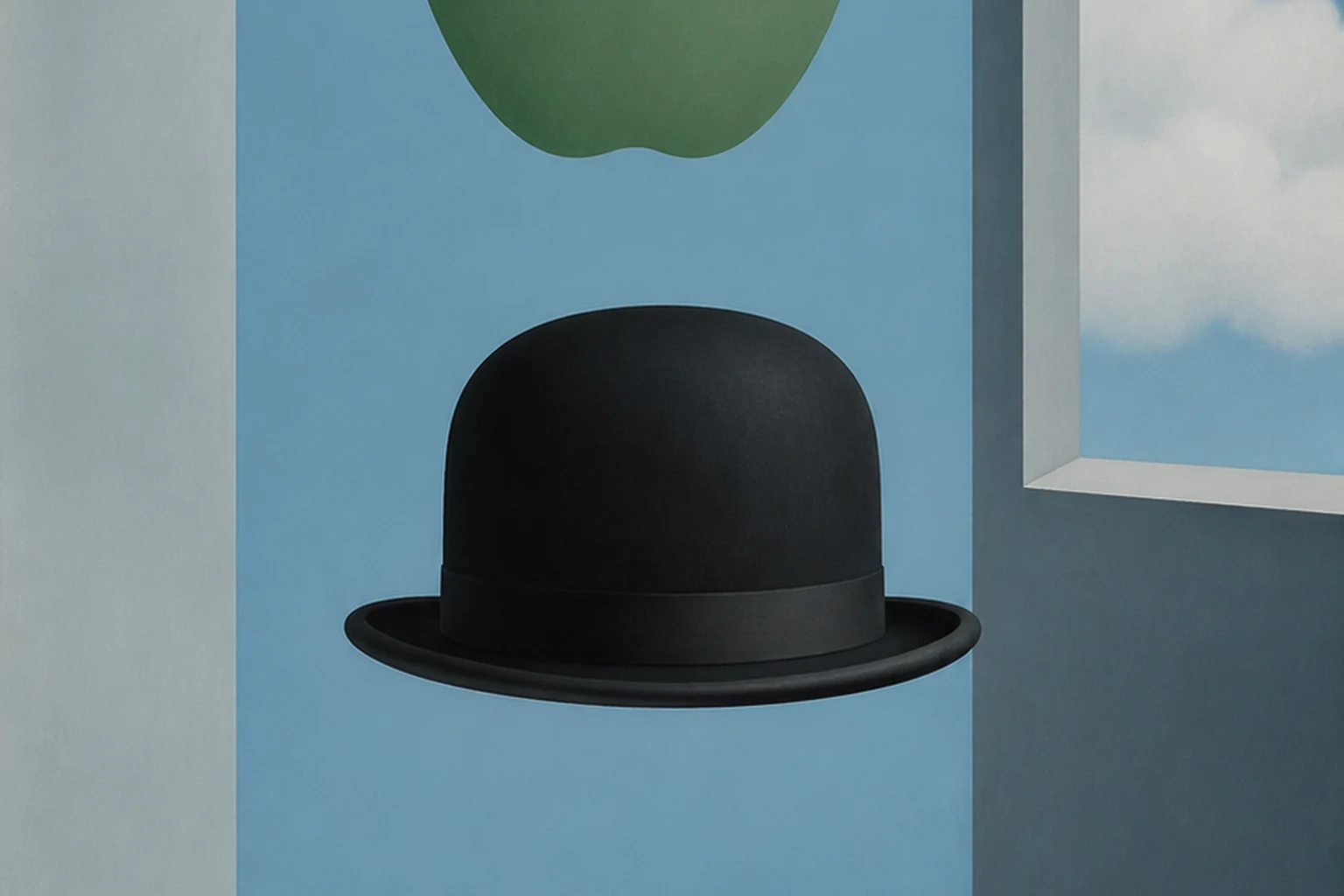
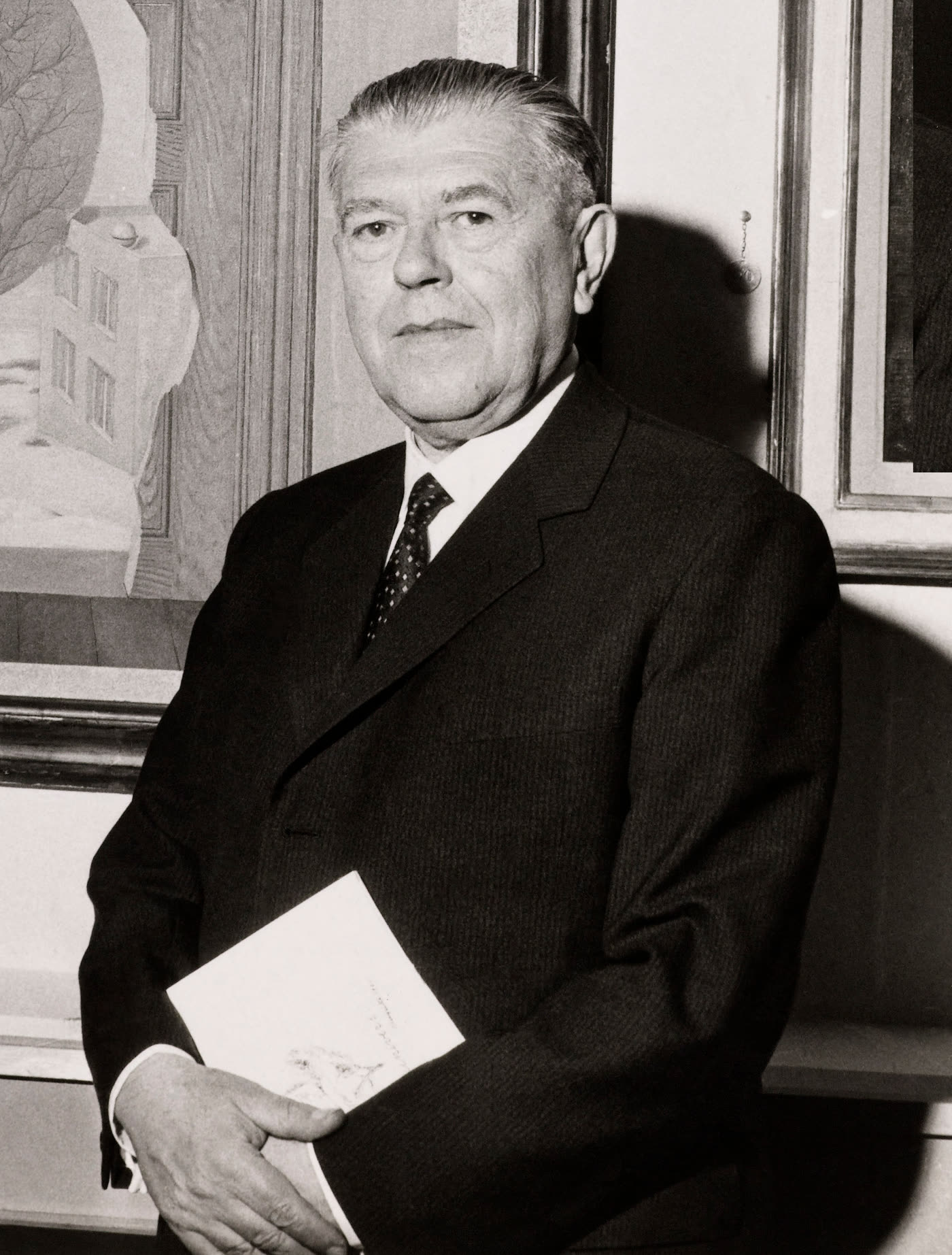
Magritte did not try to depict the dream as a personal confession. He placed ordinary things in relationships where the image ceased to be a transparent window and became an intellectual enigma about vision, language and reality.
Editorial thesis
Magritte's significance rests not on fantastical technique for its own sake, but on a systematic investigation of the relationships between object, word, image and name. His emphatically clear painting turns everyday verisimilitude into an instrument of doubt.
Reader question
Why can a carefully painted pipe, apple, window, cloud or bowler-hatted man disrupt habitual reality more powerfully than free abstraction or a dream image?
The core subject is René Magritte, his painting, graphic work, advertising, photography, films and public strategy.
Belgian surrealism is examined as a collective intellectual environment involving Paul Nougé, Louis Scutenaire, Marcel Mariën and other figures.
The titles of works were not always Magritte's individual decisions; the role of friends and collective discussions is noted separately.
The story of his mother's suicide is not used as a universal psychological explanation for the covered faces and fabric in the paintings.
The repetition of motifs is analysed simultaneously as a philosophical method, a market practice and a means of producing recognisability.
Reproductions of works remain subject to copyright and photographic rights; a rights review is mandatory before publication.
Short answer
René François Ghislain Magritte was born on 21 November 1898 in Lessines, Belgium. He studied at the Académie Royale des Beaux-Arts in Brussels, worked in applied graphics and advertising, and by the mid-1920s had forged his own language of figurative surrealism.
The Menaced Assassin, The Lovers, The False Mirror, The Treachery of Images, The Human Condition, Not to Be Reproduced, Time Transfixed, Golconda and the Empire of Light series demonstrate his sustained interest in the discrepancy between the visible and the nameable.
1. Lessines, Châtelet and early biography
René Magritte was born on 21 November 1898 in Lessines, in the Belgian province of Hainaut. The family moved repeatedly, and his childhood unfolded in the industrial and provincial environment of Wallonia.
In his teens Magritte met Georgette Berger, whom he married in 1922. Their personal and working partnership endured until the artist's death.
The early biography later became part of the public myth, yet Magritte himself resisted explanations of art through straightforward psychological determinism.
2. The death of his mother and the limits of biographical interpretation
In 1912 Magritte's mother took her own life. This event is often used to explain the fabric-covered faces in his works.
The popular story that the artist saw his mother's body with her dress covering her face is not documented and circulates as biographical legend.
Fabric, mask and the covered face in Magritte's works are more productively analysed within his broader inquiry into visibility, desire and the impossibility of complete knowledge.
3. The Academy in Brussels
In 1916 Magritte enrolled at the Académie Royale des Beaux-Arts in Brussels.
The training did not become a complete artistic system for him, but it provided professional skills in drawing, composition and painting.
Early works included Cubist, Futurist and abstract experiments before the shift to a clear object-based manner.
4. Applied graphics, wallpaper and advertising
Before gaining steady recognition as a painter, Magritte worked as a designer at a wallpaper factory, creating posters, sheet-music covers, packaging and advertising graphics.
Later, together with his brother Paul, he handled commercial commissions through the advertising practice Dongo.
The experience of applied graphics shaped the precise contour, flat space, laconic object and the ability to rapidly produce a memorable sign.
5. The Belgian surrealist group
Belgian surrealism developed differently from André Breton's Paris group.
Paul Nougé, Camille Goemans, Louis Scutenaire, E. L. T. Mesens and other participants paid particular attention to language, the subversion of habitual meaning and collective intellectual experiment.
Magritte worked within this environment, where painting, title, magazine, photograph and short text were regarded as interrelated forms of action.
6. Giorgio de Chirico and The Song of Love
Encountering a reproduction of Giorgio de Chirico's The Song of Love was a major turning point for Magritte.
He was struck by the possibility of joining ordinary objects so that their proximity ceased to be logical and became poetic.
Unlike automatism, Magritte aimed for a consciously constructed enigma, painted in the clearest possible manner.
7. The Lost Jockey and the transition to a mature language
The Lost Jockey of 1926 is often cited as one of the first works of Magritte's mature surrealist period.
A rider moves through a space in which trees are transformed into chess-like or musical-note forms, and the familiar landscape becomes a notional stage.
The painting demonstrates the artist's key method: not to invent a fantastical object but to disrupt the relationships between familiar things.
8. Paris and relations with French surrealism
After a poorly received solo exhibition in 1927, Magritte and Georgette moved to the Paris area.
The artist entered the circle of André Breton, Paul Éluard, Max Ernst, Joan Miró and other surrealists.
Differences of outlook, personal conflicts and economic circumstances contributed to the couple's return to Brussels in 1930.
9. The Menaced Assassin
The Menaced Assassin of 1927 is constructed like a frozen frame from a crime film.
At the centre a man listens to a gramophone beside a woman's body, while armed figures wait at the door and onlookers peer through the window.
The painting offers no completed narrative: the viewer receives a multitude of clues but cannot reconstruct a single causal chain.
10. The Lovers and the covered face
In the paintings The Lovers of 1928 the faces of a kissing couple are covered with fabric.
The gesture of intimacy simultaneously becomes a gesture of the impossibility of seeing and knowing the other.
The work is often linked to the artist's family tragedy, yet such reduction forecloses a broader question about desire, the image and the opacity of human closeness.
11. The False Mirror
In The False Mirror an enormous eye is filled with sky, clouds and the black disc of the pupil.
The viewer simultaneously looks at the eye as an object and, as it were, looks through it as through a window.
The title, suggested by Paul Nougé, calls into question the idea of vision as neutral mechanical reflection.
12. Words, images and The Treachery of Images
In the series of word-image paintings Magritte investigated the arbitrary link between object, image and name.
The caption Ceci n'est pas une pipe beneath a meticulously painted pipe reminds us: what the viewer faces is not an object but an image of an object.
The work does not deny the obvious; it separates levels of reality that everyday language habitually conflates.
13. The Human Condition
In The Human Condition a painting on an easel exactly coincides with the landscape beyond the window.
The viewer cannot determine which part of the visible belongs to the external world and which to the image on the canvas.
Magritte turns the classic window-painting metaphor into a problem: all vision is already organised by a frame and a cultural system of representation.
14. Window, painting and the frame of vision
The window continually appears in Magritte's painting as a boundary between interior and exterior.
Broken glass may retain fragments of the depicted landscape, while a curtain simultaneously conceals space and indicates its existence.
The frame is not a neutral edge: it defines what counts as image, object and reality.
15. Not to Be Reproduced and Edward James
Not to Be Reproduced of 1937 was made for the British poet and collector Edward James.
A man stands before a mirror, yet the mirror reproduces the back of his head instead of the reflection of his face.
The precise painterly logic makes the impossibility especially persuasive: the violation occurs not in technique but in the very mechanism of representation.
16. Time Transfixed
In Time Transfixed of 1938 a locomotive emerges from a fireplace in a tidy bourgeois interior.
Chimney and steam engine are linked by the function of smoke, yet their scale and spatial conjunction remain impossible.
The painting was part of Magritte's relationship with Edward James and shows how a commission could become a laboratory of poetic juxtaposition.
17. The title as a collective practice
Magritte frequently discussed the titles of paintings with friends during meetings of the Belgian surrealist group.
Paul Nougé, Louis Scutenaire and other participants proposed titles that did not explain the image but created an additional tension.
The title should therefore be regarded as a separate element of the work and sometimes as the result of collective authorship.
18. Photography, staging and domestic theatre
Magritte and his circle created staged photographs in which they enacted gestures, disguises, doubles and visual jokes.
Photography served not only as documentation but as an autonomous field of surrealist action.
The domestic scale of these scenes differed from the heroic model of the avant-garde artist and underscored the collective, playful side of the practice.
19. War and 'surrealism in full sunlight'
During and after the German occupation Magritte temporarily changed his palette and turned to a lighter, more painterly manner.
He called this direction 'surrealism in full sunlight', setting it against the dark atmosphere of the wartime period.
The period remains contested: optimistic painting may have been simultaneously an aesthetic resistance and an evasion of direct depiction of political violence.
20. The période vache
In 1948, for an exhibition in Paris, Magritte produced a series of deliberately crude, bright and caricatural works.
The label période vache is linked to mocking aggressiveness, cheap paint and the rejection of the customary refinement of his images.
This episode was an assault on Parisian taste and simultaneously a demonstration of the artist's ability to destroy his own brand.
21. Golconda and the anonymous man in the bowler hat
In Golconda of 1953 a multitude of nearly identical men in overcoats and bowler hats hang suspended before house façades.
The figures can be read as rain, a crowd, a recurring social type or a dispersed self-portrait.
Magritte transforms the standard bourgeois suit into a sign of anonymity, repetition and the unsettling impossibility of defining space.
22. The Empire of Light and repetition
In the Empire of Light series a daytime sky is joined with a nocturnal street, house or landscape.
The contradiction does not look fantastical because of the restrained painterly manner and the precise light.
Magritte returned to the composition repeatedly, producing versions for different clients; repetition became at once an investigation and an economic model.
23. The Son of Man and the late visual canon
The Son of Man of 1964 shows a man in a bowler hat whose face is obscured by a green apple.
The painting is linked to the persistent motif of the visible that promises revelation of identity yet is immediately blocked by a new object.
Later the image became one of the most commercially recognisable symbols of twentieth-century art, often detached from the original philosophical problem.
24. Sculpture, film and the expansion of media
In the late period Magritte translated certain painterly motifs into bronze sculpture.
He also shot short amateur films with friends and family, using masks, domestic spaces and staged actions.
These works show that his method was not exclusively dependent on the painted canvas and could be transferred between media.
25. Georgette Magritte, friends and collective production
Georgette Magritte was a constant model, the host of the home studio, a participant in photographic stagings and the keeper of the artist's personal environment.
Friends proposed titles, wrote texts, took part in photographs, magazines and exhibition projects.
Acknowledging the collective environment does not cancel Magritte's authorship but makes the history of his works more accurate and less mythologised.
26. Advertising, design and global recognisability
The clear contour, a single dominant object and a simple visual contradiction made Magritte's language especially influential for advertising, covers, film and the music industry.
Commercial culture frequently uses the apple, the bowler hat, the cloud and the covered face as ready-made signs of 'surrealist-ness'.
Such diffusion confirms the power of the method, but at the same time turns a critical enigma into a decorative brand.
27. Critique: women, coloniality and the commodity image
The female body in Magritte is not infrequently turned into a fragment, an object of substitution or a surface for visual operation.
Like European surrealism as a whole, his milieu was formed within a society with colonial and gender hierarchies that did not always become the object of direct critique.
Contemporary reading must analyse not only the intellectual game but also whose body, labour and cultural experience are turned into the material of the image.
28. Museums, foundation and authentication
The Musée Magritte Museum in Brussels opened in 2009 on the basis of the collection of the Royal Museums of Fine Arts of Belgium.
The Fondation Magritte and the Comité Magritte work with the archive, image rights and questions of authentication.
The large number of repeats, variants, graphic works and posthumous reproductions makes provenance verification especially important for the market and publication.
29. Conclusion
René Magritte turned the everyday image into a philosophical instrument.
His paintings demonstrate that vision, language and name do not automatically coincide, and that a realist technique can produce radical uncertainty.
Magritte's chief legacy is not a set of apples, pipes and bowler hats but a discipline of doubt about how the image creates reality.