artist profile
Yayoi Kusama
Infinity, repetition and the disappearance of the self
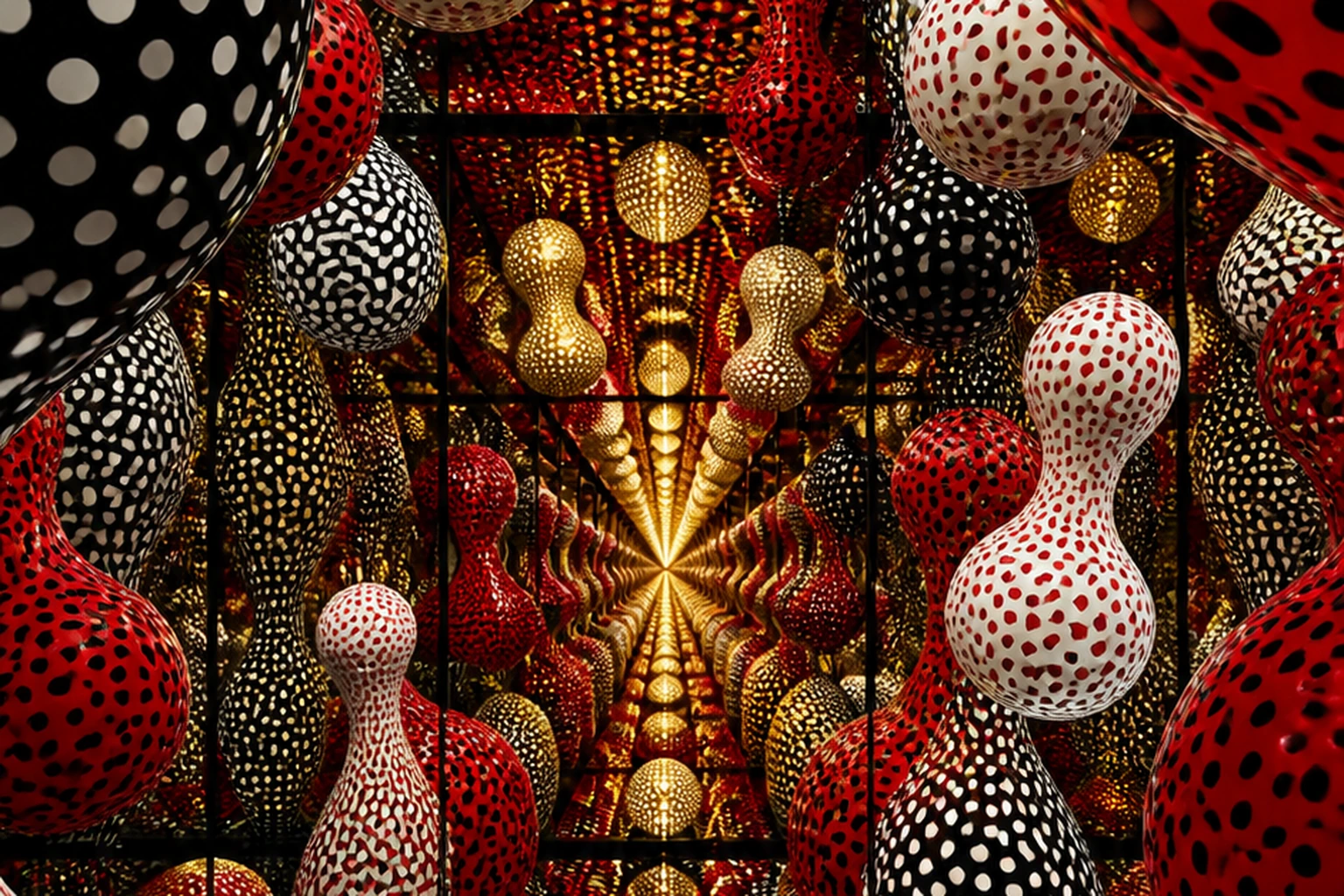
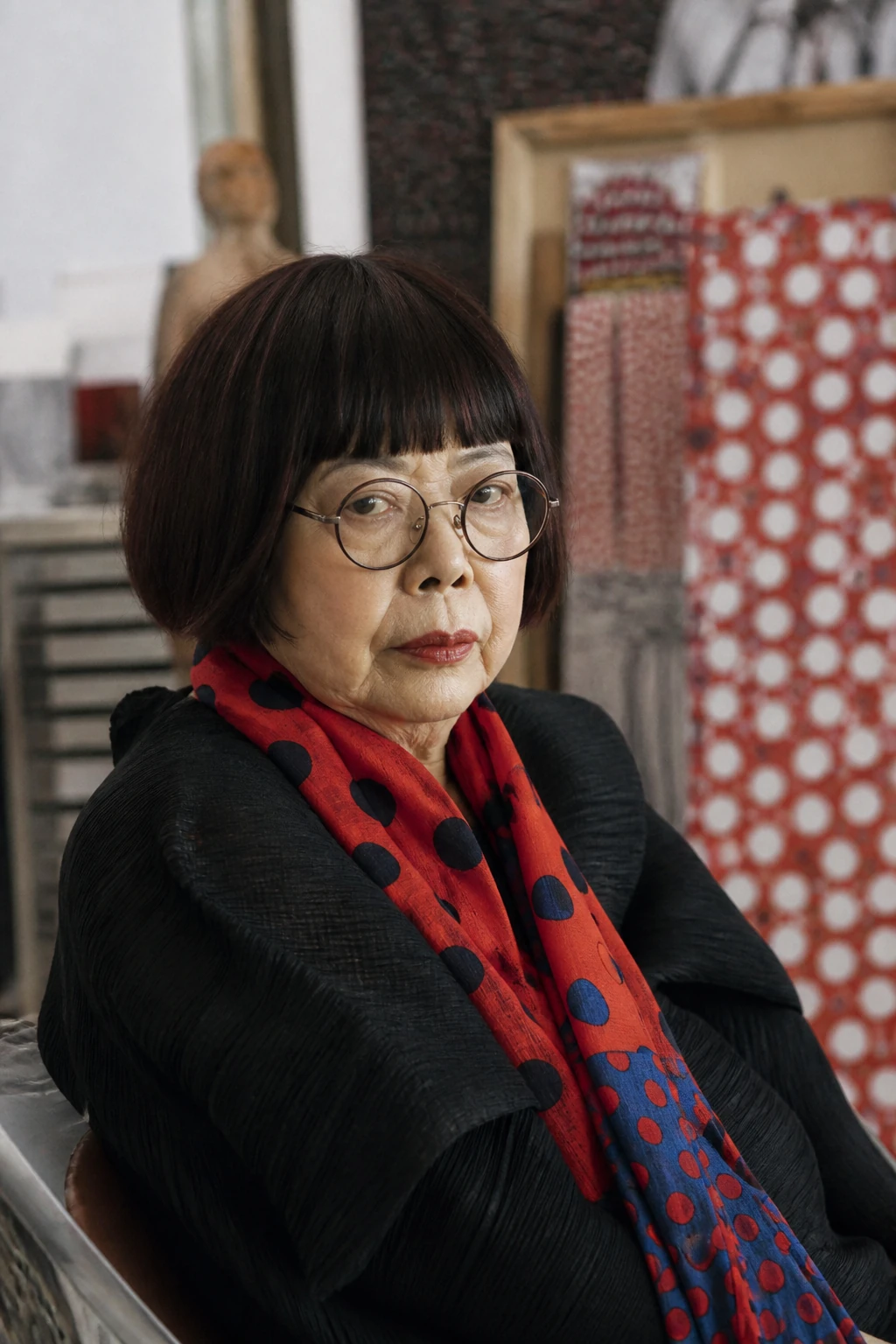
Editorial voice: VANSMITHLAB Type: Encyclopedia / art-historical and visual-culture material Date of preparation and last review: 8 August 2026 Status: detailed editorial document / draft for evidence review Verification state: partially_verified / Confidence: 0.97 Language: en / source_revision: 1 / route: /en/glossary/artists/yayoi-kusama Kusama turned repetition into a method: the net, the dot, the soft form and the mirror simultaneously expand space and dissolve the individual body. Her art exists between private compulsion, the avant-garde, mass culture and the global economy of spectacle.
Editorial thesis
Kusama cannot be reduced to 'the polka-dot artist' and a set of photogenic mirror rooms. Her practice grew out of early drawing, post-war Japan, the New York avant-garde, feminist and anti-war action, literature, and a decades-long investigation of repetition, sexuality, fear, death and self-obliteration.
Reader question
How did a single gesture of repetition become at once a means of psychological survival, a formal experiment, a political act and one of the most recognisable artistic languages in the world?
Biographical information about mental health is used only where it is documented by the artist herself or by authoritative institutions; diagnosis is not used as a universal explanation of the art.
The New York happenings are examined in the context of the anti-war, sexual and countercultural movements of the 1960s.
The Infinity Mirror Rooms are analysed as a spatial practice, not as a backdrop for social media.
Commercial projects and Louis Vuitton are examined together with rights, reproduction and brand economics.
Literature, the museum, studio labour, the market and contemporary institutionalisation are accounted for separately.
Short answer
Yayoi Kusama was born on 22 March 1929 in Matsumoto, Japan. In 1957 she moved to the United States, and from 1958 worked in New York, where she produced the Infinity Nets, soft sculptures, mirror installations, performances, body painting and anti-war happenings. In 1973 she returned to Japan, continued her artistic and literary work, and later became one of the most institutionally and popularly recognised artists of the present day.
1. Matsumoto, family and early drawing
Kusama grew up in Matsumoto. The official biography links her early drawings of nets and dots to visual experiences in childhood. It is important not to turn this fact into the sole cause of the later practice: her artistic language was also formed through education, the exhibition environment and deliberate strategy.
2. Kyoto and the Japanese system of painting
In the late 1940s Kusama studied traditional Japanese painting in Kyoto. She later distanced herself from academic constraints and sought an international contemporary environment.
3. Georgia O'Keeffe and the route to the United States
Kusama entered into correspondence with Georgia O'Keeffe and sought advice about working in the United States. In 1957 she left for America, first to Seattle and then to New York.
4. New York and the Infinity Nets
From the late 1950s Kusama produced the large monochrome canvases of the Infinity Nets. The repeated gesture dismantled central composition: the net could be imagined continuing beyond the edges of the canvas.
5. Repetition as labour and as limit
For Kusama repetition is at once meditative and exhausting. It makes the time of production visible and turns the surface into a field with no privileged point.
6. Accumulations
In the early 1960s the artist covered furniture and objects with masses of soft sewn forms. Seriality invaded the domestic object, making the familiar bodily and unsettling.
7. The phallus, fear and sexuality
The soft phallic forms are often interpreted through Kusama's stated relationship to sexual fear. Yet these objects also work as a feminist inversion: the repeated sign of male sexuality becomes manufactured, soft and almost comic.
8. Aggregation: One Thousand Boats Show
The 1963 installation combined a boat covered in soft forms with hundreds of repeated photographs of the object on the walls. Image and thing formed an early total environment.
9. Infinity Mirror Room — Phalli's Field
In 1965 mirrors made it possible to replace the physical fabrication of an infinite number of objects with optical repetition. The space became a machine for multiplying the body, the object and the viewer.
10. Self-Obliteration
Kusama described self-obliteration as the dissolution of the boundaries of the self through repetition and the spread of a motif. The dot can denote both a discrete particle and the disappearance of individuality within an infinite field.
11. Happenings and the public body
In the second half of the 1960s Kusama organised happenings with nude participants, body painting and public actions. The body became a carrier of pattern and of political message.
12. Anti-war actions
Some of the happenings were directed against the war in Vietnam. Erotic freedom and public nudity were used as a countercultural gesture against militarism and conservative morality.
13. Narcissus Garden
At the 1966 Venice Biennale Kusama laid out a mass of mirrored spheres and offered them to visitors. The gesture drew reflection, the desire to possess and the art market into a single scene.
14. Fashion and the Kusama Fashion Company
Kusama transferred dots and cut-outs onto clothing and established her own fashion activity. For her, fashion was not incidental commerce but another way of extending the body into a total pattern.
15. The film Kusama's Self-Obliteration
The 1967 experimental film recorded and reworked Kusama's performative world. It won festival awards and remains an important document of her New York period.
16. Visibility, gender and competition
Kusama worked alongside artists of minimalism, pop art and performance but long remained less institutionally protected. Later art history revised its account of her contribution to seriality, soft sculpture and immersive installation.
17. The return to Japan
In 1973 Kusama returned to Japan. The move did not mean the end of her practice: she went on making collages, objects, paintings and texts.
18. The psychiatric hospital and the studio
Since 1977 Kusama has lived voluntarily in a psychiatric hospital in Tokyo and works in a separate studio. This arrangement should not be turned into a romantic myth of the 'mad genius': her practice remains disciplined professional production.
19. Literature
Kusama writes novels and poetry; in 1983 she received a literary award for a novel. Her literary practice shows that her world is not confined to visual signs.
20. Venice 1993 and the institutional return
In 1993 Kusama represented Japan at the Venice Biennale. The moment marked an important stage of international institutional recognition after decades of uneven visibility.
21. The pumpkin
The pumpkin became one of the principal motifs of Kusama's later work. The artist associated it with childhood memory and with a stable, benign form; the dots turn a natural object into a system of repetition.
22. Naoshima Pumpkin
The public pumpkins on Naoshima became part of a link between art, architecture and island tourism. After the yellow Pumpkin was damaged by a typhoon in 2021, the work was restored and reinstalled in 2022.
23. Infinity Mirror Rooms as a global phenomenon
From the 1990s, and especially in the twenty-first century, the mirror rooms became the centrepiece of major exhibitions. Timed entry, queues and photography changed the way the installation is consumed.
24. Social media and the problem of spectacle
The popularity of photographs taken in the mirror rooms widened Kusama's audience but also risks reducing the complex history of self-obliteration to a striking backdrop. The institutional task is to return historical and bodily context to the viewer.
25. My Eternal Soul
The series My Eternal Soul began in 2009 and by 2021 had grown to roughly 900 paintings. Vivid faces, cells, eyes and organic forms extended the artist's language far beyond the classic dot.
26. Every Day I Pray for Love
In 2021 Kusama began a new series, Every Day I Pray for Love. She continues to work with life, death, the cosmos, love and repetition, sustaining an intense late output.
27. The Yayoi Kusama Museum
The Yayoi Kusama Museum opened in Tokyo in 2017. It runs its own programme of temporary exhibitions and examines different strands of her practice.
28. Louis Vuitton
Kusama collaborated with Louis Vuitton in 2012, and a large new collaboration was launched in 2023. Dots and the figure of the artist were transferred onto products, shop windows, architectural façades and advertising environments.
29. Luxury and the total environment
A collaboration with a luxury brand follows logically from Kusama's long-standing strategy of extending a motif across the body and the surrounding space. But the global commercial machine also accelerates the conversion of an artistic language into a status sign.
30. Market, edition and authenticity
High demand for Kusama's work has produced an active market in prints, objects and licensed goods. In 2026 the official site issued a specific warning about fraudulent websites and investment schemes built around her work.
31. Studio production and authorship
The late practice includes large paintings, sculptures, public objects and installations that require technical teams. The authorial language belongs to Kusama, but the material realisation is often collective production.
32. KUSAMA's POP, 2026
The exhibition KUSAMA's POP runs at the Yayoi Kusama Museum from 16 April to 30 August 2026. It examines the artist's relationship with pop art, mass consumption and her own compulsive impulses.
33. The retrospective of 2025–2026
A major retrospective that opened at the Fondation Beyeler in 2025 continued at the Museum Ludwig in Cologne in 2026. It covers the path from early childhood drawings to recent work.
34. Critical conclusion
Kusama built an art in which private experience does not remain a personal confession but becomes a public structure. Her central innovation is not the dot in itself but the capacity to make repetition absorb the painting, the object, the body, the room, the market and the viewer.