critic theorist profile
John Berger
Art, Power and the Politics of Looking

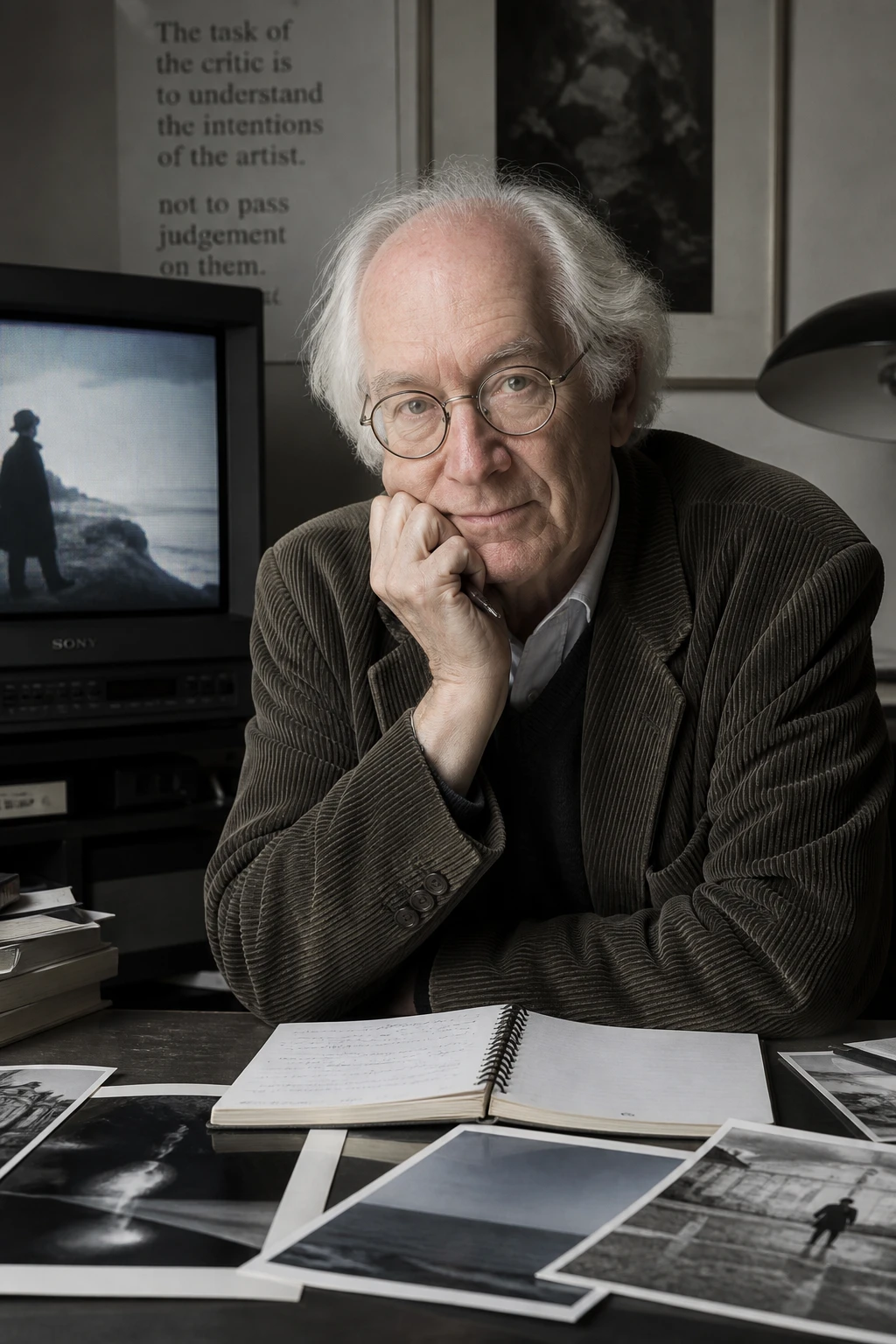
Berger transformed art criticism from a judgment on objects into an analysis of relations: who looks, who is shown, who owns the image, how it is reproduced and what systems of power it makes visible.
Editorial thesis
John Berger matters not because he left a few quotable statements about seeing. He changed the unit of art criticism itself: instead of the autonomous artwork he placed the relation among image, viewer, property, technology, gender, class and history.
Reader question
Why can a 1972 television series still help us analyse advertising, fashion imagery, photography, social media and AI images even though the media environment has changed completely?
Short answer
Because Berger analyses not one platform but the relations around an image. As long as images can be removed from context, recaptioned, sold, reposted or embedded in systems of status, his questions remain active.
1. London, 1926: seeing the world before becoming a critic
John Peter Berger was born in London on 5 November 1926. His generation was formed between economic crisis, war and post-war reconstruction, so culture never appeared to him as something outside history. 2
He would become famous as a critic, but academic art history was not his starting point. He was interested in why one image appears natural and authoritative while another appears political or improper. That suspicion of visual neutrality became the central nerve of his work.
2. Army and art school: discipline before freedom
During the Second World War Berger served in the British Army and, after demobilisation, studied art in London, including at Chelsea School of Art and the Central School of Art. 2
Military experience and training in drawing produced an unusual combination: attention to physical reality and mistrust of institutional discipline. For Berger, drawing was not decoration around thought. It was a test of whether one was actually looking at an object rather than repeating its ready-made name.
3. Artist first: criticism grows out of practice
In the late 1940s Berger began as a painter and teacher of drawing. Art UK records this early sequence explicitly: painter, drawing teacher, then writer and broadcaster. 2
That matters for his criticism. He writes about surface, gesture, scale and material not as an external judge. Even when writing becomes his principal medium, the painter's habit remains: move closer, linger, compare parts of an image and ask what precisely makes vision happen.
4. New Statesman: the critic enters public conflict
During the 1950s Berger became a prominent art critic and wrote for the New Statesman. The British Library archive preserves substantial runs of his published journalism from this period. 2
He did not seek the position of a neutral referee. Berger openly connected aesthetic judgment to class structure, politics and conditions of production. In post-war British criticism this made him both influential and confrontational: an art review could become an argument about whom culture serves.
5. Marxism: art does not hang outside economics
Berger worked consistently within a Marxist tradition, but his strongest writing cannot be reduced to a mechanical base-and-superstructure formula. He wanted to see how property, labour, markets, class and technology become visible inside images. 2
The method follows: look not only at what is represented, but at the conditions that produced the representation. Who commissioned it? Who can own it? Where is it displayed? What kind of viewer does it expect us to become? These questions later shape Ways of Seeing.
6. Henry Moore and the canon: the critic as dissenter
In the 1950s Berger argued sharply against the growing institutional canonisation of Henry Moore and against the idea of modern art as an autonomous succession of great individual geniuses. Tate now treats the conflict as an important part of the history around both figures. 2
The dispute matters beyond personal antagonism. Berger resisted the machinery by which museum, market and national prestige reinforce one another. His attacks could be excessive, but they posed a still-relevant question: who manufactures artistic authority?
7. A Painter of Our Time, 1958: the novel becomes a critical instrument
Berger's first novel, A Painter of Our Time, appeared in 1958. The British Library preserves several working notebooks for the book, and Verso continues to include it in the core Berger catalogue. 2
Fiction allowed Berger to do what a newspaper review could not: show an artistic position from within, as a conflict among work, politics, exile and personal responsibility. Literature is not an escape from criticism here. It is another method for examining how history enters private life.
8. 1962: leaving the British centre
In 1962 Berger left Britain and spent most of the rest of his life in continental Europe, principally in France and Switzerland. The Booker Prize Foundation describes the move as a permanent departure from Britain. 2
Distance from the London cultural system changed the scale of his writing. He became less a national reviewer of current exhibitions and more a storyteller working across migration, rural labour, painting, medicine, war and memory.
9. Picasso: success can also contain failure
In The Success and Failure of Picasso and later essays, Berger refused the convenient idea that international fame automatically confirms artistic victory. He considered Picasso both a revolutionary artist and a figure whose later public position was shaped by fame, market and history. 2
The principle is more important than the verdict. Criticism does not have to choose between worship and destruction. An artist can be great and contradictory at the same time. This double reading turns the canon into an object of analysis rather than a list of names to admire.
10. A Fortunate Man, 1967: words and photographs become equal partners
In 1966 Berger spent several months with country doctor John Sassall in the Forest of Dean. A Fortunate Man, published in 1967, combined Berger's writing with Jean Mohr's photographs. Canongate stresses that the book explores both one doctor and the social fabric of a community. 2
Photography does not illustrate a conclusion already fixed by prose. Image and text alternately specify and disturb each other. Berger repeatedly returns to this model: meaning is produced between media, not inside one medium alone.
11. Ways of Seeing, 1972: television becomes a machine for criticism
Ways of Seeing was broadcast by the BBC in January 1972 as four television programmes created by Berger with producer-director Mike Dibb and other collaborators. The British Library describes the series as addressing both the Western canon of art history and contemporary consumer culture. 2
Television was part of the argument. Berger looks directly at the camera, montage collides paintings with advertising and music, and reproduction breaks the museum's distance. Criticism stops being a lecture beside a slide and becomes a demonstration of how media changes vision itself.
12. Answering Civilisation: art history without the voice from above
Ways of Seeing is often read as a deliberate counterpoint to Kenneth Clark's Civilisation. Instead of a tour through masterpieces that confirms a unified story of high culture, Berger asks how such a story comes to feel natural. 2
The shift is from “why is this a masterpiece?” to “what relations of power make this way of looking habitual?” Berger does not abolish pleasure in art. He tries to detach pleasure from obedience to authority.
13. Reproduction: the image loses its single place
One of the central claims of Ways of Seeing inherits Walter Benjamin: mechanical reproduction removes a work from its single place and allows the image to enter new sequences. 2
A painting in a museum, a television crop, a book reproduction and an advertising quotation are no longer the same cultural object even when they show the same picture. Context changes function. On today's screen the point is sharper still: an image can move from archive to meme, advertisement or political montage in minutes.
14. Caption and montage: a photograph does not close its own meaning
Berger repeatedly opposed the idea that a photograph completely explains itself. Text, sequence and viewing situation can redirect an image. In Understanding a Photograph this concern with context runs through writing on Cartier-Bresson, W. Eugene Smith and many others. 2
The practical consequence is important: a caption is not a technical afterthought. It can verify, narrow, distort or open a photograph. Montage therefore becomes an ethical responsibility.
15. Woman as image: an early mass critique of gendered looking
In Ways of Seeing Berger analyses the European nude and distinguishes the position of the observing man from that of the woman trained to see herself as an object being observed. This became a major popular route into later discussions of the male gaze and representation. 2
Berger should not, however, be turned into the sole author of feminist theories of looking. His scheme was binary and based on a limited Western corpus; later feminist, queer and postcolonial work greatly expanded the problem.
16. Oil painting and property: the image as a form of possession
Berger connects European oil painting with a history of property: objects, land, fabrics, animals and bodies are rendered as available to possession. The argument is intentionally broad and debatable, but productive as a way of seeing the economic function inside aesthetic pleasure. 2
The claim is not that every painting is an advertisement for wealth. It is that a visual culture able to describe material abundance with extraordinary specificity developed alongside systems of property, trade and status.
17. Publicity: advertising sells a future version of the viewer
The final Ways of Seeing programme moves from old painting to publicity and advertising. Berger argues that advertising rarely sells an object alone: it constructs an image of the person the viewer may become after purchase — more attractive, free or desirable. 2
Envy is therefore part of the visual economy. The viewer looks not only at the product but at a projected transformation of self. The same structure now operates through lifestyle content, influencers and personalised advertising.
18. The book Ways of Seeing: design is part of the argument
The printed Ways of Seeing was made by a five-person team: John Berger, Sven Blomberg, Chris Fox, Michael Dibb and Richard Hollis. Hollis describes the book as a collective assembly of text and image at the BBC, while Penguin stresses the unusual seven-essay structure. 2
The book is not a simple transcript of television. Its small scale, dense montage and refusal of academic distance between text and images make the thesis physical: publication design changes thought.
19. Walter Benjamin: influence, translation and independence
Ways of Seeing is deeply indebted to Walter Benjamin's essay on the work of art in the age of mechanical reproduction, but Berger does not simply restate Benjamin. Research on the programme's origins also identifies Frederick Antal and other historians as important influences. 2
Berger turns complex theory into a television and book grammar. That is both his strength and a source of risk: popularisation makes ideas available, but can compress distinctions that an academic text might keep open.
20. G. and the Booker Prize: literature enters the same political system
In 1972 Berger's novel G. won the Booker Prize. He immediately transformed the literary award into a critical act: in his acceptance speech he examined the economic history of Booker McConnell and argued that the prize had to be turned against itself. 2
This is not an eccentric side story unrelated to Ways of Seeing. It shows the consistency of his method: an institution is never a neutral container for culture; one must ask where its money, prestige and authority come from.
21. Half the prize and A Seventh Man: criticism becomes production
Berger gave half of the Booker money to the London-based Black Panther Movement, while the half he retained helped him begin a study of migrant workers in Europe with photographer Jean Mohr. His acceptance speech explains the connection in detail. 2
The project became A Seventh Man, first published in 1975. Verso describes it as a joint investigation of both the material circumstances and inner experience of migrant labour. A literary prize thus enters the production history of the next critical work.
22. The migrant is not marginal but central to the system
In A Seventh Man Berger and Mohr treat the migrant not as an exception to the European economy but as a figure without whom its centre cannot function. 2
The book combines economic structure with bodily experience. Train, hostel, passport, work clothes and letter home become one system. Visual criticism has moved far outside the museum: to see means noticing the infrastructure hidden behind the apparent normality of consumption.
23. Photography: between document, memory and loss
The essays collected in Understanding a Photograph show that Berger believed neither in simple camera objectivity nor in unlimited interpretive freedom. A photograph is a trace of a specific moment, but its public life depends on how it is captioned, preserved and narrated. 2
Photography is therefore especially tied to absence: the frame confirms that something stood before the camera, while simultaneously showing that the moment is gone. This temporal double condition gives photography its particular relation to memory.
24. Why Look at Animals?: modernity through broken relations
The essay Why Look at Animals? expands Berger beyond art history. He asks how modernity transformed the relation between humans and animals as living presence was increasingly replaced by zoo, image, toy, commodity or symbol. 2
This is a characteristic Berger move: begin with a simple act of looking and draw out histories of labour, urbanism, alienation and language. The object changes; the method remains focused on relations rather than isolated things.
25. Into Their Labours: the peasant as bearer of another time
In the trilogy Into Their Labours Berger turns toward rural communities and disappearing forms of peasant life. Verso lists the trilogy among the central works of his literary career. 2
For him the peasant is not a romantic symbol of authenticity. It is another organisation of time, labour, knowledge and dependence on place. Berger tries to record a disappearing world without reducing it to nostalgic scenery.
26. Storyteller rather than “theorist”: explanation through proximity
Berger often preferred to call himself a storyteller. This explains why his criticism so rarely looks like a closed system of specialised terms. He can move from Velázquez to photography, from a country doctor to a migrant worker, from an artist's hand to political violence. 2
The unit of analysis is not the concept but the relation. Theory arrives through a concrete situation: the reader first sees a person, object or gesture, then discovers the historical structure around it.
27. Drawing and Bento's Sketchbook: vision returns to the hand
Late Berger again binds writing and drawing. Bento's Sketchbook is organised around an imagined relation to Spinoza and Berger's own practice of drawing; Verso preserves it as a major late work. 2
Drawing matters through slowness. Unlike the instant photograph or scrolling screen, it demands duration, repeated looking and movement of the hand. For Berger, to draw is to enter a prolonged relation with the subject.
28. Political solidarity: from art to Palestine and the War on Terror
In later essays Berger wrote about Palestine, Iraq, Afghanistan and global politics. Verso describes Hold Everything Dear as a meditation on resistance, violence and the political at the core of artistic expression. 2
His political position is openly declared rather than hidden behind the fiction of neutral criticism. That gives the writing force, while also requiring the reader to distinguish fact, witness, metaphor and authorial solidarity.
29. The limits of Ways of Seeing: a critical tool must not become dogma
The danger in Berger's legacy is turning an anti-canonical book into a new canon quoted without testing. Ways of Seeing was made in a specific Britain of 1972, worked largely with Western European imagery and compressed differences for the clarity of a television argument. 2
Its method is most useful as a set of questions rather than final answers: who looks, who is shown, who owns, who captions, where does the image circulate and what does a new context change?
30. 2026: the archive returns Berger to the age of algorithmic images
For Berger's centenary, the British Library is preparing a new public phase of the archive: a display drawn from the John Berger Archive is scheduled from 28 August 2026 to 5 February 2027, while Tom Overton's new biography John Berger: From Life follows in September. 2
This makes Berger unusually current for VANSMITHLAB. In a world of endless reproduction, feeds, synthetic images and AI, the central question of Ways of Seeing remains open: no image reaches us without a system that chose its place, neighbours, caption and implied viewer.