curator profile
Andrew Bolton
Fashion exhibition as argument: body, object, history and the mass museum audience
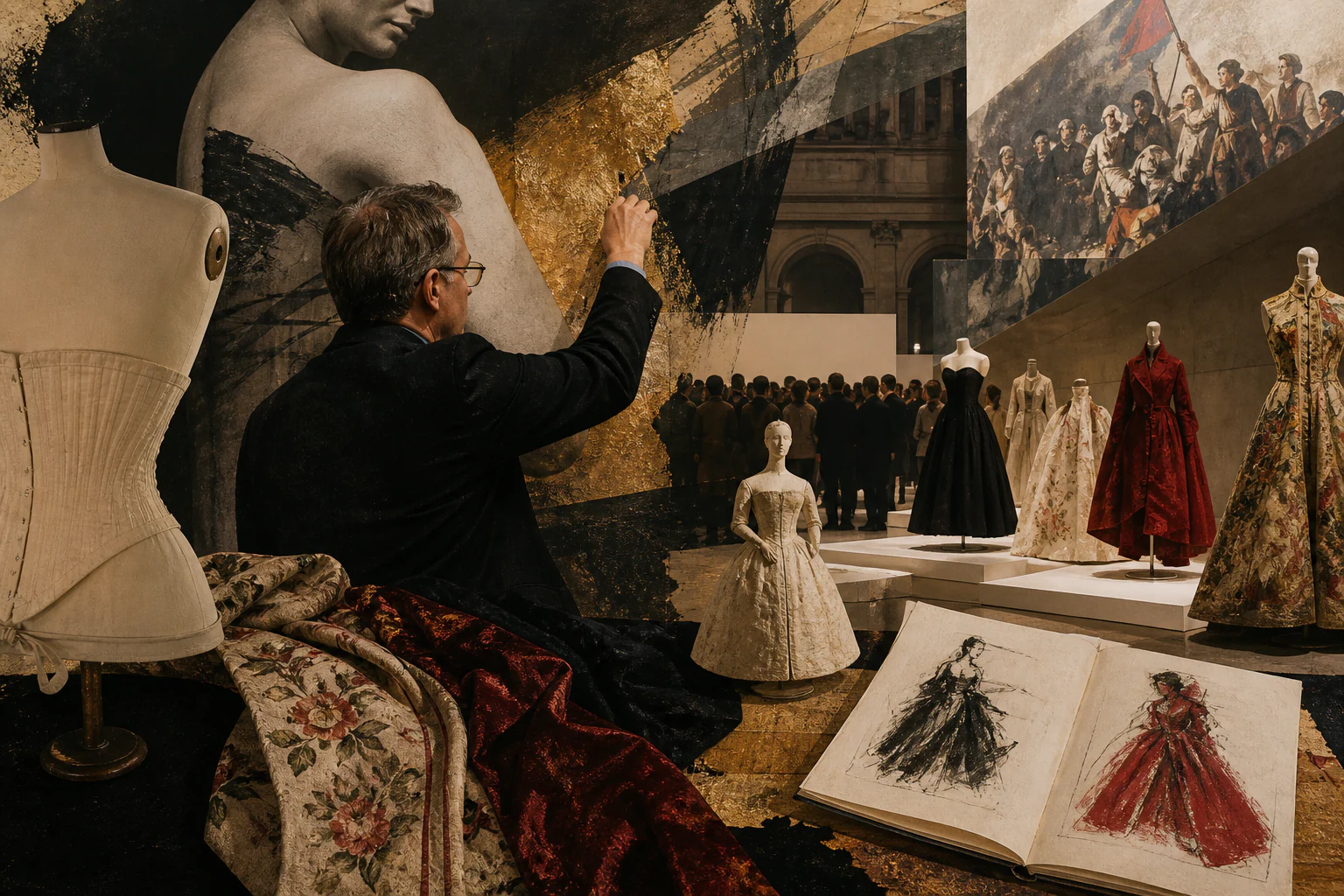

Andrew Bolton changed the scale of museum fashion exhibitions by turning them from displays of clothes into complex cultural arguments. His projects at The Metropolitan Museum of Art’s Costume Institute connect object, body, scenography, art history, technology and mass media attention, which also raises the critical question of where scholarship ends and spectacle begins.
Editorial thesis
Andrew Bolton changed the scale of museum fashion exhibitions by turning them from displays of clothes into complex cultural arguments. His projects at The Metropolitan Museum of Art’s Costume Institute connect object, body, scenography, art history, technology and mass media attention, which also raises the critical question of where scholarship ends and spectacle begins.
Reader question
How can a curator bring millions of visitors to clothing without turning the museum into a luxury display window?
Short answer
Bolton joined The Metropolitan Museum of Art in 2002 after working at the Victoria and Albert Museum. Exhibitions including Alexander McQueen: Savage Beauty, China: Through the Looking Glass, Manus x Machina, Heavenly Bodies and the 2026 project Costume Art show how fashion can be discussed through religion, technology, body, national imaginaries and art history.
1. From the Victoria and Albert Museum to the Met
Before moving to The Metropolitan Museum of Art, Bolton spent about nine years at the Victoria and Albert Museum, developing an understanding of fashion as a museum and historical object. [source]
2. Mechanism: museum training
The British decorative-arts and costume tradition provided object-based experience before the exhibitions reached mass scale. The point is not an isolated gesture but a way of organising practice. The decision connects author, material, institution, technology and audience, so it cannot be reduced to a personal signature or a polished result. For VANSMITHLAB this episode functions as a mechanism that can be compared across neighbouring practices. [source]
3. Significance: museum training
This episode explains why Andrew Bolton belongs in VANSMITHLAB’s map of authors. The significance lies in changing professional rules: who decides, how authorship is distributed, what counts as the result, and how the work enters public culture. The profile therefore keeps context attached to achievement instead of turning biography into a list of milestones. [source]
4. 2002: the Costume Institute as a new institutional stage
Bolton joined the Met’s Costume Institute in 2002 and eventually became the curator responsible for many of the department’s major exhibitions. [source]
5. Mechanism: curator within institution
Curatorial work here operates inside a large museum machine linking collection, conservation, sponsorship, opening events and global press. The point is not an isolated gesture but a way of organising practice. The decision connects author, material, institution, technology and audience, so it cannot be reduced to a personal signature or a polished result. For VANSMITHLAB this episode functions as a mechanism that can be compared across neighbouring practices. [source]
6. Significance: curator within institution
This episode explains why Andrew Bolton belongs in VANSMITHLAB’s map of authors. The significance lies in changing professional rules: who decides, how authorship is distributed, what counts as the result, and how the work enters public culture. The profile therefore keeps context attached to achievement instead of turning biography into a list of milestones. [source]
7. Savage Beauty: a monographic exhibition becomes a mass event
The 2011 exhibition Alexander McQueen: Savage Beauty drew more than 660,000 visitors and became a key example of mass interest in museum fashion. [source]
8. Mechanism: monograph and myth
Emotional scenography intensified the reading of McQueen’s collections while also demonstrating the museum’s power to construct a posthumous authorial myth. The point is not an isolated gesture but a way of organising practice. The decision connects author, material, institution, technology and audience, so it cannot be reduced to a personal signature or a polished result. For VANSMITHLAB this episode functions as a mechanism that can be compared across neighbouring practices. [source]
9. Significance: monograph and myth
This episode explains why Andrew Bolton belongs in VANSMITHLAB’s map of authors. The significance lies in changing professional rules: who decides, how authorship is distributed, what counts as the result, and how the work enters public culture. The profile therefore keeps context attached to achievement instead of turning biography into a list of milestones. [source]
10. China: Through the Looking Glass — beauty and the problem of cultural translation
The 2015 project explored Chinese influences on Western fashion, combining clothing with works of art and cinema. [source]
11. Mechanism: cultural translation
The exhibition’s beauty does not remove questions of Orientalism and who gets to translate one culture through another culture’s fantasies. The point is not an isolated gesture but a way of organising practice. The decision connects author, material, institution, technology and audience, so it cannot be reduced to a personal signature or a polished result. For VANSMITHLAB this episode functions as a mechanism that can be compared across neighbouring practices. [source]
12. Significance: cultural translation
This episode explains why Andrew Bolton belongs in VANSMITHLAB’s map of authors. The significance lies in changing professional rules: who decides, how authorship is distributed, what counts as the result, and how the work enters public culture. The profile therefore keeps context attached to achievement instead of turning biography into a list of milestones. [source]
13. Manus x Machina: hand and machine are not opposites
The 2016 exhibition juxtaposed hand and machine techniques in dress, showing their overlap across couture and industrial production. [source]
14. Mechanism: technology and craft
The curatorial argument breaks the simple hierarchy in which handmade means authentic and machine-made means cold, shifting attention to process. The point is not an isolated gesture but a way of organising practice. The decision connects author, material, institution, technology and audience, so it cannot be reduced to a personal signature or a polished result. For VANSMITHLAB this episode functions as a mechanism that can be compared across neighbouring practices. [source]
15. Significance: technology and craft
This episode explains why Andrew Bolton belongs in VANSMITHLAB’s map of authors. The significance lies in changing professional rules: who decides, how authorship is distributed, what counts as the result, and how the work enters public culture. The profile therefore keeps context attached to achievement instead of turning biography into a list of milestones. [source]
16. Heavenly Bodies: religion, fashion and a record audience
Heavenly Bodies: Fashion and the Catholic Imagination became the Met’s most visited exhibition to that date, drawing more than 1.65 million visitors. [source]
17. Mechanism: mass audience and scholarship
The record demonstrates fashion’s power as a museum entry point, while requiring popularity to be distinguished from the quality of historical argument. The point is not an isolated gesture but a way of organising practice. The decision connects author, material, institution, technology and audience, so it cannot be reduced to a personal signature or a polished result. For VANSMITHLAB this episode functions as a mechanism that can be compared across neighbouring practices. [source]
18. Significance: mass audience and scholarship
This episode explains why Andrew Bolton belongs in VANSMITHLAB’s map of authors. The significance lies in changing professional rules: who decides, how authorship is distributed, what counts as the result, and how the work enters public culture. The profile therefore keeps context attached to achievement instead of turning biography into a list of milestones. [source]
19. Scenography as part of curatorial writing
Bolton’s exhibitions use light, sound, gallery architecture, mannequins and spatial sequence as active interpretive tools. [source]
20. Mechanism: space as text
In a fashion exhibition meaning is not produced by labels alone: distance, height, shadow and adjacency become the punctuation of the argument. The point is not an isolated gesture but a way of organising practice. The decision connects author, material, institution, technology and audience, so it cannot be reduced to a personal signature or a polished result. For VANSMITHLAB this episode functions as a mechanism that can be compared across neighbouring practices. [source]
21. Significance: space as text
This episode explains why Andrew Bolton belongs in VANSMITHLAB’s map of authors. The significance lies in changing professional rules: who decides, how authorship is distributed, what counts as the result, and how the work enters public culture. The profile therefore keeps context attached to achievement instead of turning biography into a list of milestones. [source]
22. The Met Gala and the problem of the media frame
Costume Institute exhibitions are linked to the Met Gala, which generates attention and funding but often receives more popular visibility than the research itself. [source]
23. Mechanism: media around the museum
The curator works inside a paradox: media spectacle can lead audiences toward scholarship while also eclipsing it. The point is not an isolated gesture but a way of organising practice. The decision connects author, material, institution, technology and audience, so it cannot be reduced to a personal signature or a polished result. For VANSMITHLAB this episode functions as a mechanism that can be compared across neighbouring practices. [source]
24. Significance: media around the museum
This episode explains why Andrew Bolton belongs in VANSMITHLAB’s map of authors. The significance lies in changing professional rules: who decides, how authorship is distributed, what counts as the result, and how the work enters public culture. The profile therefore keeps context attached to achievement instead of turning biography into a list of milestones. [source]
25. Costume Art, 2026: dress enters the permanent map of art
In 2026 the Costume Institute opens permanent galleries, while Bolton’s Costume Art connects dress with works across museum departments through the theme of the body. [source]
26. Mechanism: a permanent place for fashion
This is an institutional shift: fashion ceases to be a seasonal guest and gains a permanent spatial presence inside an encyclopedic museum. The point is not an isolated gesture but a way of organising practice. The decision connects author, material, institution, technology and audience, so it cannot be reduced to a personal signature or a polished result. For VANSMITHLAB this episode functions as a mechanism that can be compared across neighbouring practices. [source]
27. Significance: a permanent place for fashion
This episode explains why Andrew Bolton belongs in VANSMITHLAB’s map of authors. The significance lies in changing professional rules: who decides, how authorship is distributed, what counts as the result, and how the work enters public culture. The profile therefore keeps context attached to achievement instead of turning biography into a list of milestones. [source]
28. Legacy: the fashion exhibition as public theory
Bolton has shown that a museum exhibition can formulate a complex argument through clothing while addressing an enormous audience. [source]
29. Mechanism: exhibition as theory
His influence should be assessed not only through attendance but through the way exhibitions changed fashion’s place in the museum and the language of its public discussion. The point is not an isolated gesture but a way of organising practice. The decision connects author, material, institution, technology and audience, so it cannot be reduced to a personal signature or a polished result. For VANSMITHLAB this episode functions as a mechanism that can be compared across neighbouring practices. [source]
30. Significance: exhibition as theory
This episode explains why Andrew Bolton belongs in VANSMITHLAB’s map of authors. The significance lies in changing professional rules: who decides, how authorship is distributed, what counts as the result, and how the work enters public culture. The profile therefore keeps context attached to achievement instead of turning biography into a list of milestones. [source]