curator profile
Harold Koda
Collection, Display and the Historical Responsibility of the Fashion Curator
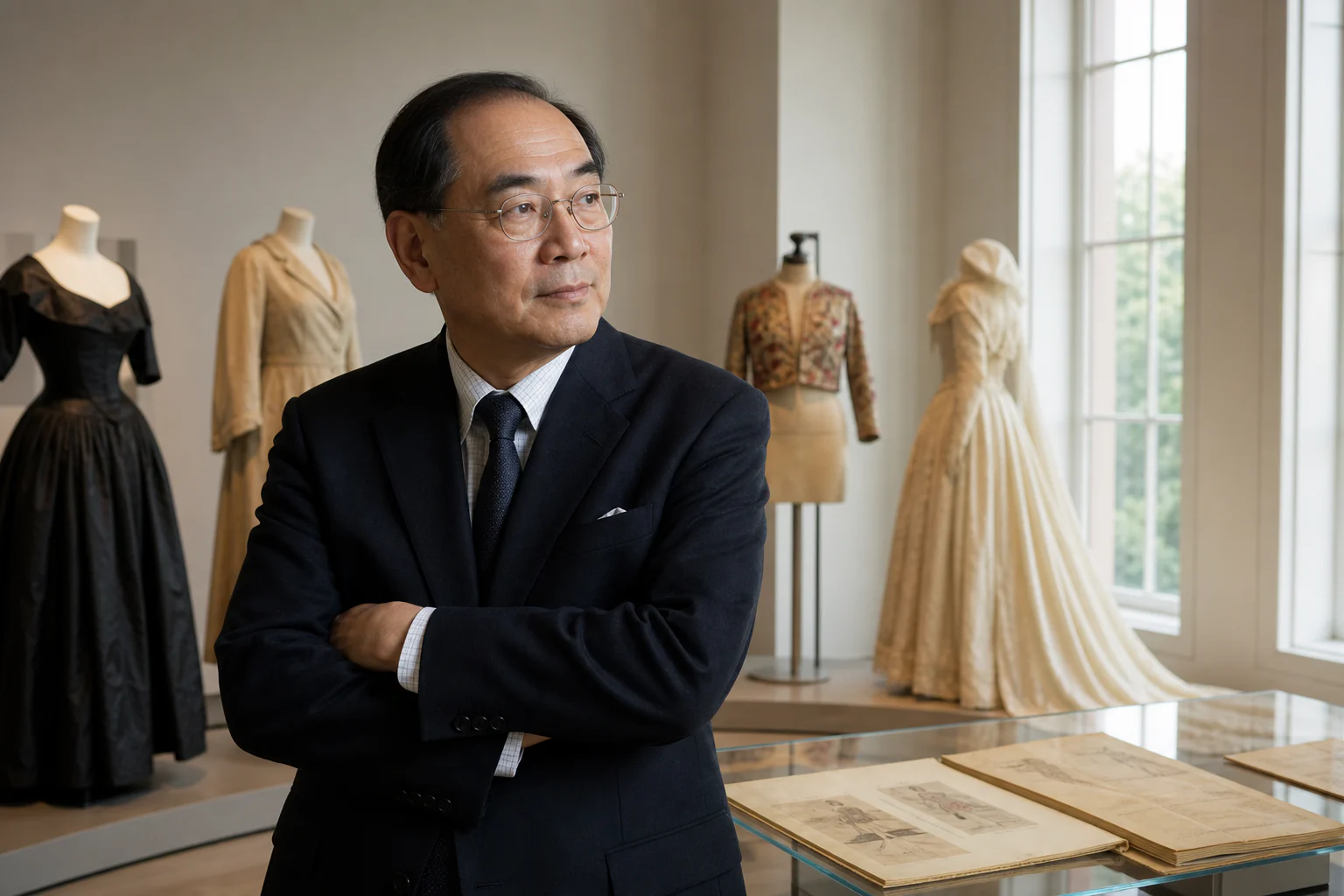
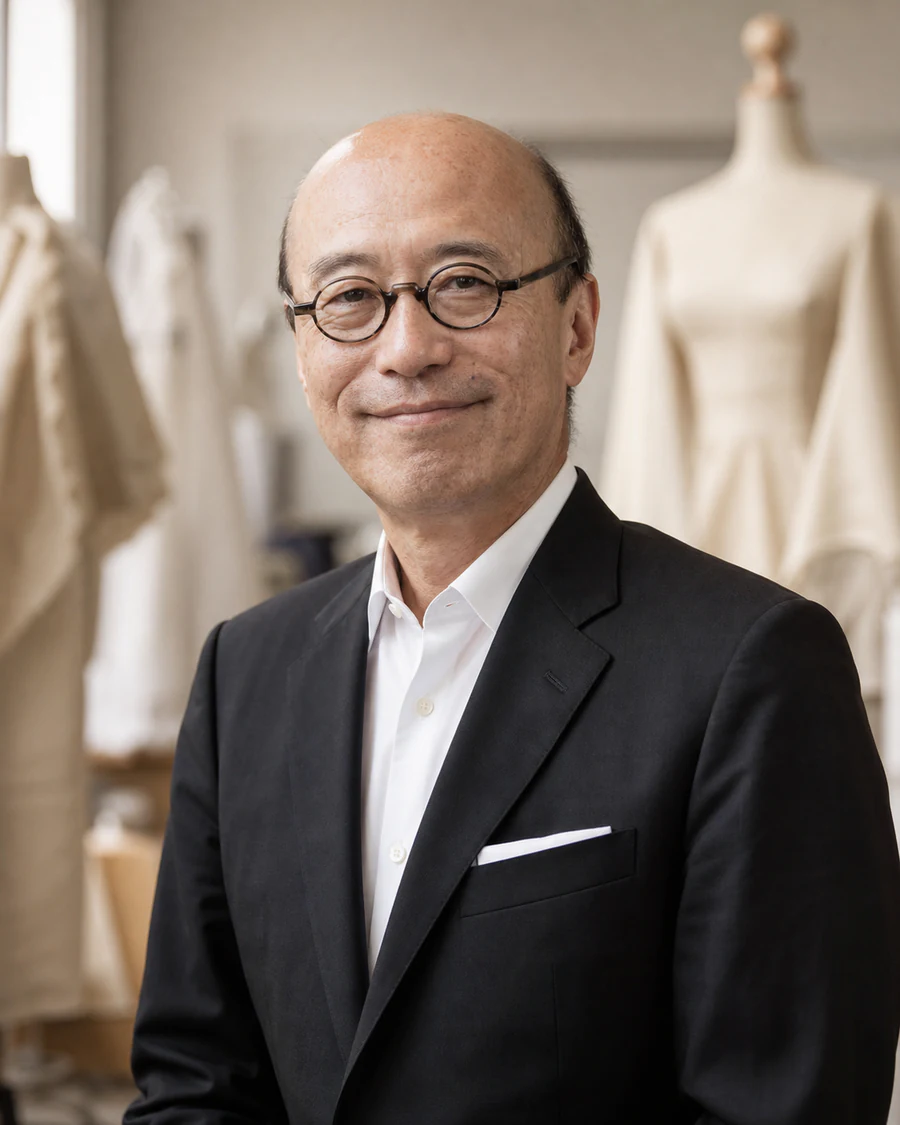
Koda helped define a model of fashion exhibition in which showmanship is justified only when it preserves respect for the object: collection, conservation, research, scenography and publication must operate as one museum system.
Editorial thesis
Harold Koda’s central contribution is not one famous exhibition but an institutional balance between effect and responsibility. From Diana Vreeland he inherited belief in display, from Richard Martin thematic discipline, while his own emphasis fell on the object and collection that must outlive any exhibition season.
Reader question
How can a fashion curator make an exhibition spectacular, work beside brands and mass media culture, and still prevent the museum from becoming a luxury showroom?
Short answer
By giving priority to the museum object: accurate attribution, conservation, acquisition, historical context and transparent collective authorship set the limits of scenography. In Koda’s model display may intensify the argument, but the collection remains the institution’s long-term core.
1. Honolulu: a curator’s history begins far from New York’s fashion system
Harold Koda was born in Honolulu and earned B.A. and B.F.A. degrees in art history at the University of Hawai‘i. The Met’s official biography does not frame his early trajectory around fashion: art history came first, followed by study at New York University’s Institute of Fine Arts. 1
That matters for his later position. Koda approached costume not as an extension of the fashion industry but as a museum object requiring formal analysis, historical context, preservation and exact attribution. His career shows how fashion becomes a serious museum subject when it no longer asks to be exempt from museum standards.
2. New York, 1974: the route to costume begins with another research interest
In a 2018 interview Koda recalled moving to New York in 1974, initially interested in the art of Côte d’Ivoire. In the city his route unexpectedly turned toward The Costume Institute and a world in which working with dress required both art-historical knowledge and practical care for objects. 2
The accident did not mean an absence of method. Koda entered the field before fashion curating became a standardised profession. He watched the discipline form through archive work, exhibition installation, designers, conservation and the constant need to explain why clothes belonged beside other arts.
3. Diana Vreeland: exhibition as theatre, but not theatre without the object
In the mid-1970s Koda worked at The Costume Institute around Diana Vreeland, first as an intern and exhibition assistant. The Met specifically notes his participation in Vreeland-era projects including The Glory of Russian Costume and Vanity Fair. 3
Vreeland demonstrated the power of exhibition spectacle: costume could be staged dramatically, with atmosphere, gesture and almost theatrical exaggeration. Koda’s mature method would be built on a balance—spectacle is useful only when it intensifies the object rather than turning historical dress into scenery.
4. The “sewing bee”: conservation as the first school of respect for the object
Koda recalled early work near conservator Elizabeth Lawrence and volunteers who helped prepare clothing for exhibitions. He later emphasised how thoroughly conservation practice had professionalised: handling museum garments became more scientific and regulated. 4
This is fundamental to his curatorial method. A fashion exhibition works with objects that cannot simply be pinned, shortened or reshaped for a beautiful image. Mannequin, support and installation must follow preservation needs. A strong exhibition begins not with a dramatic room but with an understanding of the object’s physical vulnerability.
5. FIT, 1979–1992: the Design Laboratory as a school of systematic exhibition work
From 1979 to 1992 Koda worked at the Edward C. Blum Design Laboratory of the Fashion Institute of Technology—first as associate curator and curator, then as director. The Met lists this period as a major phase in his professional formation. 5
At FIT fashion history could operate as a series of thematic problems rather than a sequence of famous names: clothing types, social codes, menswear, the body and modernity. Exhibition-making became a way to test historical arguments quickly through real objects.
6. Richard Martin: curating as dialogue and distributed authorship
Richard Martin became Koda’s key professional partner. They worked together at FIT and later at The Met on exhibitions and publications. The official history of The Costume Institute links Martin’s period with thematic projects that widened the ways dress could be discussed. 6
For VANSMITHLAB this partnership is a useful model of collective authorship. Not every exhibition of the period belongs to Koda alone or Martin alone. Its strength came from dialogue: formal sensitivity, cultural history, wit, archives and object selection formed a shared system.
7. Balenciaga, 1986: the monographic exhibition as an investigation of construction
At FIT Koda curated Balenciaga in 1986. The Met’s later biography singles out the project and also records special CFDA awards received in 1986 and 1997. 7
A monographic fashion exhibition can easily become a shrine to genius. A more useful approach is to examine how a designer works with shoulder, volume, inner support, cloth and distance from the body. That object-centred analysis later became one of Koda’s strengths.
8. Jocks and Nerds, 1989: menswear as social language
Among the FIT projects The Met mentions Jocks and Nerds (1989), produced within the Richard Martin–Koda circle. The exhibition approached men’s dress through recognisable social types rather than tailoring history alone. 8
The move matters: clothing explains role, belonging and stereotype. A museum can analyse not only rare couture but everyday visual codes. Fashion history moves closer to visual anthropology.
9. Returning to The Met in the 1990s: costume inside an encyclopedic museum
During his earlier Met tenure Koda served as Associate Curator and worked with Richard Martin on roughly twelve exhibitions. The official biography highlights Diana Vreeland: Immoderate Style, Madame Grès and Christian Dior. 9
The Met changes the scale of the task. Costume no longer exists only within a fashion museum; it must enter relations with painting, sculpture, decorative arts and historic interiors. This is one source of The Costume Institute’s cross-departmental mode of thinking.
10. Diana Vreeland: Immoderate Style, 1993: curating the former mentor
Diana Vreeland: Immoderate Style was among the exhibitions Koda worked on with Richard Martin. The project treated Vreeland not only as an editor but as someone who had turned taste, exaggeration and exhibition fantasy into an institutional method. 10
For Koda this was a complicated subject because he had learned inside Vreeland’s culture of display. Such a profile requires distance: acknowledge the mentor’s influence without turning personal proximity into automatic admiration.
11. Infra-Apparel and other thematic projects: reading clothing from the inside
In 1993 Richard Martin and Harold Koda published Infra-Apparel, a study of underlayers and structures usually hidden from view. The Met keeps the publication in its open digital library. 11
A thematic exhibition can reveal what the runway normally hides: support, lining, corsetry, structure and technical logic. For Koda this is a recurring line—fashion as a material technology of the body.
12. Christian Dior, 1996: canon through objects rather than the New Look alone
For the 1996 Christian Dior exhibition Martin and Koda produced a substantial catalogue drawing chiefly on The Costume Institute’s holdings. The Met describes it as a chronology of Dior’s achievement grounded in museum objects and archives. 12
A strong monograph does not repeat biography as mythology. It tests the myth on dresses: where is the seam, how is the hip supported, what happens to the waist, how does cloth hold the silhouette’s architecture? The curator turns an iconic name back into material decisions.
13. 1997–2000: a pause from fashion and Harvard Landscape Architecture
In the late 1990s Koda left The Costume Institute and completed a Master of Landscape Architecture degree at Harvard University by 2000. The Met records the turn in his official biography. 13
Landscape architecture may look like a detour, but exhibition-making also depends on route, sequence, view, distance and the body’s relation to space. Koda’s later exhibitions often read less like rows of cases than organised passages through different modes of seeing.
14. Giorgio Armani, 2000: fashion exhibition enters the museum of contemporary culture
Before returning to The Met, Koda co-curated Giorgio Armani at the Solomon R. Guggenheim Museum. Guggenheim archives describe the exhibition as a thematic view of Armani’s evolution and cultural contribution, while the catalogue was edited by Germano Celant and Harold Koda. 14
The exhibition demonstrates an unavoidable tension in fashion museums: a contemporary brand is simultaneously a research subject, an economic actor and a producer of its own image. Institutional transparency and precise attribution are therefore as important as visual impact.
15. 2000: Curator in Charge—from individual exhibitions to institutional leadership
Koda returned to The Met in 2000 as Curator in Charge of The Costume Institute. Andrew Bolton joined the department in 2002, and the following fifteen years became a period of expansion in exhibitions, collecting and publishing. 15
A department head is responsible for more than a personal curatorial concept. Authorship appears in hiring, acquisition policy, conservation, research, fundraising, space and the question of what future scholars will be able to study.
16. Extreme Beauty, 2001–2002: the body becomes alterable architecture
Extreme Beauty: The Body Transformed, organised by Koda, examined the ways dress alters bodily proportion. The Met separately credits him as organiser and author of the accompanying catalogue. 16
The key move is to stop treating the “natural body” as a neutral standard. Corset, shoulder, heel, hip volume and other constructions show fashion continually designing anatomy. The exhibition becomes an investigation of the visual power of silhouette.
17. Goddess, 2003: antiquity as a repeating mechanism rather than an eternal style
Goddess: The Classical Mode (2003) joined historical dress, contemporary fashion, images and decorative arts around the persistent return of classical form. Koda developed both the exhibition and its catalogue. 17
The point is not an eternal “Greek style” but a mechanism of translation: chiton, peplos, drapery and classical attributes are repeatedly reinvented. The curator shows cultural memory working through repetition with variation.
18. Dangerous Liaisons, 2004: costume returns to the room
Dangerous Liaisons: Fashion and Furniture in the 18th Century was created by Harold Koda and Andrew Bolton in collaboration with other Met departments. Eighteenth-century dress was installed in the historic French interiors of the Wrightsman Galleries. 18
This is one of The Costume Institute’s key methods: costume ceases to be an isolated sculpture. Pose, furniture, distance between bodies and room architecture return to the meaning. Yet scenography must remain interpretation rather than masquerading as documentary reconstruction.
19. Chanel, 2005: exhibiting a living brand and a historical figure
In 2005 Koda and Bolton worked on Chanel and its accompanying catalogue. The Met stressed the historical trajectory of the house and Gabrielle Chanel’s contribution while also acknowledging the continuing brand. 19
For a curator this is sensitive territory. The house remains commercially active, so the museum must separate historical attribution from current marketing aura. Otherwise exhibition scholarship can become an amplifier for brand mythology.
20. Poiret, 2007: a major acquisition becomes new research
Poiret: King of Fashion was organised by Koda and Bolton after The Met acquired a major group of Poiret works from an important private collection. The exhibition and catalogue used this new core to reassess the designer’s place in twentieth-century fashion history. 20
This demonstrates the link between acquisition and curating. A museum does not acquire solely to store. New objects change the questions that can be asked. In Koda’s practice, research exhibitions often begin with an object capable of changing an already familiar story.
21. The collection as the lasting legacy: thinking beyond one exhibition
Later Met material about Koda repeatedly returns to the collection. At his retirement colleagues emphasised the expansion of holdings and strategic acquisitions that would continue to function after temporary exhibitions ended. 1
This corrects the media image of The Costume Institute. A gala lasts one night and an exhibition a few months, while a well-built object archive works for decades. For Koda, long-term museum value resides here.
22. blog.mode, 2007–2008: the museum lets the viewer into interpretation
blog.mode: addressing fashion connected an exhibition of recent Costume Institute acquisitions with a public blog. The Met invited visitors to discuss individual objects while Koda and Bolton published curatorial commentary and responded to reactions. 2
Today the format appears ordinary, but in 2007 it was a meaningful move: interpretation no longer ended with wall text. The museum began to treat the audience not only as a recipient of authority but as a participant in discussion.
23. 2009: the Brooklyn Museum Costume Collection changes the scale of The Costume Institute
In January 2009 the renowned Brooklyn Museum costume collection was transferred to The Met and became the Brooklyn Museum Costume Collection at The Metropolitan Museum of Art. The institution’s official history connects the transfer to Koda’s tenure. 3
The move was not an administrative footnote. It substantially strengthened holdings in American fashion and Charles James in particular. Curatorial infrastructure operates here at institutional scale: combining collections determines what histories a museum will be able to tell.
24. The Model as Muse, 2009: the model becomes a historical agent
The Model as Muse: Embodying Fashion was organised by Harold Koda and guest co-curator Kohle Yohannan. The Met also records a large collective responsible for exhibition design, hair, wigs, graphics and lighting. 4
The exhibition considered not only garments but the model as mediator among designer, photographer, magazine and mass culture. It marks a shift from object to image-making system without erasing the authorship of separate participants.
25. Schiaparelli and Prada, 2012: the imaginary conversation as a research form
Schiaparelli and Prada: Impossible Conversations was conceived by Koda and Bolton as a series of imagined dialogues between designers from different eras. The concept drew on Miguel Covarrubias’s Impossible Interviews, while Baz Luhrmann produced film elements for the installation. 5
The device is risky because the museum deliberately constructs a conversation that never happened. It works only when fiction is transparent. Its strength lies not in imitation of a historical document but in creating a comparative framework for real objects.
26. Charles James, 2014: conservation and digital visualisation work together
Charles James: Beyond Fashion was organised by Harold Koda and Jan Glier Reeder after The Met’s holdings expanded through the Brooklyn transfer. Conservators, photographers and Diller Scofidio + Renfro all contributed, and The Met documented the study of construction and new modes of display. 6
James is especially suited to this method: the internal geometry of a dress is difficult to understand from the exterior alone. Technology, detailed photography and conservation research can make invisible construction legible without damaging or wearing the original.
27. Anna Wintour Costume Center, 2014: space becomes institutional authorship
In May 2014, after a two-year renovation, The Costume Institute reopened its spaces as the Anna Wintour Costume Center. The Met names this as one of the major events of Koda’s tenure. 7
For a curator, infrastructure matters more than one successful season. Galleries, storage, conservation and research facilities shape the work of future teams. Institutional leadership becomes a form of authorship largely invisible to visitors.
28. Jacqueline de Ribes, 2015–2016: style as personal construction
Koda’s final exhibition as Curator in Charge was Jacqueline de Ribes: The Art of Style, opening in November 2015. He treated de Ribes not only as a couture client but as an author of her own visual identity, including alterations and the creation of her own fashion house. 8
Style is therefore read not as a list of expensive clothes but as a practice of selection and transformation. Agency returns to the wearer: the image is not produced by the designer alone.
29. January 2016: retirement and the Harold Koda Gift
Koda finished his Met tenure on 8 January 2016 after fifteen years leading The Costume Institute. More than thirty designers later donated works to the museum in his honour, and a group of those acquisitions appeared in Masterworks: Unpacking Fashion. 9
The gesture matters as more than a personal tribute. It reveals a professional network of trust between museum and designers while converting gratitude into a long-term public asset: objects enter a museum collection rather than disappearing into private commemoration.
30. The central legacy: between showmanship and historical responsibility
Harold Koda helped define a fashion-curator model in which spectacle and scholarship do not have to cancel one another. His career runs from Vreeland’s theatrical display through Richard Martin’s systematic costume history, major monographs, participatory blogging and the technologically complex Charles James. 10
Yet the final measure remains material: what happened to the collection, how accurately was an object attributed, preserved and contextualised? That balance makes Koda important for VANSMITHLAB—an exhibition can be an event, but museum authorship is measured by what remains after the event.