curator profile
Judith Clark
Exhibition as a thinking device: fashion, space, scale and museum critique
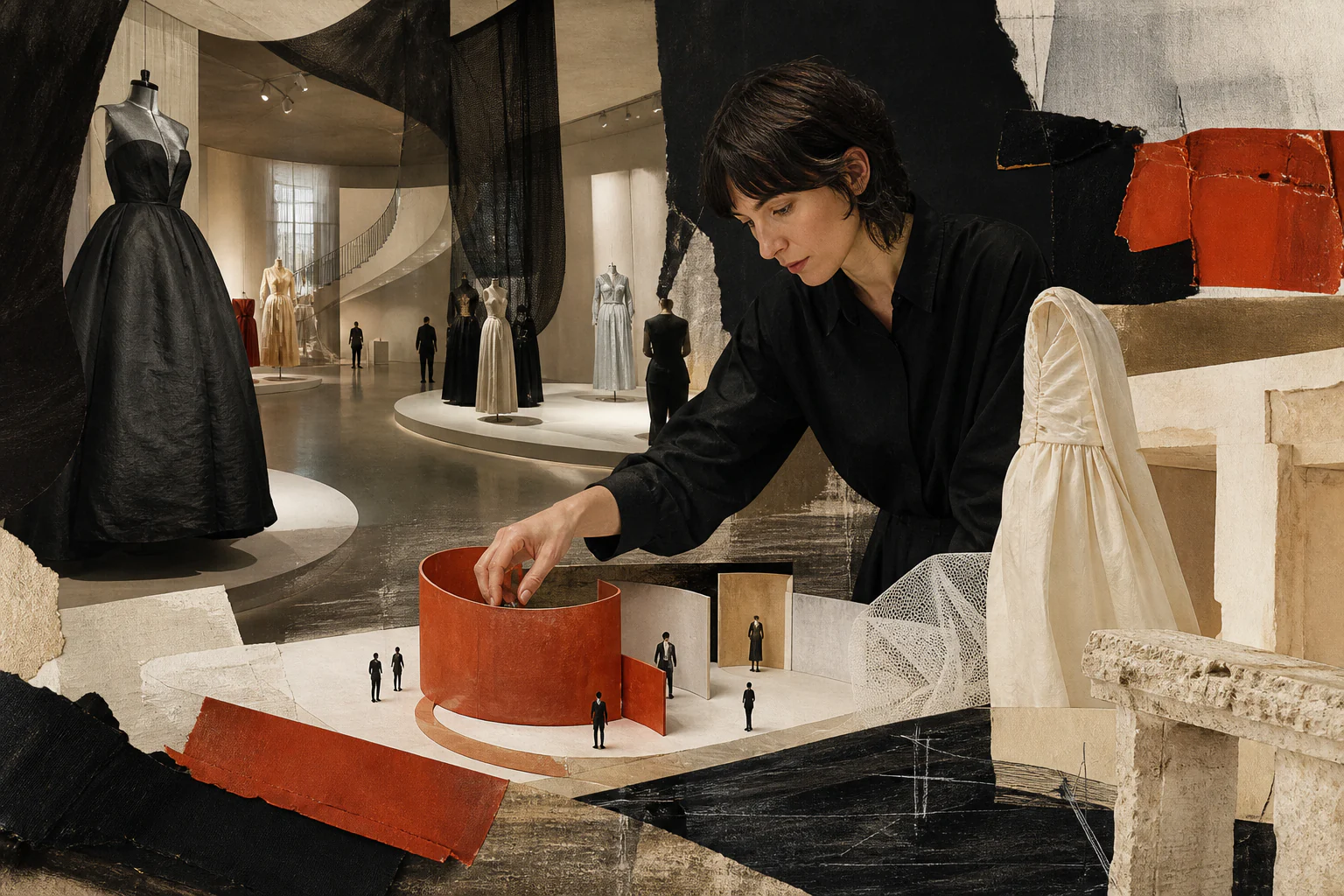
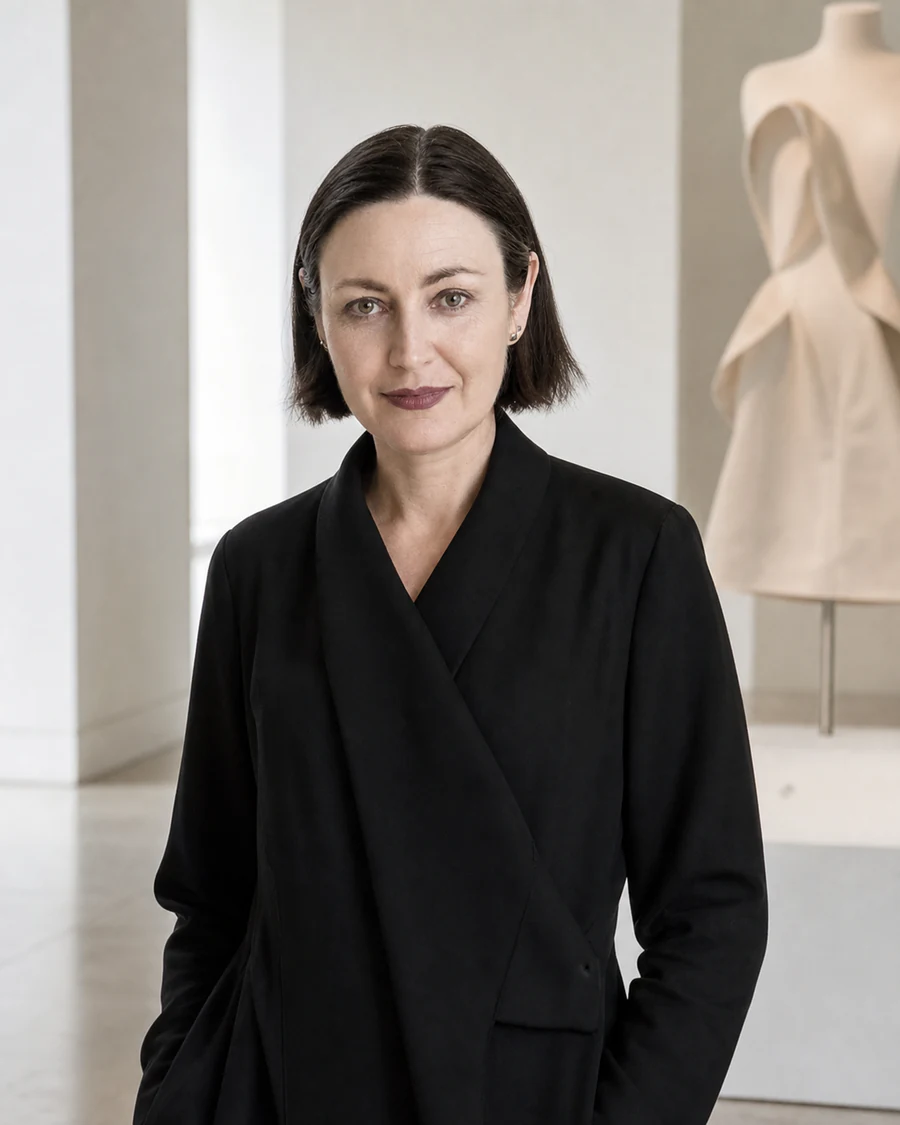
Judith Clark treats the fashion exhibition not as a neutral container for beautiful clothes but as an independent medium of thought. In her projects display case, scale, copy, emptiness, text and visitor route become parts of an argument about memory, time and the ways museums produce fashion history.
Editorial thesis
Judith Clark treats the fashion exhibition not as a neutral container for beautiful clothes but as an independent medium of thought. In her projects display case, scale, copy, emptiness, text and visitor route become parts of an argument about memory, time and the ways museums produce fashion history.
Reader question
What happens when a curator designs not only a list of objects but the very way a visitor is asked to doubt an exhibition?
Short answer
Clark is a curator, researcher and teacher associated with London College of Fashion and the Centre for Fashion Curation. Since the late 1990s she has developed an experimental exhibition practice in which historical dress interacts with architecture, theatre, psychoanalysis, dictionaries and the conventions of the museum.
1. A small gallery as laboratory
In the late 1990s Clark opened the Judith Clark Costume Gallery in London, creating room to experiment with dress display outside a large museum structure. [source]
2. Mechanism: exhibition as prototype
Small scale allows ideas to be tested quickly and the exhibition to operate as a prototype. The point is not an isolated gesture but a way of organising practice. The decision connects author, material, institution, technology and audience, so it cannot be reduced to a personal signature or a polished result. For VANSMITHLAB this episode functions as a mechanism that can be compared across neighbouring practices. [source]
3. Significance: exhibition as prototype
This episode explains why Judith Clark belongs in VANSMITHLAB’s map of authors. The significance lies in changing professional rules: who decides, how authorship is distributed, what counts as the result, and how the work enters public culture. The profile therefore keeps context attached to achievement instead of turning biography into a list of milestones. [source]
4. Curator and architect in one process
Clark designs the spatial structure of her exhibitions and treats cases, platforms and partitions as part of the content. [source]
5. Mechanism: exhibition architecture
Exhibition architecture stops being packaging for a list of objects and becomes a way to formulate relationships among them. The point is not an isolated gesture but a way of organising practice. The decision connects author, material, institution, technology and audience, so it cannot be reduced to a personal signature or a polished result. For VANSMITHLAB this episode functions as a mechanism that can be compared across neighbouring practices. [source]
6. Significance: exhibition architecture
This episode explains why Judith Clark belongs in VANSMITHLAB’s map of authors. The significance lies in changing professional rules: who decides, how authorship is distributed, what counts as the result, and how the work enters public culture. The profile therefore keeps context attached to achievement instead of turning biography into a list of milestones. [source]
7. Spectres: the past does not return linearly
Spectres: When Fashion Turns Back examined the repetition of historical forms and the ways contemporary fashion turns toward the past through quotation, memory and haunting. [source]
8. Mechanism: time as return
History becomes not a staircase of periods but a network of returns in which an old silhouette can suddenly become contemporary. The point is not an isolated gesture but a way of organising practice. The decision connects author, material, institution, technology and audience, so it cannot be reduced to a personal signature or a polished result. For VANSMITHLAB this episode functions as a mechanism that can be compared across neighbouring practices. [source]
9. Significance: time as return
This episode explains why Judith Clark belongs in VANSMITHLAB’s map of authors. The significance lies in changing professional rules: who decides, how authorship is distributed, what counts as the result, and how the work enters public culture. The profile therefore keeps context attached to achievement instead of turning biography into a list of milestones. [source]
10. Scale and copy: the museum need not pretend neutrality
Clark uses enlargements, miniatures, copies, mirrors and other artificial devices that emphasise the constructed nature of museum display. [source]
11. Mechanism: the constructed museum
When the display mechanism is visible, the visitor can better understand that the museum does not merely preserve history but actively interprets it. The point is not an isolated gesture but a way of organising practice. The decision connects author, material, institution, technology and audience, so it cannot be reduced to a personal signature or a polished result. For VANSMITHLAB this episode functions as a mechanism that can be compared across neighbouring practices. [source]
12. Significance: the constructed museum
This episode explains why Judith Clark belongs in VANSMITHLAB’s map of authors. The significance lies in changing professional rules: who decides, how authorship is distributed, what counts as the result, and how the work enters public culture. The profile therefore keeps context attached to achievement instead of turning biography into a list of milestones. [source]
13. A Concise Dictionary of Dress: word and object argue with each other
A Concise Dictionary of Dress, made with Adam Phillips, organised an exhibition around words and spatial conditions rather than fashion chronology. [source]
14. Mechanism: word as space
A dictionary becomes architecture: a term does not finally explain an object but opens several ways of reading it. The point is not an isolated gesture but a way of organising practice. The decision connects author, material, institution, technology and audience, so it cannot be reduced to a personal signature or a polished result. For VANSMITHLAB this episode functions as a mechanism that can be compared across neighbouring practices. [source]
15. Significance: word as space
This episode explains why Judith Clark belongs in VANSMITHLAB’s map of authors. The significance lies in changing professional rules: who decides, how authorship is distributed, what counts as the result, and how the work enters public culture. The profile therefore keeps context attached to achievement instead of turning biography into a list of milestones. [source]
16. Anna Piaggi: a personal archive without simplified biography
In working with Anna Piaggi’s legacy, Clark encountered wardrobe, magazines and the image of a person who made dressing itself an editorial practice. [source]
17. Mechanism: person and archive
The curator must preserve personal complexity without turning a collection of things into illustration of one legend. The point is not an isolated gesture but a way of organising practice. The decision connects author, material, institution, technology and audience, so it cannot be reduced to a personal signature or a polished result. For VANSMITHLAB this episode functions as a mechanism that can be compared across neighbouring practices. [source]
18. Significance: person and archive
This episode explains why Judith Clark belongs in VANSMITHLAB’s map of authors. The significance lies in changing professional rules: who decides, how authorship is distributed, what counts as the result, and how the work enters public culture. The profile therefore keeps context attached to achievement instead of turning biography into a list of milestones. [source]
19. The Vulgar: taste as a social construction
The exhibition The Vulgar examined vulgarity through historical dress and contemporary design practices. [source]
20. Mechanism: taste and power
Taste becomes the object of analysis: the museum shows that “too much” and “wrong” depend on class, period and power. The point is not an isolated gesture but a way of organising practice. The decision connects author, material, institution, technology and audience, so it cannot be reduced to a personal signature or a polished result. For VANSMITHLAB this episode functions as a mechanism that can be compared across neighbouring practices. [source]
21. Significance: taste and power
This episode explains why Judith Clark belongs in VANSMITHLAB’s map of authors. The significance lies in changing professional rules: who decides, how authorship is distributed, what counts as the result, and how the work enters public culture. The profile therefore keeps context attached to achievement instead of turning biography into a list of milestones. [source]
22. Teaching: curatorial practice transmitted as method
Clark works at London College of Fashion and is involved in the Centre for Fashion Curation, where exhibition-making is studied as a research practice. [source]
23. Mechanism: teaching curation
Curation becomes not a set of intuitive decisions but a discipline that can be analysed, taught and criticised. The point is not an isolated gesture but a way of organising practice. The decision connects author, material, institution, technology and audience, so it cannot be reduced to a personal signature or a polished result. For VANSMITHLAB this episode functions as a mechanism that can be compared across neighbouring practices. [source]
24. Significance: teaching curation
This episode explains why Judith Clark belongs in VANSMITHLAB’s map of authors. The significance lies in changing professional rules: who decides, how authorship is distributed, what counts as the result, and how the work enters public culture. The profile therefore keeps context attached to achievement instead of turning biography into a list of milestones. [source]
25. An exhibition does not have to be comfortable
Clark’s projects often create pauses, difficult routes, unusual distances and intentionally visible structures. [source]
26. Mechanism: discomfort as attention
Discomfort can become a tool of attention when it makes visitors notice how they themselves are looking. The point is not an isolated gesture but a way of organising practice. The decision connects author, material, institution, technology and audience, so it cannot be reduced to a personal signature or a polished result. For VANSMITHLAB this episode functions as a mechanism that can be compared across neighbouring practices. [source]
27. Significance: discomfort as attention
This episode explains why Judith Clark belongs in VANSMITHLAB’s map of authors. The significance lies in changing professional rules: who decides, how authorship is distributed, what counts as the result, and how the work enters public culture. The profile therefore keeps context attached to achievement instead of turning biography into a list of milestones. [source]
28. Legacy: the curator designs doubt
Clark expanded the language of fashion exhibitions by bringing in methods from architecture, literature and critical museology. [source]
29. Mechanism: doubt as method
Her legacy is a counterweight to display-as-showcase: a strong exhibition not only presents objects but makes the act of display itself questionable. The point is not an isolated gesture but a way of organising practice. The decision connects author, material, institution, technology and audience, so it cannot be reduced to a personal signature or a polished result. For VANSMITHLAB this episode functions as a mechanism that can be compared across neighbouring practices. [source]
30. Significance: doubt as method
This episode explains why Judith Clark belongs in VANSMITHLAB’s map of authors. The significance lies in changing professional rules: who decides, how authorship is distributed, what counts as the result, and how the work enters public culture. The profile therefore keeps context attached to achievement instead of turning biography into a list of milestones. [source]