curator profile
Hans Ulrich Obrist
Curating as the continuous production of connections, conversations, and archive rather than as the preparation of an individual exhibition.
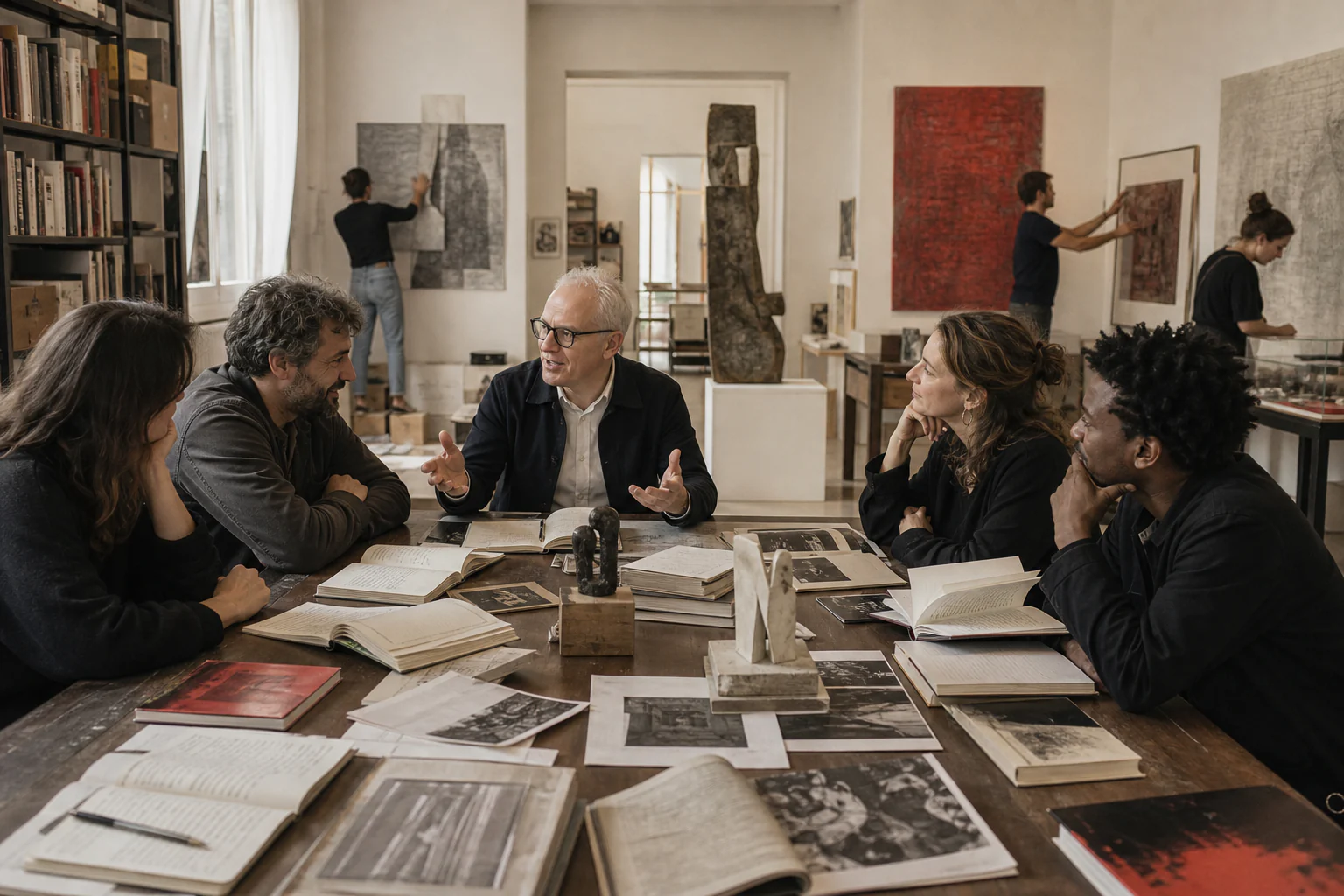

Editorial thesis
Obrist matters for turning curatorial work from preparing displays into maintaining a network: his principal work is an accumulated corpus of conversations.
Reader question
What does a curator produce besides exhibitions?
Short answer
They produce connections and records: bringing together people who would not otherwise meet, and recording statements that would not otherwise survive.
1. Position
Obrist works as a curator and has long been associated with a major London gallery. His practice is unusual for its volume and continuity rather than for individual projects.
2. The interview as principal genre
Central to his work is a decades-long project of recording conversations with artists, architects, scientists, and designers. The corpus runs to thousands of hours.
3. Why this matters
A conversation records a position at the moment of its formation, before it becomes a canonical formulation. This is a source of a different kind from later recollection.
4. Accumulation as method
The corpus derives its value from volume: one interview is material, a thousand is a picture of an era. The method requires time and is therefore rarely reproduced.
5. The exhibition as network node
A display in his practice is a point of connection rather than a conclusion. A project continues through publications, conversations, and subsequent exhibitions.
6. Early projects outside institutions
He began with exhibitions in domestic spaces — a kitchen, a flat, a hotel room. This redefined where a display can occur at all.
7. The marathon as format
Multi-hour public conversation series turn discussion into an event with its own audience. The format borrows duration and publicity from the exhibition.
8. Interdisciplinarity as principle
He consistently brings artists together with scientists and architects. Productivity here is expected from the collision of vocabularies rather than from a shared subject.
9. The curator as public figure
His case documents the curator’s transformation into a recognisable name. This changed the profession: the curator became an author whose participation is itself an argument.
10. Speed and volume
His productivity is exceptional and is part of the method. Presence at many points simultaneously sustains a network that would otherwise dissolve.
11. The archive as work
The recorded conversations form an archive whose significance will grow. It is a deferred result, difficult to assess at the moment of production.
12. Attitude to design
Design and architecture enter his field on equal terms with art. This widening of participants is itself a curatorial decision.
13. What transfers
The format transfers: systematically recording conversations with practitioners as a way of preserving knowledge that does not reach publications. The method applies in any discipline.
14. What does not transfer
Access does not transfer. The ability to record the right person is secured by a position in the network, accumulated over decades.
15. Critique
A justified objection: quantity displaces selection. A continuously growing corpus ceases to be a curatorial statement and becomes an accumulation.
16. A second objection
The network reproduces itself: those already inside are invited. The widening of participants proceeds more slowly than the growth of volume.
17. A third objection
The conversation format does not accommodate objection. An interviewer maintaining relations with everyone rarely asks an uncomfortable question, and the corpus turns out uncritical.
18. Historical position
He is the limit case of curating as network activity. The model has spread widely, and its limitations are visible precisely at his scale.
19. Link to the knowledge base
The material connects to the entries on the exhibition, the museum and canon, corporate collections, and the archive as infrastructure.
20. How to read this today
Use the corpus as a source rather than as an assessment. A recorded statement is valuable in itself; the selection of speakers requires verification of its own.