designer profile
Alexander McQueen
Fashion as theatre, anatomy, trauma and technological spectacle
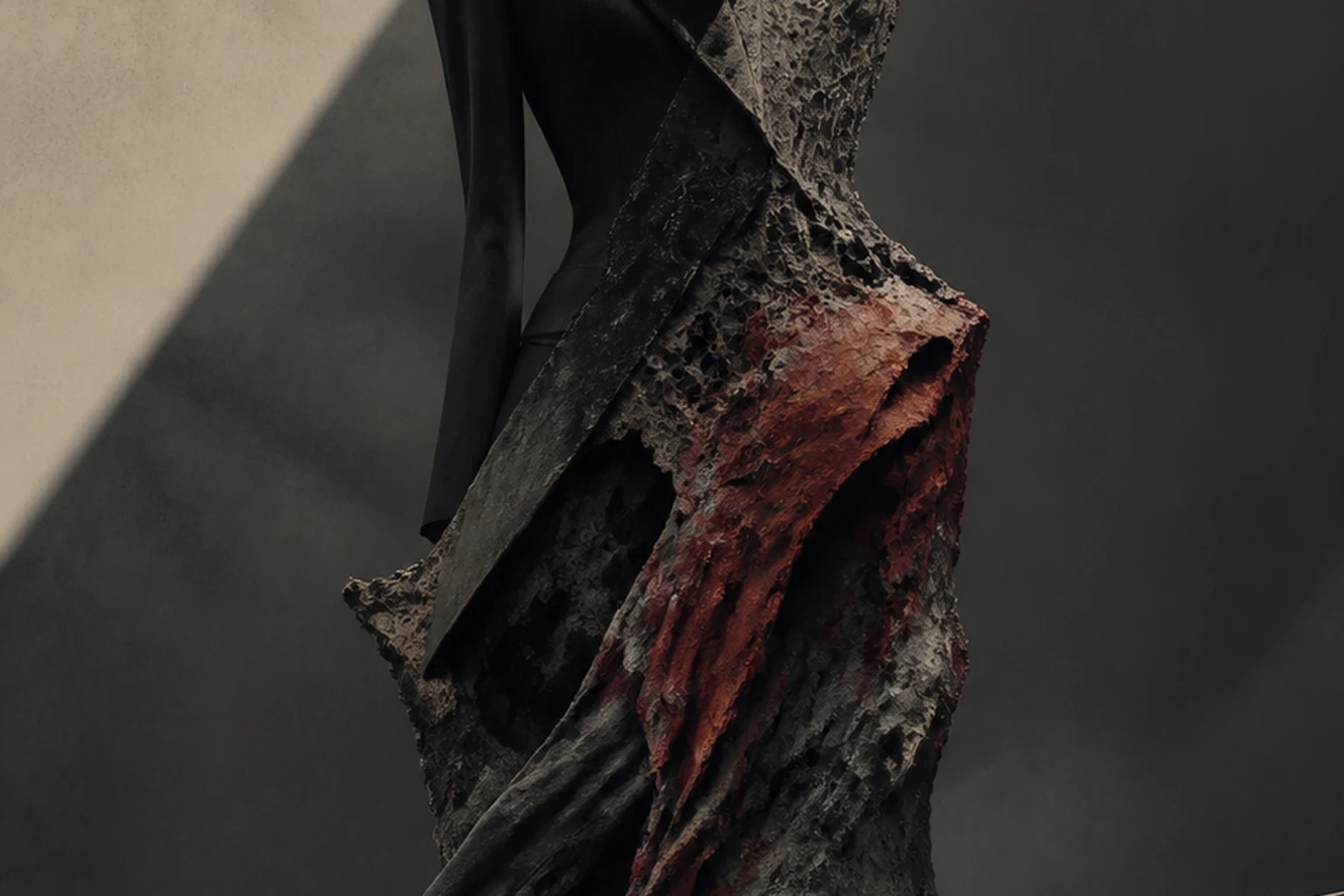
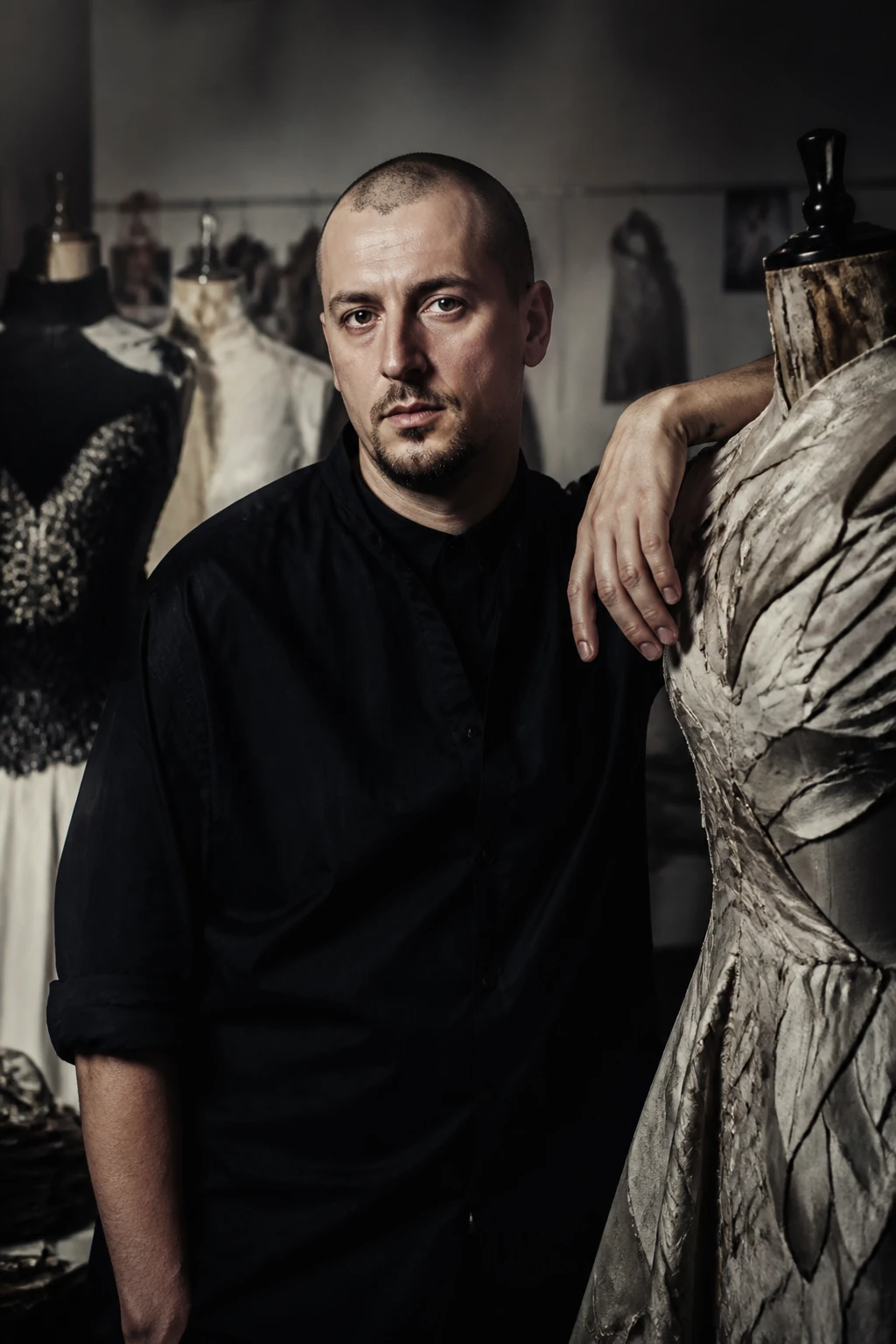
McQueen turned the runway into a space where clothing, the body, fear, history and technology existed as a single dramatic work. His strength lay not only in provocation but in impeccable tailoring that held even the most radical images together.
Editorial thesis
Alexander McQueen's historical significance rests on joining several systems: the menswear tailoring craft, historic costume, Gothic culture, autobiographical trauma, scenography and new media. He did not simply make spectacular shows. McQueen used the runway as critical theatre and cutting as an instrument for controlling the body, power and emotion.
Reader question
How did a London tailor from a working-class district become one of the most influential designers of the late twentieth and early twenty-first centuries, and why do his collections continue to define the language of fashion shows, visual storytelling and technological fashion?
To present McQueen at once as tailor, author of collections, head of the house, Givenchy designer and director of shows. The material separates biographical facts from myths, analyses difficult themes without romanticising violence, and distinguishes the designer's personal legacy from the later history of the Alexander McQueen brand.
The core subject is Lee Alexander McQueen: his education, professional activity, method and legacy from 1969 to 2010.
The Alexander McQueen house after the founder's death is treated only as context; it requires a separate article.
The collections are analysed as artistic and institutional projects, not merely as a sequence of striking images.
Themes of violence, mental health, suicide and the exploitation of the body are described without sensationalism.
The notions of 'genius', 'provocateur' and 'enfant terrible' are used only as historical labels, at a critical distance.
All archival images require a separate rights check.
Short answer
Lee Alexander McQueen was born on 17 March 1969 in London. At sixteen he left school and began training on Savile Row, where he mastered the precise construction of the men's suit. After work in the theatrical workshops of Angels & Bermans, with Koji Tatsuno and with Romeo Gigli, he entered the master's programme at Central Saint Martins. His 1992 graduation collection, Jack the Ripper Stalks His Victims, was bought by Isabella Blow, who became one of the key figures of his early career.
In his own house McQueen developed a sharp, anatomically precise language: the low-cut bumster trousers, the elongated line of the body, corsets, historic cutting, distressed surfaces and complex scenography. The collections Highland Rape, No.13, VOSS, The Widows of Culloden and Plato's Atlantis joined fashion with politics, national memory, biology, technology and a critique of the viewer. From 1996 to 2001 he also headed Givenchy. In 2000 the Gucci Group acquired a controlling stake in his house, allowing the business to expand. McQueen died on 11 February 2010. His legacy lives on in the modern understanding of the show as a total medium, and in the discipline of cutting that lay beneath the theatricality.
1. London and the working-class family
Lee Alexander McQueen was born on 17 March 1969 in the London district of Lewisham and grew up in Stratford. He was the youngest of six children of Ronald McQueen, a taxi driver, and Joyce McQueen, a teacher of social studies.
His background became an important part of the public story because British high fashion had long been associated with elite education and social distance. McQueen entered the system through craft, not through his family's cultural capital.
Later he used his personal biography actively in the collections, but did not turn it into a simple story of social ascent. Working-class London, family memory, the harshness of the urban environment and a feeling of exclusion existed in his work alongside the aristocratic suit and museum craft.
2. Savile Row: the foundation of the method
At sixteen McQueen left school and began an apprenticeship at Anderson & Sheppard, then worked at Gieves & Hawkes. Savile Row gave him a knowledge of the men's suit: balance, the construction of the shoulder, working with wool, hand finishing and the link between the pattern and movement.
This technical base is often hidden behind the theatricality of his shows. Yet it was precisely the precision of the cutting that let him distort the figure without losing control. He could raise the shoulder line, lengthen the torso or radically lower the waist because he understood the classical norm.
The tailoring discipline also shaped his attitude to the fitting. The body was treated as a constructive problem, not merely as a surface for decoration.
3. Theatre, Koji Tatsuno and Romeo Gigli
After Savile Row McQueen worked at the costume company Angels & Bermans, where he gained experience of historic and stage costume. Theatre taught him to perceive clothing in movement, light and dramatic space.
He then worked for the Japanese designer Koji Tatsuno in London and for Romeo Gigli in Milan. These periods widened his language: from strict British tailoring towards a more plastic treatment of the body, drapery and historic romance.
The combination of tailoring, theatrical illusion and Italian sensuality later became the foundation of his independent collections.
4. Central Saint Martins and Isabella Blow
McQueen entered the master's programme at Central Saint Martins after initially wanting to teach cutting. In 1992 he presented the graduation collection Jack the Ripper Stalks His Victims.
The collection joined Victorian history, family genealogy, dark romance and details associated with hair. The fashion editor Isabella Blow bought the entire collection and became one of the young designer's principal champions.
The story that Blow 'discovered' McQueen should not hide the institutional role of the school, the tutors, the team and his own craft experience. Yet her support did help form his public image and professional network.
5. Founding his own house
In the early 1990s McQueen created collections with extremely limited resources. The lack of budget became part of the aesthetic: found materials, rough surfaces, small venues and the intense work of the team created a feeling of immediate danger.
The house was built around authorial control and a strong visual identity. The name Alexander McQueen, proposed by Isabella Blow as more formal, separated the public brand from the name Lee, which those close to him used.
The first seasons quickly drew the press, but the commercial infrastructure remained fragile. A strong image did not always mean stable production and sales.
6. Bumster and a new anatomy
One of McQueen's most famous inventions was the bumster trouser with an extremely low waistline. They appeared in the early collections and radically elongated the torso, exposing the lower back.
The designer explained the device through an interest in the lower spine and the proportions of the body. The bumster changed the direction of mass fashion in the late 1990s and early 2000s, although the commercial versions were considerably softened.
It is important to see more than sexual provocation here. The low line dismantled the habitual centre of the figure and turned the body into an elongated architectural construction.
7. Highland Rape: history, the body and critique
The collection Highland Rape, autumn-winter 1995-1996, became one of McQueen's most discussed projects. Torn fabrics, the exposed body, tartan and aggressive choreography drew accusations of aestheticising violence.
The designer himself linked the collection to the history of England's suppression of Scotland and the violent destruction of Highland culture, not to the depiction of sexual crime as entertainment.
The criticism, however, remains important: the author's intention does not cancel how the images are read by the viewer. The collection shows a tension between political metaphor, bodily vulnerability and the power of the fashion spectacle.
8. Dante and religious theatre
The collection Dante, autumn-winter 1996-1997, was presented in Christ Church, Spitalfields. McQueen joined religious architecture, military photography, skeletons, lace and a historic silhouette.
The show explored the connection between war, faith, martyrdom and beauty. Religious images were used not as decoration but as a dramatic system in which the body is at once protected, condemned and put on display.
Dante confirmed McQueen's ability to turn the venue into part of a collection's meaning.
9. Givenchy, 1996-2001
In 1996 McQueen was appointed chief designer of Givenchy, succeeding John Galliano. For a British author this meant access to the Paris couture ateliers, the archive and the global infrastructure of LVMH.
The relationship was tense. McQueen publicly criticised corporate constraints, and his own aesthetic did not always coincide with the codes of Givenchy. Nevertheless the period gave him experience of managing large teams and of high craft.
These years cannot be described only as a failure. They widened the designer's technical possibilities, even though his most coherent statements continued to happen in his own house.
10. No.13 and robotic painting
The finale of the show No.13, spring-summer 1999, became one of the key moments of fashion performance. The model Shalom Harlow stood on a rotating platform in a white dress while two industrial robots sprayed black and acid-yellow paint onto it.
The scene joined control and threat, factory production and the living body, chance and precise calculation. The dress turned into a unique object before the viewers' eyes.
The performance was not a technological demonstration for effect. It raised the question of who controls the image: the designer, the machine, the model or the system of observation.
11. VOSS: the viewer as the object of observation
The show VOSS, spring-summer 2001, took place inside a mirrored cube. Before it began the viewers saw their own reflections, and after the light came on the models appeared inside a space resembling a clinical ward.
The collection worked with beauty, the psychiatric institution, observation and disgust. A final glass box revealed the figure of the writer Michelle Olley in a composition referring to a photograph by Joel-Peter Witkin.
VOSS inverted the usual structure of the show: the public itself first became the exhibited object. This was not only a spectacle of clothing but a critique of the desire to look.
12. Scanners, Deliverance and movement
In Scanners, autumn-winter 2003-2004, McQueen explored migration, travel and the collision of cultures through complex layers, fur, leather and constructions reminiscent of protective clothing.
Deliverance, spring-summer 2004, used the dance marathon as the basis of its choreography. Models and professional dancers gradually lost physical stability, and the clothing was revealed through fatigue and movement.
Both projects show that McQueen designed not only a static silhouette. He built a dramaturgy of the body's change over time.
13. The Widows of Culloden and Pepper's Ghost
The collection The Widows of Culloden, autumn-winter 2006-2007, returned to Scottish history in a more melancholy and memorial form. Tartan, lace, antlers, feathers and strict tailoring joined mourning with national memory.
The finale used the Pepper's Ghost illusion: the ghostly figure of Kate Moss appeared inside a glass pyramid. A nineteenth-century technology turned the contemporary supermodel into a vanishing image.
This moment is often called a hologram, but technically it is more correct to speak of a stage optical illusion.
14. Plato's Atlantis: nature, digital media and the Armadillo
Plato's Atlantis, spring-summer 2010, explored an imagined evolution of humanity after an ecological catastrophe. Digital prints joined reptile skin, marine structures and abstract symmetry.
The Armadillo shoes radically changed the gait and the proportions of the body. Two robotic cameras moved along the runway, and a live internet broadcast of the show was meant to make the event global.
Interest in the broadcast surged after Lady Gaga announced the premiere of Bad Romance, demonstrating a new link between the fashion show, the music audience and digital infrastructure. The collection became the designer's last fully completed show.
15. Materials, crafts and historic costume
McQueen worked with feathers, shells, wood, leather, metal elements, lace, embroidery and digital printing. An unusual material was always subordinated to construction and dramaturgy.
Historic costume was not a source of literal reproduction but a system of engineering solutions. The corset, the crinoline, the doublet and the military uniform offered ways to alter the body and distribute power.
His collaboration with craftspeople showed that radical fashion depends on collective craftsmanship.
16. Sarah Burton and the structure of the studio
Sarah Burton joined McQueen's studio in 1996 after an internship and over time came to lead the women's design. She played an important role in translating the author's ideas into collections and in organising the team.
After McQueen's death Burton was appointed creative director of the brand. Her period confirmed that the house possessed not only the founder's charisma but also a professional infrastructure.
At the same time, McQueen's personal authorship and the brand's later work must not be mixed. The continuation of the name does not mean a full continuation of the method.
17. Business, the Gucci Group and scaling
In December 2000 the Gucci Group acquired 51 percent of Alexander McQueen. The deal gave the house resources for international development, accessories, stores and the expansion of the team.
It also allowed McQueen to leave the Givenchy contract after fulfilling his commitments. The house gained a more stable commercial structure while retaining for the designer a significant creative freedom.
This stage shows that the avant-garde image and corporate development were not mutually exclusive. On the contrary, large-scale shows required a serious economic infrastructure.
18. Mental health and death
By the late 2000s McQueen was suffering heavy personal losses, addiction and problems with his mental health. The death of Isabella Blow in 2007 and of his mother Joyce in February 2010 became part of a complex crisis.
On 11 February 2010 the designer died in his home in London. The inquest established suicide. This death cannot be turned into a romantic confirmation of the image of the 'tormented genius'.
Professional pressure, illness and loss require precise and respectful language. Creative value does not arise from suffering automatically, and mental health must not be used as a decorative legend of the brand.
19. Legacy and influence
McQueen changed the idea of the fashion show as an independent work. Contemporary shows that combine film, sound, performance, robotics and live streaming largely develop the system he made central.
His influence is also visible in the silhouette: the extreme waist, anatomical tailoring, the historic corset, the protective shell and the hybrid of the body with an animal or a machine continue to appear in fashion.
Yet the legacy is not reducible to a dark aesthetic. McQueen's most enduring lesson is the need for technical discipline capable of turning a concept into a convincing physical form.
20. Myths and contested formulations
McQueen is often described as an author who always sought to shock. This simplification hides the research structure of the collections and the precision of the craft.
Another myth is the image of him as a solitary genius. His projects depended on Sarah Burton, Katy England, Philip Treacy, Shaun Leane, Sam Gainsbury, the models, the ateliers and many technical partners.
The formula 'invented the fashion show as theatre' is also excessive: theatre in fashion existed earlier. McQueen radically expanded its scale and made dramaturgy not an addition but the core of the collection.
21. Conclusion: the construction that holds the spectacle
Alexander McQueen remains important because he joined opposites: precise costume and destruction, beauty and disgust, historic craft and robotic production, private trauma and mass media.
His shows could seem chaotic, but they were built on strict direction. His clothing could look dangerous, but it rested on a professional knowledge of the body and material.
McQueen's chief legacy is not the visual formula of Gothic but an ability to create a system in which construction, image, space and emotion reinforce one another.