designer profile
Cristóbal Balenciaga
The architect of the fashion silhouette: how a Basque tailor turned fabric, cutting and the emptiness around the body into one of the principal languages of twentieth-century haute couture
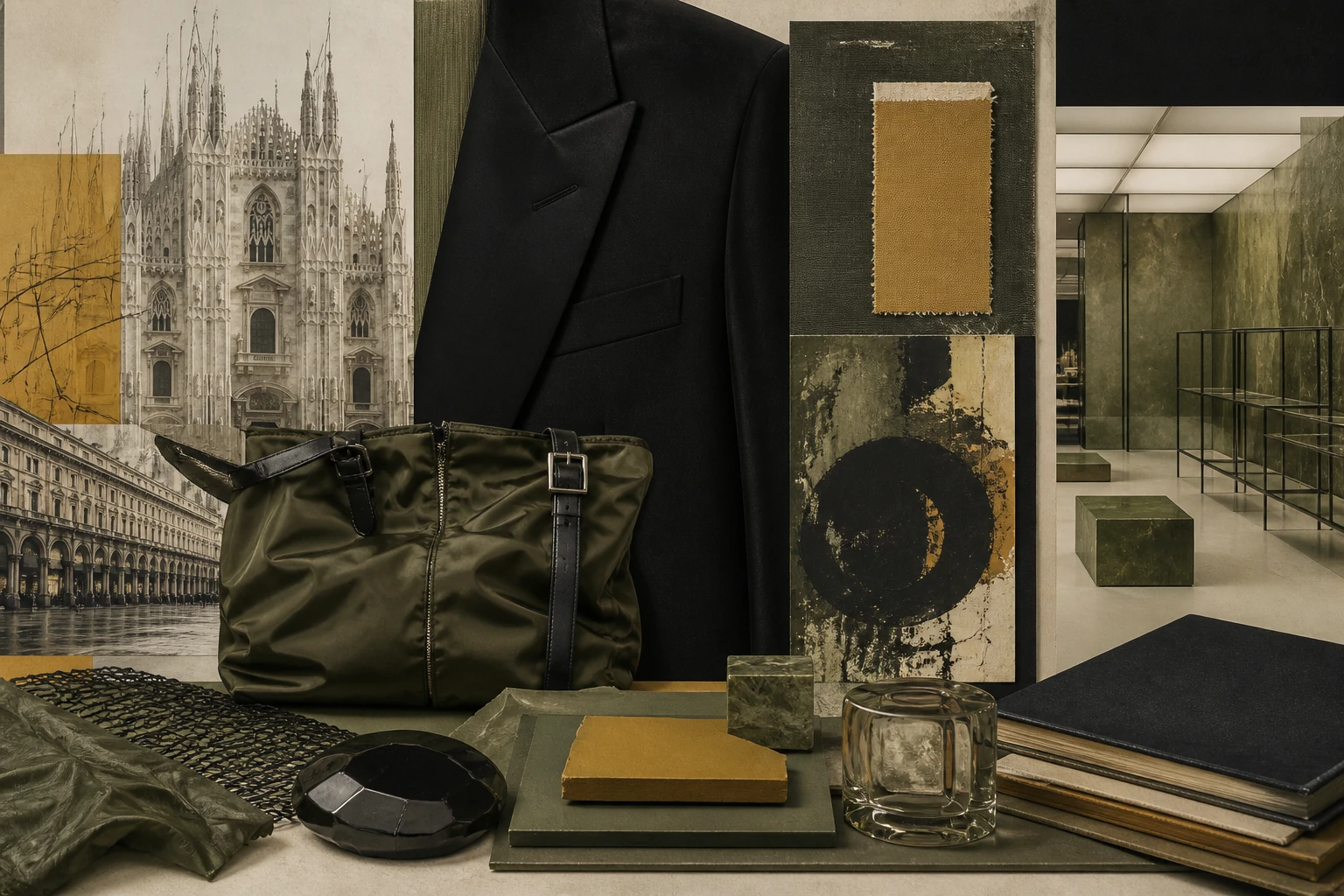
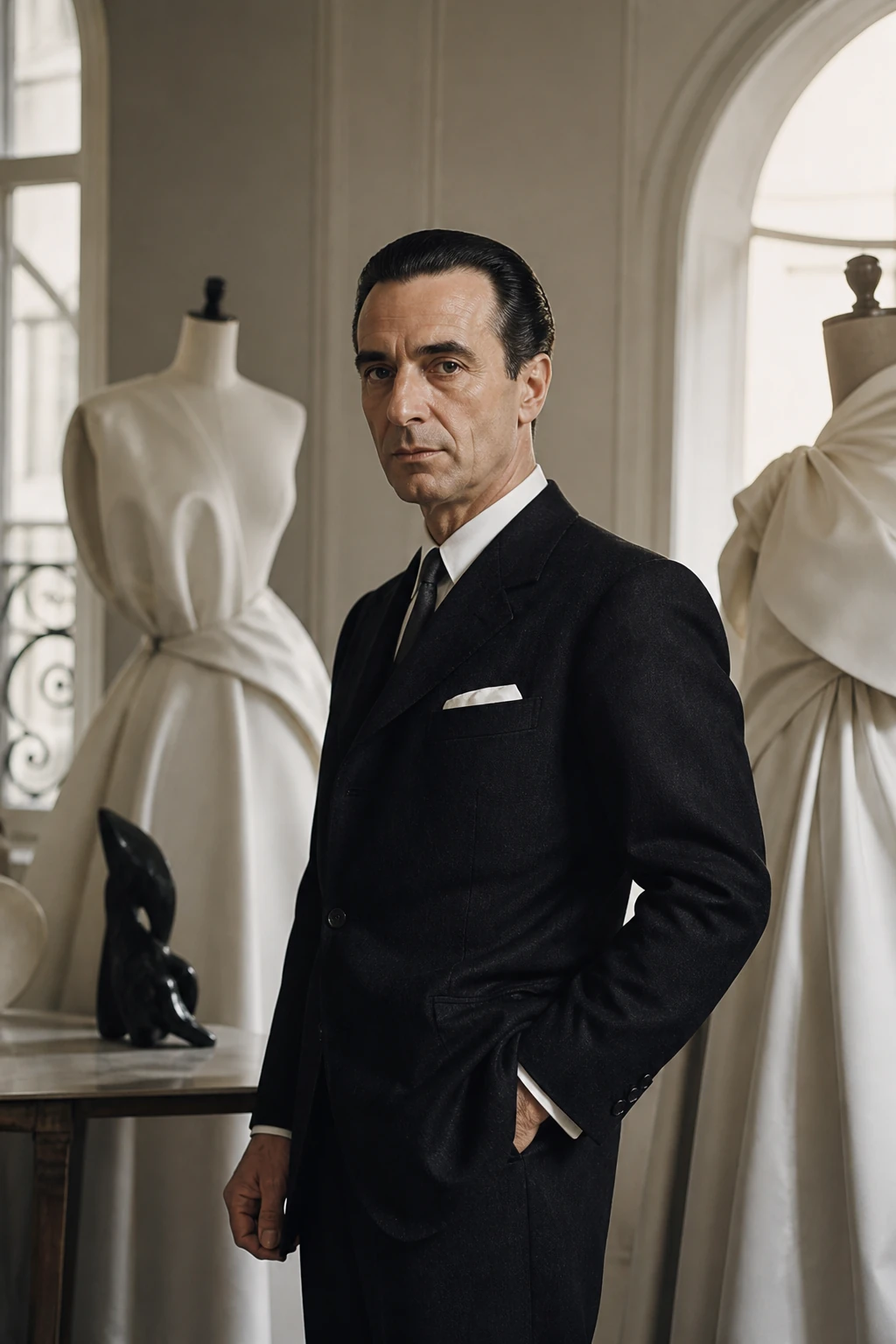
Balenciaga's significance does not lie in a single famous silhouette. He changed the very principle of designing clothing: fabric ceased only to repeat the body and began to create an independent space around it.
Editorial thesis
Cristóbal Balenciaga was not only the author of striking dresses but a master of the full production chain of haute couture. He understood fabric, knew how to build a pattern, cut, drape, fit and refine a form with his own hands. Thanks to this he successively freed clothing from direct subordination to the body. His silhouettes of the 1940s to 1960s — tonneau, semi-fit, balloon, tunic, sack and baby-doll — formed a new idea of elegance in which comfort, volume, emptiness and the precision of construction mattered more than the display of the waist.
Reader question
How did the son of a fisherman and a seamstress from the Basque town of Getaria become one of the most authoritative couturiers of Paris, how did he change the female silhouette, and why does his method continue to influence designers and visual culture?
To present Balenciaga at once as a person, tailor, entrepreneur, head of the ateliers and author of a system of form. The material separates biographical facts from later legends, distinguishes the Spanish enterprises from the Parisian house, explains the construction of the key silhouettes and does not turn the professional admiration of contemporaries into an unproved claim of absolute primacy.
The core subject is Cristóbal Balenciaga Eizaguirre: his professional biography, design method and creative legacy from 1895 to 1972.
The history of the active Balenciaga brand after 1968 is included only as context of the legacy; it is the subject of a separate material.
The Spanish enterprises C. Balenciaga, Balenciaga y Cía, Cristóbal Balenciaga, Martina Robes et Manteaux and EISA Costura are not described as a single legally continuous company.
The formulas 'the only true couturier', 'the master of us all' and 'the architect of haute couture' are given as assessments of contemporaries, with attribution.
The proposed images pass a separate rights gate and are not embedded in the document.
Short answer
Cristóbal Balenciaga was born on 21 January 1895 in Getaria, into a working family. His mother was a seamstress and worked for the family of the Marquises de Casa Torres; an early acquaintance with the craft and with the clothing of wealthy clients became the foundation of his professional path. By 1907 he lived in San Sebastián and was learning the tailoring trade, and in 1917 he opened his first registered business. In 1937, after the start of the Spanish Civil War, he moved the centre of his activity to Paris and opened a salon on Avenue George V. [1][2]
Unlike many heads of fashion houses, Balenciaga personally mastered the main operations of couture — from the idea and the pattern to the fitting. He worked not only with the contour of the body but with the space around it: he shifted the volume back, blurred the waistline, separated the fabric from the torso and achieved freedom of movement beneath outward severity. This logic appeared in the tonneau line of 1947, semi-fit of 1951, balloon of 1953, the tunic of 1955, the sack dress of 1957 and baby-doll of 1958. In 1968 he closed his houses, as prêt-à-porter was displacing the model of individual couture. Balenciaga died on 23 March 1972, but his method remained one of the fundamental bases of contemporary fashion. [1][2][3]
1. Getaria: the family and the craft of the mother
Cristóbal Balenciaga Eizaguirre was born on 21 January 1895 in Getaria, a small fishing town on the coast of the Basque Country. His father was a fisherman, and his mother Martina Eizaguirre was a seamstress. His father died when Cristóbal was eleven, and it was his mother's craft that became his first durable professional reference. [1]
Martina also worked for the family of the Marquises de Casa Torres. For the future designer this meant joining two environments: the everyday economy of a working coastal town and the material culture of an aristocratic wardrobe. He observed not only the finished dresses but the very process of their creation — the fabric, the fit, the correction, the hand labour and the relation between the craftswoman and the client.
The popular biographical tradition often turns the early patronage of the marchioness into a fairy-tale story of the instant recognition of talent. It is safer to speak more cautiously: the Casa Torres family was indeed connected with his professional formation, and the marchioness became one of his first clients and patrons.
2. San Sebastián: learning the tailoring trade
By 1907 Balenciaga was registered as a resident of San Sebastián — a resort city that the Spanish court visited in summer and where there was a steady demand for clothing connected with Parisian fashion. Here he successively learned the tailoring trade in enterprises oriented towards the international market. [1]
His early training is of essential importance. Haute couture divided the authorial idea, modelling, cutting and execution among many specialists. Balenciaga formed as a practising master able to understand a garment as a whole. Later this allowed him to assess immediately whether a material would hold a given volume, where a seam should be moved and how the inner structure would change the movement of the fabric.
San Sebastián taught him to work with a demanding clientele. Couture exists through the fitting, the body and a specific way of life. Balenciaga kept this applied discipline even as his forms became increasingly abstract.
3. 1917-1936: the Spanish atelier system
In 1917 the twenty-two-year-old Balenciaga registered his own business, C. Balenciaga, at 2 Calle Vergara in San Sebastián. The enterprise was soon transformed into Balenciaga y Cía with the participation of the Lizaso sisters. After the partnership ended in 1924 he registered a company under his own name; the enterprise already provided work for 71 people. [1]
In 1927 he created an additional brand, Martina Robes et Manteaux, named after his mother; it then received the name EISA Costura, from the surname Eizaguirre. EISA expanded to Madrid in 1933 and Barcelona in 1935. This was an important part of the entrepreneurial strategy: several enterprises allowed him to serve clients in different cities and to work at several organisational levels.
One must distinguish the brands and the legal structures. The later history of the brand often reduces them into a single continuous legend. In reality Balenciaga's Spanish system consisted of several enterprises, addresses and partnerships.
4. Paris, 1937
The Spanish Civil War disrupted the work of the resort and capital ateliers. In 1937 Balenciaga opened the Parisian house at 10 Avenue George V. Paris provided access to the leading fabric suppliers, embroidery houses and an international clientele. [1][2]
The move did not mean abandoning the Spanish experience. On the contrary, the Parisian house allowed him to translate that experience into the language of the international couture system. The early collections included forms connected with portraits of the infantas, the bolero, the mantilla, black lace and the clothing of bullfighters.
His authority was built above all within the profession — among tailors, editors, fabric producers and other couturiers. Contemporaries valued not the loudness of the public image but a rare unity of idea and execution.
5. The couturier-tailor
Balenciaga's principal professional trait lay in combining creative and technical competence. He knew how to drape fabric on a mannequin, build and correct the patterns, cut, carry out the fitting and understand the sequence of assembly. The Metropolitan Museum of Art stresses that he could himself create and adjust a toile — a trial model in cotton fabric. [3]
This does not mean that he fully sewed every garment alone. The Parisian house was a complex organisation with premières, pattern-makers, tailors, embroiderers and suppliers. But Balenciaga could speak to every level of production in the language of the specific operation.
The architectural metaphor therefore applies to him not as a decorative compliment. He designed support, distance, balance and the distribution of weight. The outward simplicity of many dresses rested on a hidden system of seams, linings, darts and inner tapes.
6. Fabric and inner construction
Balenciaga did not always begin with a drawing. For him the material could precede the form: the density, elasticity, sheen and ability to hold a fold suggested what volume was possible. Soft wool allowed a free back of a coat; silk taffeta held roundness; gazar created rigid yet visually light shells.
V&A research using X-rays and the digital recreation of patterns showed how carefully the supports, seams and ways of distributing volume were hidden. [2] Visual clarity was the result of complexity, not of its absence.
The fitting served not only as a check of size. The designer assessed how the garment behaved in turning, walking and sitting, how it opened the neck, where the sleeve ended and how freely the body existed within the form.
7. The space around the body
Balenciaga's principal contribution is often described as creating a new female silhouette. More precisely, he changed the relation between the body and the shell of the clothing. In the dominant model of the late 1940s the figure was read through the shoulders, bust, narrow waist and full skirt. Balenciaga gradually moved attention from the frontal contour to the back, the side profile and the space between the fabric and the body.
He could keep the front of a jacket comparatively close-fitting and make the back free; raise the front edge and lengthen the back; hide the waist instead of emphasising it. This asymmetry of perception forced the viewer to walk around the figure and to look at the clothing in movement.
The emptiness within the garment was an active constructive element. It provided comfort and at the same time created a form that did not coincide with the anatomy.
8. The evolution of the silhouette, 1947-1958
The Balenciaga museum describes his development as a gradual, not an instantaneous, revolution. He returned to the same problem for several seasons in a row, reduced the details, changed the proportions and tested new materials. [1]
The key sequence includes the tonneau line of 1947, semi-fit of 1951, balloon of 1953, the tunic of 1955, the sack dress of 1957 and baby-doll of 1958. These names do not denote isolated 'inventions'. Together they show a movement from the redistribution of volume within the familiar suit towards an almost complete rejection of the traditional reading of the waist.
The evolution was not a linear movement towards abstraction: Balenciaga continued to create close-fitting evening dresses, suits and ceremonial ensembles. But his most influential line of research made the body less literally described.
9. Tonneau and semi-fit
The tonneau — 'barrel-shaped' — line appeared in 1947, at the very moment when Christian Dior presented the New Look. Unlike Dior's emphasis of the waist, Balenciaga widened the middle of the silhouette and created a smooth volume that did not have to repeat the curves of the body.
In 1951 he developed the semi-fitted line: the front of a jacket or dress kept its connection with the body, while the back moved away from it and formed a free volume. [1][2] Such a solution looked gathered in front and unexpectedly light in profile.
Semi-fit changed the role of the back in fashion. It ceased to be a secondary continuation of the front and became an independent space of design. Freedom was not expressed through sportiness: a woman kept a complex image, but could move without a rigid shell.
10. Balloon, tunic and the sack dress
The balloon jackets and balloon skirts of the early 1950s created a rounded form visually filled with air. This effect required precise control over length, lining, gathering and the properties of the fabric. The volume must not sag or look accidental.
The tunic of 1955 continued the separation of the clothing from the waist: a free top ran along the torso. In 1957 the sack dress carried this logic further. The sack dress hid the usual landmarks of the figure and was built as a single elongated volume. [1][2]
It is important not to attribute the sack dress to a single author without qualification: the mid-1950s were a period of parallel experiments by different houses with the straight line. Balenciaga's significance lies in the sequence, the technical clarity and the connection of the decision with the wider system of his research.
11. Baby-doll and the late minimalism
The baby-doll dress of 1958 joined a raised line of volume, a short length and a free fall of the fabric. It did not model the body by the traditional scheme but created an independent bell-shaped form. [1][2]
In the 1960s Balenciaga increasingly reduced the number of visible constructive elements. Simple shift dresses and evening shells could be built on a few precise seams and a strong material. Minimalism did not mean poverty of execution: the fewer the external details, the higher the demands on proportion, edge and surface.
This late clarity influenced the designers of the space age and the following generations of minimalists. Couture could be contemporary not through decoration but through the radical simplification of form.
12. Gazar as a technology of form
One of the materials most closely connected with the late Balenciaga was gazar — a dense silk fabric with a dry, springy structure, developed by the Swiss manufacturer Abraham in collaboration with the designer. It made it possible to create forms that stood away from the body without a heavy frame.
Gazar suited especially the evening dresses and capes of the 1960s. Its surface reflected light soberly, and its density held rounded and geometric volumes. The material did not simply serve a finished sketch; it widened the very set of possible forms.
The collaboration with the manufacturers shows Balenciaga as a technological author. Innovation arose not only in the atelier but in the chain of suppliers.
13. Spain as a visual archive
Balenciaga's Spanish origin appeared not as a constant quotation of national costume but as a set of proportions, colours and types of surface. The V&A connects his infanta dresses with the portraits of Velázquez, and the bolero, lace and black mantillas with the traditional clothing and ceremonies of Spain. [2]
He turned to the bullfighter's costume, the short jacket, puffed sleeves, gold embroidery and the contrast of black and bright colour. But the historical source was edited: a detail could be enlarged, stripped of ornament or turned into an abstract volume.
Spanish painting gave him a model of solemn restraint. A dark background, matte black, a rigid line of the collar and the local glow of an ornament created drama without visual overload.
14. Black and the discipline of the palette
Black held a special place in the Balenciaga system. It concentrated attention on the silhouette, texture and the boundary between the body and space. In lace, velvet, silk and gazar the same black behaved differently — absorbing light, reflecting it or creating a translucent layer.
At the same time the designer was not exclusively monochrome. He used rich red, pink, green, yellow, white and complex floral fabrics. His discipline appeared in the precision of the combinations: colour supported the construction and did not destroy the proportion.
The contrast could be local — a white collar on a black dress, a coloured lining, a precious embroidery on a calm surface. Such economy heightened the effect.
15. The client, the body and comfort
Balenciaga dressed the international aristocracy, wealthy American clients, actresses and women of high society. Among the famous clients were Mona von Bismarck, Rachel Lambert Mellon, Gloria Guinness and Ava Gardner. The V&A notes that Mona von Bismarck ordered from him everything from ball gowns to garden shorts. [2]
The understanding of the client, however, cannot be reduced to status. He designed clothing so that it helped the real body, not only displayed an ideal figure. A free back, the line of the neck, the sleeve and the construction of a coat could correct the proportions without direct tightening.
Comfort became part of luxury — invisible to the viewer but tangible for the wearer. A woman looked composed and monumental, but was not immobilised.
16. The ateliers as a collective system
The Parisian haute couture house was a complex organisation. The work was divided between flou — soft dresses — and tailleur — suits and coats; the premières managed the teams, and external métiers executed embroidery, feathers, flowers, shoes and ornaments.
Balenciaga demanded high precision and could rework a model many times. His perfectionism ensured the coherence of form and execution, but depended on the collective knowledge of the atelier workers.
The Spanish enterprises continued to play a role in his system even after the opening of Paris. This shows once again that the designer's activity cannot be described only through a single address.
17. The press, shows and copying
Balenciaga was known for his reclusiveness and did not seek to turn his own personality into a public brand. The V&A notes that over a long career he gave only one full interview. [2] The house worked with the press and photographers, but controlled access.
In the 1950s Balenciaga, together with Givenchy, began showing the collections to the press later than the usual schedule, in order to reduce the time for copying the models. Haute couture already existed within a system of rapid reproduction on international markets.
His caution reflected an understanding of design as intellectual and craft capital. In an era before the modern system of design protection, control of the show was one of the instruments for preserving an advantage.
18. The closure of the houses in 1968
In 1968 Balenciaga announced the end of his activity and closed the Parisian house, as well as the related Spanish enterprises. The museum and the V&A connect the decision with a change in the fashion system: individual haute couture was losing its central role, while prêt-à-porter offered a faster and more scalable format. [1][2]
The closure was radical, because Balenciaga did not want to turn his method into a compromise serial version. It is more accurate to see in the decision a collision between a production model based on individual fitting and the master's control and the new economy of the industry.
For the clients and the staff the closure was a real institutional rupture. It ended not only the author's career but the work of a system in which specific skills had accumulated for decades.
19. The final work and death
After closing the houses Balenciaga almost entirely withdrew from fashion activity. The exception was the wedding dress for María del Carmen Martínez-Bordiú, created for her wedding in 1972. This commission turned out to be one of the designer's last completed works.
Cristóbal Balenciaga died on 23 March 1972 in Xàbia, Spain. He was buried in Getaria. His death came at a moment when designer ready-to-wear, youth culture and the media were gradually displacing the old model of the closed couture salon.
The posthumous exhibitions quickly fixed his status as a historical author. The World of Balenciaga at The Metropolitan Museum of Art in 1973 became an important stage in the institutionalisation of his legacy.
20. Pupils and legacy
Balenciaga had a direct influence on the designers who worked in his house or beside him. Hubert de Givenchy was a close friend and follower; André Courrèges and Emanuel Ungaro worked for him before creating their own houses. [2]
This line of succession does not mean copying. Courrèges translated the purity of cutting and the freedom of the body into the language of the space age; Ungaro developed plasticity and colour; Givenchy kept the aristocratic clarity of couture.
The V&A traces Balenciaga's influence in the works of more than thirty designers — from direct pupils to authors working with minimalism, volume and experimental materials. [2] His legacy is especially visible where clothing is treated as space.
21. Myths and contested formulations
Around Balenciaga formed a durable set of quotations. Christian Dior called him the master who set the direction for the other couturiers; Coco Chanel stressed that he mastered all the operations of making clothing; Givenchy spoke of him as the architect of haute couture. These assessments matter as evidence of authority, but are not neutral proof of absolute superiority.
The phrase 'a couturier must be an architect of form, a painter of colour, a musician of harmony and a philosopher of measure' is widely quoted by the museum. It expresses the method accurately, yet exists in several versions of transmission and translation.
Another myth is the image of the designer as a wholly isolated genius. His achievements depended on his mother, patrons, partners, atelier workers, fabric producers and clients. Strong authorship existed within the collective infrastructure of couture.
22. Conclusion
Balenciaga remains contemporary not because today's fashion continues literally to repeat his dresses. His relevance is connected with a method of posing questions. Must clothing describe the body? Can comfort look solemn? What happens when the material determines the form? How does hidden construction create outward simplicity?
He turned cutting into an instrument of spatial thought. In his best works the event itself becomes the distance between the body and the fabric. Such logic matters for haute couture, minimalism, experimental ready-to-wear and digital research into form.
At the same time the historical Balenciaga must not turn into a universal justification for any oversized silhouette. His work rests on discipline, proportion, a knowledge of material and precision of execution. The combination of freedom and control — not a single recognisable volume — forms the core of the legacy.