designer profile
Gabrielle Chanel
Creating the modern women's wardrobe: how comfort, menswear cutting, knitwear, black and a managed legend formed one of the most durable languages of twentieth-century fashion
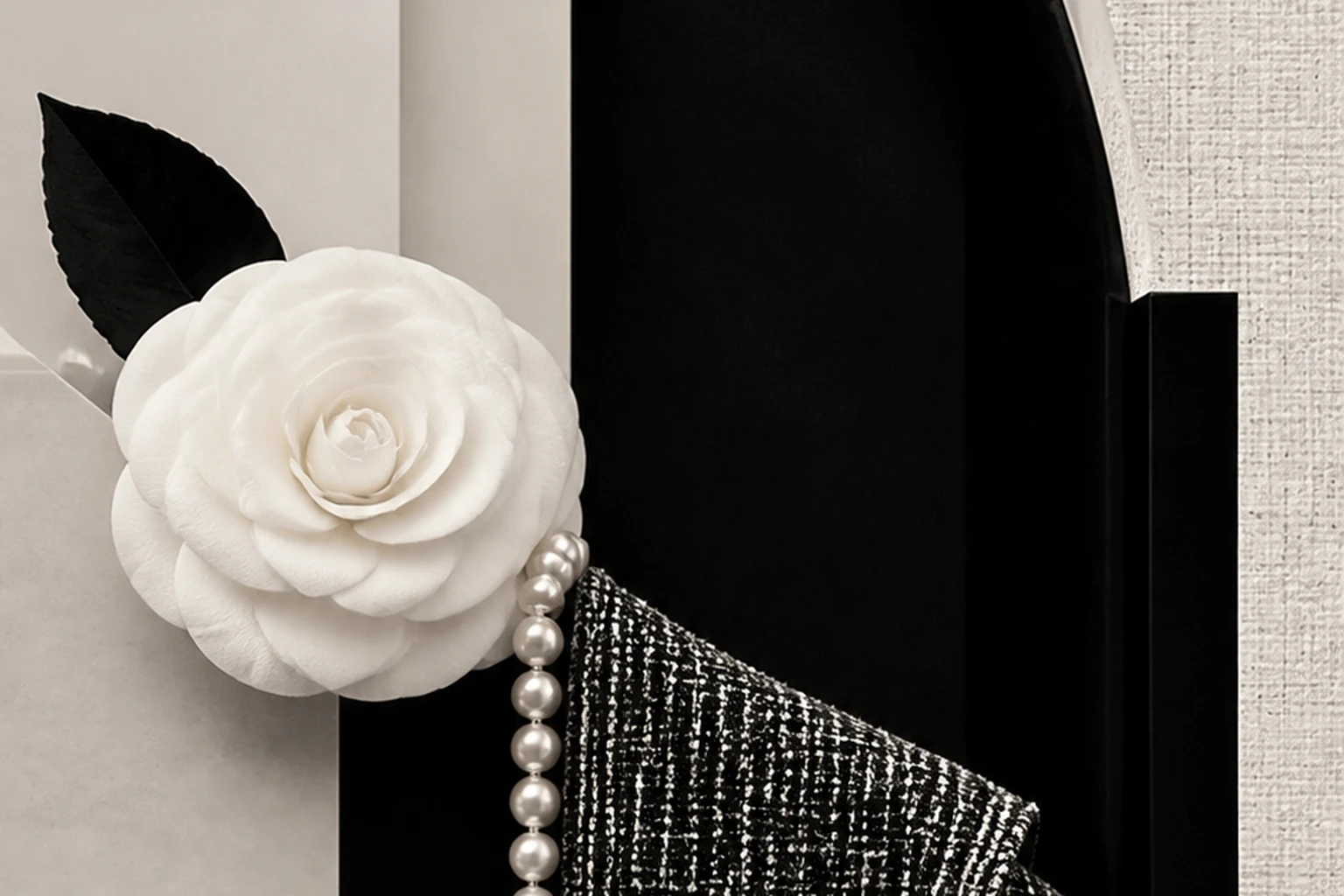
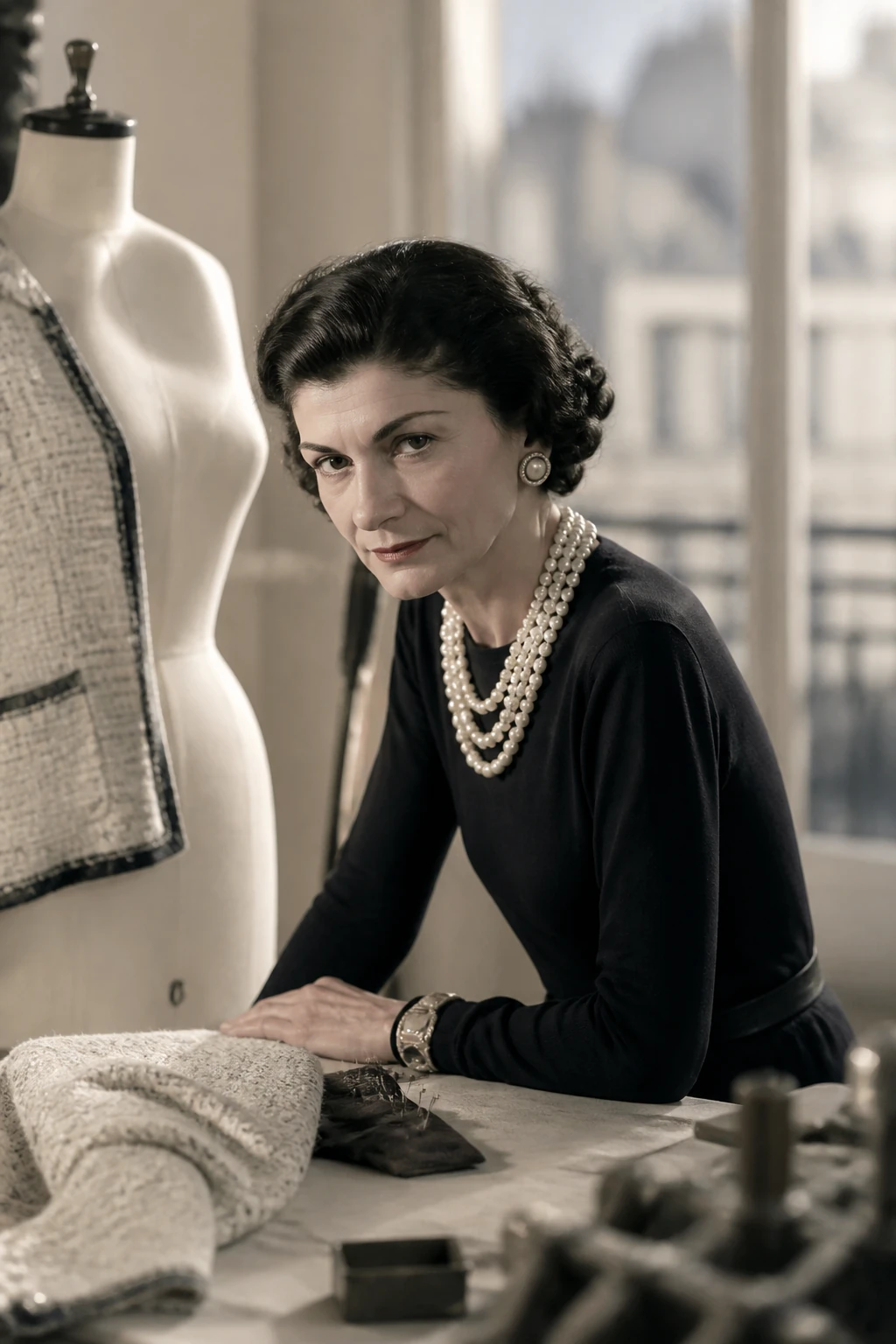
Chanel changed the women's wardrobe not with a single garment. She created a system in which freedom of movement, simplicity, personal style and repeatable codes became a modern form of luxury.
Editorial thesis
Gabrielle Chanel's historical significance rests not on the myth of an instant 'liberation of women' but on the long restructuring of the everyday wardrobe. She made comfort, soft construction, borrowings from menswear, knitwear, sporting elements, black and a mix of real and imitation jewellery part of a new elegance. At the same time she built her own public legend, a commercial system and a set of recognisable codes that outlived her personal career.
Reader question
How did a woman without a professional academic education turn her personal way of dressing into an international fashion system, why did her aesthetic prove durable, and how should her wartime biography be discussed without concealment or sensationalism?
To trace Chanel as designer, entrepreneur, author of a public image and participant in a cultural network. The material explains the construction of her wardrobe, distinguishes confirmed facts from brand legends, shows the role of partners and staff, and separately examines the contested actions of the occupation period.
The core subject is Gabrielle Bonheur Chanel (1883-1971): her professional biography, design method and cultural legacy.
The history of the House of Chanel after the founder's death is treated only as context; it is the subject of a separate institutional article.
Formulations such as 'freed women from the corset', 'invented the little black dress' and 'created the modern woman' are replaced by more precise ones: popularised, systematised, redefined and made part of a durable wardrobe.
The wartime period is described according to documented facts with an indication of the degree of evidence; the absence of a conviction is not used to deny confirmed connections and actions.
Personal relationships are included only when they explain the business, the visual sources, the cultural connections or the documented biography.
Every image passes the rights gate; archival photographs and museum objects are not embedded in the document.
Short answer
Gabrielle Bonheur Chanel was born on 19 August 1883 in Saumur. After her mother's death she spent part of her childhood in a religious institution at Aubazine; later she worked as a seamstress and performed in café-concerts, where the nickname Coco became fixed. In 1909-1910 she began selling hats in Paris, then opened shops in Deauville and Biarritz. Her early clothing rested on knitwear, a loose fit and nautical and sporting motifs — decisions that matched women's new, mobile way of life.
In the 1920s Chanel formed the essential elements of her language: the soft suit, the straight dress, black, the combination of expensive and imitation jewellery, the perfume Chanel N°5 and a strict visual code. In 1939 she closed the couture atelier. During the occupation she lived at the Ritz, was in a relationship with the German officer Hans Günther von Dincklage, tried to use antisemitic legislation against the Wertheimer partners and appeared in the documents of German intelligence. After the war she left for Switzerland. In 1954 she returned to Paris and re-established the Chanel suit, the two-tone shoe and the quilted bag as a system of the mature wardrobe. She died on 10 January 1971, completing a career of nearly sixty years.
1. Saumur, the family and early instability
Gabrielle Bonheur Chanel was born on 19 August 1883 in Saumur. Her father Albert Chanel was a travelling salesman and her mother Jeanne Devolle worked as a laundress. The family lived unsteadily and moved often; the parents married officially only after the birth of several children. [1][2][3]
After her mother's death in 1895 her father placed the daughters in a religious institution at Aubazine. Chanel later repeatedly reshaped this part of her biography, presenting herself now as an orphan, now as a girl raised by strict aunts. The divergence between the documents and her stories became the first element of the future legend.
The experience of social vulnerability matters for understanding her later discipline. Chanel sought to control her origins, appearance, money and public image. Her minimalism was not only an aesthetic but a way of eliminating dependence on imposed rules.
2. Aubazine: discipline, sewing and the mythology of origins
At Aubazine the girls learned practical skills, including sewing. The strict environment, the architecture of the monastery and the black-and-white palette were later often interpreted as sources of Chanel's visual language. Such connections are plausible but not always documented by the designer herself and should be presented as analytical comparisons rather than a proven direct genealogy.
There Chanel came to know the economy of means, the repeatability of form and the culture of the uniform. Her future wardrobe likewise rested on a limited set of elements that could be combined, repeated and adapted to different situations.
Aubazine became part of a managed legend: the later biographical accounts hid poverty and institutional upbringing while turning strictness into a sign of independence.
3. Moulins, the stage and the name Coco
In her youth Chanel worked as a seamstress in Moulins and performed in café-concerts. The nickname Coco is usually linked to the songs 'Ko Ko Ri Ko' and 'Qui qu'a vu Coco?'. The exact story of the name's origin varies, but it was the stage environment that gave her the experience of an independent public identity.
Her singing career did not become significant. What matters more is that she learned to observe the audience, understand the effect of a simple image and use a repeatable name as a sign of recognisability.
Unlike the hereditary couturiers, Chanel entered fashion through her own style and social connections. She compensated for the absence of academic training with observation, practical taste and an ability to edit already existing forms.
4. Balsan and Boy Capel: social and financial infrastructure
Her connection with Étienne Balsan introduced Chanel to the world of riding, country sport and a wealthy clientele. She wore men's shirts, simple skirts and small hats, setting them against the decorative fashion of the era. This personal wardrobe became advertising before a full brand existed.
Arthur 'Boy' Capel supported the development of her business and helped open the shops. His role was financial and emotional, but it does not cancel Chanel's entrepreneurial agency: she quickly built an independent clientele and began returning the investment.
Relationships with men are often used in biographies as a simplified explanation of a woman's success. It is more accurate to see them as an infrastructure of access that Chanel transformed into her own durable system.
5. 1909-1915: hats, Deauville, Biarritz and her own business
In 1909 Chanel began making hats in Balsan's Paris apartment on the Boulevard Malesherbes. In 1910 she registered Chanel Modes and opened a boutique at 21 rue Cambon. Her hats were comparatively simple and compact against the large decorated models of the Belle Époque. [1][4]
In 1913 the shop in Deauville allowed the move from headwear to clothing for resort life. In 1915 a couture house opened in Biarritz. Chanel officially dates the beginning of its own haute couture to 1915. [4]
The geography was strategic: Deauville and Biarritz combined sport, travel, a wealthy international clientele and less formal dress codes. Here the new wardrobe looked not like an avant-garde manifesto but a practical answer to a way of life.
6. Jersey: a utilitarian fabric as a new language
Jersey became one of the key materials of early Chanel. Previously knitwear had been widely used for men's underwear, sportswear and stockings. Its fluidity, stretch and relative availability made it possible to create simple garments that required no rigid inner construction. [5]
Chanel did not 'invent' jersey and was not the only designer to use knitwear. Her contribution was changing the status of the material: she systematically introduced it into the wardrobe of the wealthy woman and connected it with modern elegance.
The material supported the main idea: clothing should move with the body. A sweater, cardigan, straight skirt and dress in jersey formed a modular wardrobe that could be worn in the city, at the resort and while travelling.
7. Sport, the sea and the menswear wardrobe
Sailor blouses, matelot collars, stripes, trousers, cardigans and loose coats entered Chanel from uniform, sport and menswear. By 1916 the marinière was already part of her visual language. The V&A includes a spring-summer 1916 sailor blouse among the key objects of the exhibition. [6]
The borrowing was not literal. Chanel changed the proportions, material and context, turning a functional item into an element of feminine elegance. She did not disguise the source but used its practical logic.
This strategy changed the very notion of luxury: value could lie not in the amount of ornament but in the precision of the line, comfort and appropriateness.
8. The female body: freedom without a slogan
Chanel is often called the woman who freed the body from the corset. Historically this is too broad a claim: the rejection of the rigid corseted form happened gradually and was linked to dress reformers, sport, the First World War and the work of several designers, including Paul Poiret.
Her real contribution was creating a durable wardrobe in which freedom of movement became the norm rather than the exception. Clothing rested on the shoulders, followed the body softly and allowed one to sit, walk, drive a car, work and travel.
Chanel designed above all for her own body and way of life. That is why her decisions were perceived not as abstract theory but as a convincing model of behaviour.
9. The 1920s: creating a recognisable system
By the 1920s Chanel had become a major Parisian house. Its language included straight dresses, soft suits, knitwear, black and beige, long strands of pearls, and a contrast between the simplicity of the clothing and the intensity of the accessory.
What matters is not a single object but a repeatable system. Chanel constantly returned to solutions already found, changing the length, proportion, fabric and finish. The V&A characterises her sixty-year practice as the successive refinement of the principles of comfort, simplicity and wearability. [5]
In this way recognisability formed without a rigid uniform: a woman could change the combinations while staying within a shared language.
10. The little black dress
In 1926 American Vogue published a drawing of a simple black Chanel dress and compared its versatility with the Ford car. The moment became the symbol of the little black dress, although black dresses had existed long before Chanel.
The novelty lay in cultural translation. Black ceased to be only the colour of mourning, service or evening formality and became a neutral base of the modern wardrobe. A simple dress could change its meaning through jewellery, shoes and context.
The little black dress demonstrates Chanel's method: not inventing an object from scratch but redefining its social function and turning it into a reproducible code.
11. Chanel N°5 and the Parfums Chanel business
In 1921 Chanel N°5 was presented, created by the perfumer Ernest Beaux. The scent stood out for a complex aldehyde composition and an abstract name that described neither a flower nor a romantic plot. [1][7]
In 1924 Pierre Wertheimer, Théophile Bader and Chanel created Parfums Chanel. The share structure gave the Wertheimers control over production and distribution, and Chanel herself a smaller share and royalties. She later considered the agreement unfair and for decades tried to change the balance.
The perfume turned the designer's name into an independent mass product and showed that a luxury house could be built as a system of categories. At the same time it created a complex ownership history that cannot be reduced to the founder's creative biography.
12. Jewellery, pearls and the mixing of value
Chanel joined real jewels with imitation pearls, glass, gilding and large decorative elements. This broke the obligation of jewellery to be only proof of wealth.
Costume jewellery worked as a compositional instrument: long strands elongated the silhouette, a brooch fixed the drapery, a massive bracelet balanced a simple dress. An object could look luxurious without displaying its market price.
Such an approach matched her general strategy: mixing the codes of the high and the utilitarian, the masculine and the feminine, the real and the artificial, turning choice into an expression of personal freedom.
13. Russian, Byzantine and artistic connections
After meeting Grand Duke Dmitri Pavlovich, Chanel turned to Russian and Byzantine motifs: shirts, embroidery, cabochons, crosses and rich colours. The house Kitmir, founded by Grand Duchess Maria Pavlovna, executed embroidery for Chanel. [1]
She did not copy tradition as an ethnographic object but translated it into the modern wardrobe. Today this method requires critical analysis: cultural admiration existed within unequal relations between Parisian fashion and sources beyond it.
Byzantine and Slavic motifs broadened Chanel's minimalist image, showing that her language combined a strict base with decorative intensity.
14. Theatre, ballet, cinema and artists
Chanel was connected with Jean Cocteau, Pablo Picasso, Misia Sert, Sergei Diaghilev and other figures of the artistic milieu. She created costumes for theatre and ballet, including Le Train Bleu of 1924. [1][6]
Working with the stage made it possible to test clothing in movement and to see how a simple silhouette works at a distance. She also helped artists and projects financially, forming a cultural network around her own house.
Chanel nevertheless did not become an avant-garde atelier in the literal sense. Art gave her contacts, motifs and ways of composition, but the final result kept a practical wearability.
15. Britain, tweed and the Duke of Westminster
In the 1920s her ties with Britain strengthened through the relationship with Hugh Grosvenor, Duke of Westminster. Chanel observed the British country wardrobe, menswear tailoring, fishing, hunting and the use of tweed. [8]
In 1927 she opened a London salon and atelier in Mayfair. The V&A stresses that British fabrics and way of life became an important source of her practice. [8]
Tweed at Chanel was softened and freed from the rigid masculine construction. The material kept its associations with tradition but turned into comfortable women's clothing.
16. The Chanel suit: construction and movement
The classic Chanel suit took final form in the mature period: a jacket without a rigid lining architecture, a comparatively straight silhouette, braid along the edges, patch pockets, a contrasting lining and a chain along the lower edge for correct fall. [3]
Its chief innovation is not a decorative set but a balance. The jacket had to keep its line while remaining soft; the skirt had to allow movement; the lining had to help it slide over the body. The chain acted as a hidden technical element.
The suit was not an unchanging formula. Chanel repeated it in different fabrics, colours and proportions, creating a long-term wardrobe instead of a seasonal effect.
17. The house, the apartment and the public self-portrait
Chanel's spaces on rue Cambon joined the shop, the salon, the atelier and the private apartment. A mirrored staircase allowed Chanel to watch the show while staying outside the direct view of the audience.
The apartment with Coromandel screens, gilded objects, books, lions, crystals and religious symbols worked as a material self-portrait. It differed from the restrained wardrobe but explained the designer's love of mixing asceticism with rich decoration.
Chanel understood the interior as part of the brand. Objects, gestures, the address, the scent and her own appearance formed a single scenography.
18. The closure of 1939
With the outbreak of the Second World War Chanel closed the couture atelier, leaving the perfume boutique open. Thousands of employees lost their jobs. The reasons included the war, economic risk and her difficult relations with the workers after the strikes of 1936.
The closure ended the first great period of her career. The house, which in the 1930s was one of the largest couture organisations in Paris, effectively disappeared from clothing production for fifteen years.
The later brand history often moves quickly from the 1930s to the return of 1954. For accurate analysis it is important to see this period as an institutional rupture.
19. The occupation: relationships, intelligence and the 'Aryanisation' attempt
During the German occupation of Paris Chanel lived at the Ritz and was in a relationship with Hans Günther von Dincklage, who was connected with German intelligence. Declassified documents indicate that she was registered by German intelligence under the code name Westminster and took part in a diplomatic initiative through Madrid. [9][10]
In 1941 Chanel tried to use the antisemitic laws to gain control of Parfums Chanel from the Jewish Wertheimer family. The attempt failed: the Wertheimers had already transferred formal control to Félix Amiot, and after the war they recovered the property. [9]
After the liberation of Paris Chanel was questioned, but no charges were brought against her. This legal fact does not cancel the documented relationship, the 'Aryanisation' attempt or the contacts with intelligence. Historians differ in assessing her motives and the scale of her involvement, so the material separates confirmed actions from assumptions.
20. Switzerland and the postwar silence
After the war Chanel moved to Switzerland and for a long time lived between Lausanne and Paris. She produced no couture collections, but continued to earn income from the perfumery after settling her relations with the Wertheimers.
The period was at once a retreat and a preparation. She watched the New Look of Christian Dior, which brought back a tightly built waist and a full skirt. For Chanel this system became the opposite of her idea of the mobile wardrobe.
The postwar silence did not destroy her codes but changed their meaning: what had been radical modernity in the 1920s could in the 1950s be perceived as a strict alternative to theatrical couture.
21. The return of 1954
On 5 February 1954 the seventy-year-old Chanel presented her return collection in Paris. The French press received it coldly, considering the clothes outdated, but American editors and buyers saw in the suit a practical modernity. [3]
Over several seasons she reworked the proportions, fabrics and finishes. The return succeeded not through nostalgia but because the soft suit matched the life of women who worked, travelled and did not want to change the base of their wardrobe every season.
The period shows her capacity for iteration. Chanel did not abandon her old principles but retuned them for a new market.
22. 2.55, the two-tone shoe and the mature system of codes
In February 1955 the 2.55 bag appeared, with a shoulder chain and a quilted surface. It freed the hands and turned a practical detail into a luxury object. The name fixed the date of release rather than a personal name.
In 1957 the two-tone shoe with a beige body and a black toe helped visually lengthen the leg and protected the toe from visible wear. Like the suit, it joined an optical task with an everyday function.
By the late 1950s a mature system had formed: the suit, the camellia, pearls, costume jewellery, the slingback, the 2.55, N°5, black and beige. Each element could exist separately, but together they created instant recognisability.
23. American recognition and global status
The American market played an important role both in the 1920s and after the return. Vogue, Harper's Bazaar, department stores and Hollywood clients turned Chanel into an international model of the wardrobe.
In 1957 Chanel received the Neiman Marcus Fashion Award. Her suits were worn by political figures, actresses and women of the business elite. In the United States they were perceived as a practical alternative to the more formal European couture.
Global status strengthened the paradox: Chanel became at once an authorial style and a mass-recognised formula copied at different price levels.
24. The final collections and death
Chanel continued to work personally on the collections until the end of her life. The V&A considers her practice from the first hat boutique to the final collection of 1971. [6]
She died on 10 January 1971 at the Ritz. After her death the collection was completed by the house's staff. She was buried in Lausanne at the Bois-de-Vaux cemetery.
A career lasting about sixty years, with a great fifteen-year gap, allowed a single author to pass from the Belle Époque to the youth culture of the late 1960s. This is a rare scale of historical observation and adaptation.
25. Contradictions, myths and critical assessment
Chanel deliberately changed the stories about her childhood, the origin of her name and the circumstances of her career. Her legend was not an accidental result of fame but part of her authorship. A biographer must therefore constantly compare the self-narration with the documents.
The emancipatory image also requires qualification. Chanel's clothing did widen comfort and freedom of movement, but the designer was not a political activist for women's rights and did not represent the interests of all social groups. Her client remained predominantly the wealthy woman.
The wartime biography cannot be set aside as a 'personal mistake'. It is connected with business, property, antisemitic legislation and political networks. At the same time historical accuracy requires avoiding unconfirmed sensations and distinguishing the document, the interpretation and the moral judgment.
26. Legacy: the wardrobe as a system
Chanel's chief legacy is the idea of a wardrobe built not around a single formal image but around compatible elements. A jacket, skirt, trousers, knitwear, little dress, bag and shoes can change context while preserving a shared language.
She made personal style more important than constant novelty. Repetition ceased to be a flaw and became a way of refinement. In contemporary design this principle appears in capsule collections, the author's uniform, quiet luxury and long-term brand codes.
But the legacy cannot be reduced to a set of signs — the chain, the camellia and tweed. Behind them stood a functional logic: freedom of movement, visual balance, editing out the superfluous and an ability to join practicality with social desire.