designer profile
John Galliano
Historic costume, theatrical storytelling and fashion as a total staging
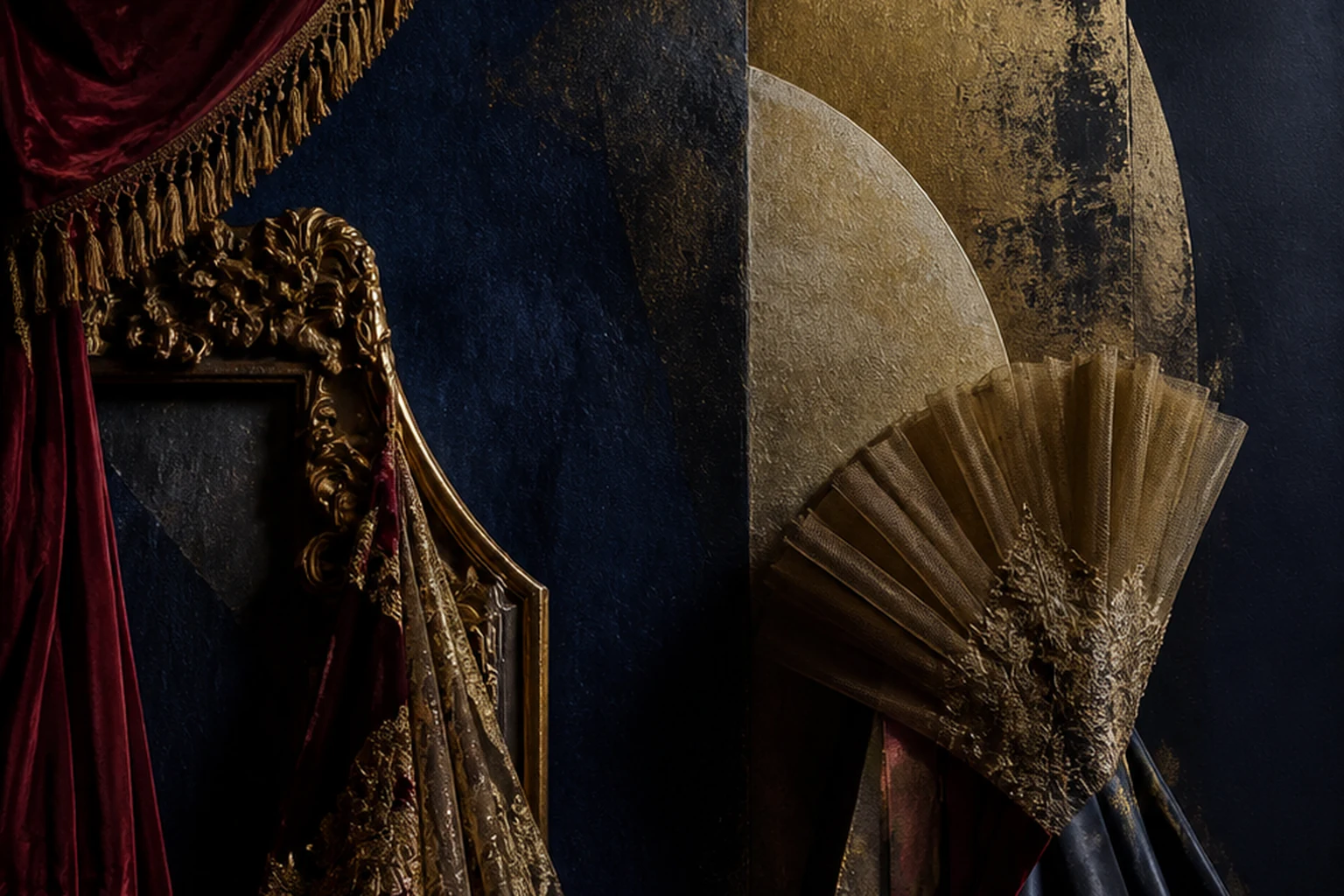
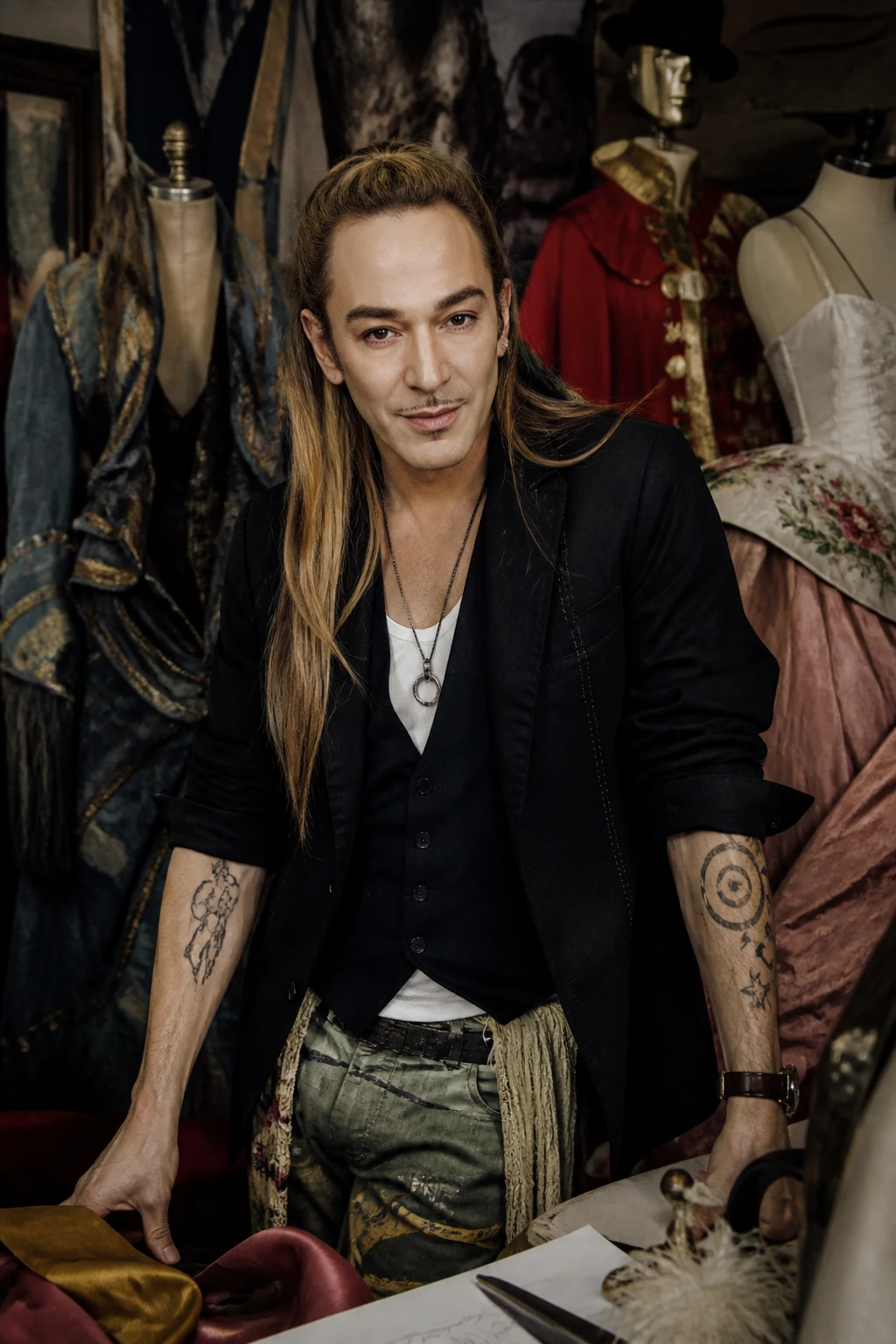
Galliano turned historic costume into a living system of translation. His collections worked like performances in which the study of an era, bias cutting, makeup, music, space and the model's image came together into a single world.
Editorial thesis
John Galliano's historical significance rests not only on theatricality. He joins deep research into costume, the technique of bias cutting, deconstruction, romantic dramaturgy and an ability to build a modern brand through narrative. His career also shows the limits of the cult of the creative director: outstanding professional influence does not cancel responsibility for public actions and the systemic risks of an industry built on the personality of a single author.
Reader question
How did a designer of Gibraltarian roots turn a graduation collection into an international career, redefine the image of Dior and later rethink the deconstructive legacy of Maison Margiela?
To present Galliano as a researcher of costume, master of cutting, director of shows and head of major houses. The material distinguishes the personal brand, the Givenchy, Dior and Maison Margiela periods, and examines the 2011 crisis without trying to separate the professional legacy from ethical responsibility.
The core subject is John Charles Galliano: his education, authorial method and work in fashion houses from 1984.
The history of Christian Dior and Maison Margiela is examined only within the bounds of his creative periods.
The 2011 scandal is described precisely and without softening; professional achievements are not used to justify the antisemitic statements.
The collections are treated as artistic, production and media systems, not as a sequence of costumes.
The definitions 'genius', 'romantic' and 'theatrical designer' are used as critical categories, not as a final assessment.
Archival images require a separate rights check.
Short answer
John Galliano was born on 28 November 1960 in Gibraltar and grew up in London. In 1984 he graduated from Central Saint Martins with the collection Les Incroyables, inspired by the French Revolution; it was bought by the London boutique Browns. In his own house Galliano developed a language based on historical research, romantic dramaturgy, complex cutting and the creation of characters.
In 1995 he became the first British designer to head the French haute couture house Givenchy, and in 1996 moved to Christian Dior. Over fifteen years at Dior he turned the shows into global cultural events and radically broadened the visual range of the house. After his dismissal in 2011 and a period of recovery, Galliano returned to professional work; in 2014 he was appointed creative director of Maison Margiela. There he joined his own theatrical language with deconstruction, the décortiqué technique and the memory of objects. His late period confirmed a capacity for transformation, but did not cancel the ethical assessment of the 2011 events.
1. Gibraltar, London and the formation of identity
John Charles Galliano was born on 28 November 1960 in Gibraltar into a family of Gibraltarian and Spanish roots. When he was a child the family moved to London.
The experience of cultural duality later became an important part of his language. Galliano constantly built images at the intersection of geographies, eras and social roles. He perceived identity not as a fixed essence but as a set of costumes, gestures and stories.
His public image was also theatricalised: the designer used clothing, makeup and posture as a way of managing his own visibility. This brought him close to the characters of the collections, but at the same time strengthened the cult of personality.
2. Central Saint Martins and Les Incroyables
In 1984 Galliano graduated from Central Saint Martins. His graduation collection Les Incroyables drew on the radical youth culture of the period after the French Revolution.
The collection joined historical reconstruction, asymmetry, romantic raggedness and a strong plasticity of fabric. Browns bought it for sale, which quickly drew press attention.
Les Incroyables formulated the essential method: study a specific historical system, isolate its characteristic gestures and translate them into a contemporary silhouette without literal museum copying.
3. The early collections and the crisis of his own house
After graduation Galliano founded his own brand. The early collections were highly praised by editors and buyers, but the company suffered a constant shortage of capital.
The designer changed financial partners several times, moved his activity between London and Paris and depended on the support of editors, models and private investors. This instability shows the gap between cultural success and sustainable production.
In the early 1990s Anna Wintour, André Leon Talley, Amanda Harlech, Stephen Jones and other members of the professional network played an important role. Galliano's career developed as a collective project despite the strong image of a solitary author.
4. Historical research as method
Galliano built collections through research boards, books, archives, film, painting and travel. A historical source became the basis of the character, colour, construction, gait and scenography.
He was interested not only in ceremonial costume but in the traces of time: wear, the mixing of cultures, theatrical wardrobes, military uniform, underwear and the clothing of marginal figures.
The strongest collections do not reproduce a single era. They create a fictional history in which factual details join artistic montage.
5. Bias cutting and the movement of fabric
One of Galliano's key technical foundations was bias cutting, connected with the legacy of Madeleine Vionnet. Fabric turned at an angle to the grain softly wraps the body and responds to movement.
Galliano used the technique for dresses that seemed at once historical and contemporary. Asymmetry, drapery and elongated lines allowed the fabric to form the image without a rigid outer construction.
The theatricality of his fashion rested on craft precision. Without a knowledge of material, the complex movements of the runway would have turned into visual chaos.
6. The character image and the model as actress
In Galliano's shows the model did not simply display the clothing. She received a role, an emotional state, a way of walking and sometimes a fragment of a fictional biography.
Such an approach strengthened the narrative, but could limit the model's autonomy: the body became part of the directorial system. In the best cases the image and the performer created a joint character; in the worst, individuality was subordinated to total control.
Casting, makeup, hair and gait were not secondary services but equal elements of the design.
7. Givenchy, 1995-1996
In 1995 Bernard Arnault appointed Galliano artistic director of Givenchy. He became the first Briton to head a French haute couture house.
The period was short but institutionally important. Galliano gained access to the couture ateliers, the archive and the international structure of LVMH. His debut showed how authorial romanticism could interact with the codes of an old house.
Already in 1996 he was moved to Christian Dior, and Alexander McQueen took over Givenchy. The short duration of the period does not allow it to be seen as a fully formed era.
8. Dior: the appointment and the first couture collection
In 1996 Galliano succeeded Gianfranco Ferré at Christian Dior. His first haute couture collection was presented in January 1997, when the house was celebrating its fiftieth anniversary.
Galliano did not literally repeat the New Look. He treated the archive as a system of gestures: an emphasised waist, a dramatic skirt, the flower, embroidery, theatrical femininity and the idea of travel.
The appointment coincided with the transformation of luxury houses into global cultural platforms. Dior needed an author capable of creating not only clothing but powerful media events.
9. Dior as a theatrical machine
Under Galliano the Dior shows turned into large-scale productions with sets, complex makeup, historical characters and cinematic dramaturgy.
The collections could be built around a traveller, a silent-film actress, a revolutionary, a circus heroine or a fictional aristocrat. The visual world was often much wider than the specific items sold.
This division became part of the modern luxury model: the show produced cultural attention, and accessories, fragrance and ready-to-wear turned that attention into business.
10. The newspaper print, Saddle and commercial codes
Galliano's period was not only a couture spectacle. It included the creation of strong commercial codes. The newspaper print became one of the symbols of the late 1990s and early 2000s.
The Saddle bag, launched by the house in 1999, used an asymmetrical form recalling a saddle. It became an example of an accessory that worked at once as a design object and a global product.
The creative director took part in visually redefining Dior as a young, sexual and media brand, although the success depended on a broad system of accessory designers, marketing and production.
11. Historical and cultural sources
Galliano turned to Europe, Asia, Africa, America, theatre and cinema. Such freedom created complex visual worlds, but at the same time raises the question of cultural appropriation.
Historical fashion long perceived non-European cultures as an accessible archive of the exotic. Contemporary analysis must distinguish research, fantasy, collaboration and the use of symbols without context.
The aesthetic complexity of a collection does not cancel the need to ask whose images are used, who controls the interpretation and what relations of power remain invisible.
12. Show, makeup, music and space
Galliano's shows were created through close collaboration with a team: stylists, makeup artists, hair artists, directors, musicians, models and lighting specialists.
Music organised the tempo and the emotional transition between images. Makeup could change age, social role and even the anatomical perception of the face.
Space served not as a neutral runway but as a stage: a railway station, an opera, a palace, an abandoned interior or a fantastical street set the way of reading the clothing.
13. Team, ateliers and collective labour
The cult of Galliano often hid a collective infrastructure. The couture models were created by premières, pattern-makers, tailors, embroidery houses and craft workshops.
Amanda Harlech, Stephen Jones, Pat McGrath, Orlando Pita and other regular collaborators played a key role in building the image.
It is more accurate to speak of strong artistic direction within a complex collective system. The authorial idea could be radical, but its material persuasiveness depended on hundreds of specialists.
14. The 2011 crisis and dismissal
In February 2011 Galliano was detained after an incident in a Paris café. Soon video recordings of his antisemitic and racist statements were published.
Dior suspended and then dismissed the designer. Later a French court found him guilty of public insults on grounds of origin and religion.
Alcohol and other addiction may explain a person's state, but does not cancel responsibility. The episode is part of the professional biography and must not be displaced by a story of creative talent.
15. Return to work
After the dismissal Galliano underwent treatment and gradually returned to professional activity. In 2013 he temporarily worked in the studio of Oscar de la Renta.
The return was accompanied by public debates about remorse, rehabilitation and the possibility of continuing a career after discriminatory statements.
This theme has no simple universal formula. The industry must at once consider responsibility, real changes in behaviour, the affected communities and the disproportionate power of the famous author.
16. Maison Margiela: a new institutional task
In October 2014 OTB appointed Galliano creative director of Maison Margiela. His first Artisanal collection was presented in January 2015.
The appointment joined two different authorial systems: Martin Margiela's anonymous deconstruction and Galliano's theatrical personality. The early seasons showed a tension between them.
Gradually Galliano abandoned direct quotation of his own Dior past and focused on the construction of clothing, the traces of production, recycling and the change of an object's identity.
17. Décortiqué, Recicla and the memory of construction
The décortiqué technique reveals or removes parts of a garment, leaving the structure visible: the frame, the lining, the seams and fragments of the surface.
Recicla, presented in Galliano's period, developed the idea of found vintage garments that were selected and given new labelling within the house's system.
These methods joined the Margiela memory of material with Galliano's interest in the character and transformation. An old garment became not simply raw material but the bearer of another's biography.
18. Artisanal and the late shows
In Artisanal Galliano received space for the most complex experiments. Hand production, found materials, painting, masks and deconstruction joined precise direction.
The late projects strengthened an interest in the perception of the face, gender ambiguity, bodily plasticity and the digital circulation of the image.
The strongest shows of this period demonstrate a change in Galliano himself: the spectacle remains important, but becomes less dependent on historical illustration and more focused on the process of transformation.
19. Influence on contemporary art direction
Galliano helped fix the model of the creative director as the author of a whole world. Today a major house expects not only a collection but a system of casting, campaigns, show design, visual history and cultural references.
His method is visible in editorial shoots, music videos, red-carpet fashion and shows in which the character matters more than the individual object.
Yet the total authorial system carries a risk: the success of the brand becomes dependent on a personality, and the workload and power concentrate on one person.
20. Myths and contested formulations
Galliano is often called exclusively a theatrical designer. This hides the technical foundation: bias cutting, work with proportion and deep knowledge of historic costume.
Another myth is the idea of his collections as pure individual fantasy. They arose through collective work and access to the resources of major houses.
Finally, the professional return does not mean that the 2011 crisis is 'closed'. The ethical assessment remains part of the history and must exist alongside the analysis of the design.
21. Conclusion: fashion as the translation of history
John Galliano made history not an archive of ready quotations but material for translation. He joined eras, bodies and cultural roles, creating images that looked at once familiar and impossible.
His best works are held together not by decoration but by construction. Cutting, fabric and movement allow the character to exist physically, not only as illustration.
His career also shows a contradiction of contemporary fashion: the industry can create outstanding culture and at the same time concentrate excessive power around a single author. Analysing Galliano therefore requires both aesthetic precision and ethical memory.