designer profile
Karl Lagerfeld
The author of a visual empire: how drawing, the archive, photography and parallel work for several houses formed the model of the contemporary creative director

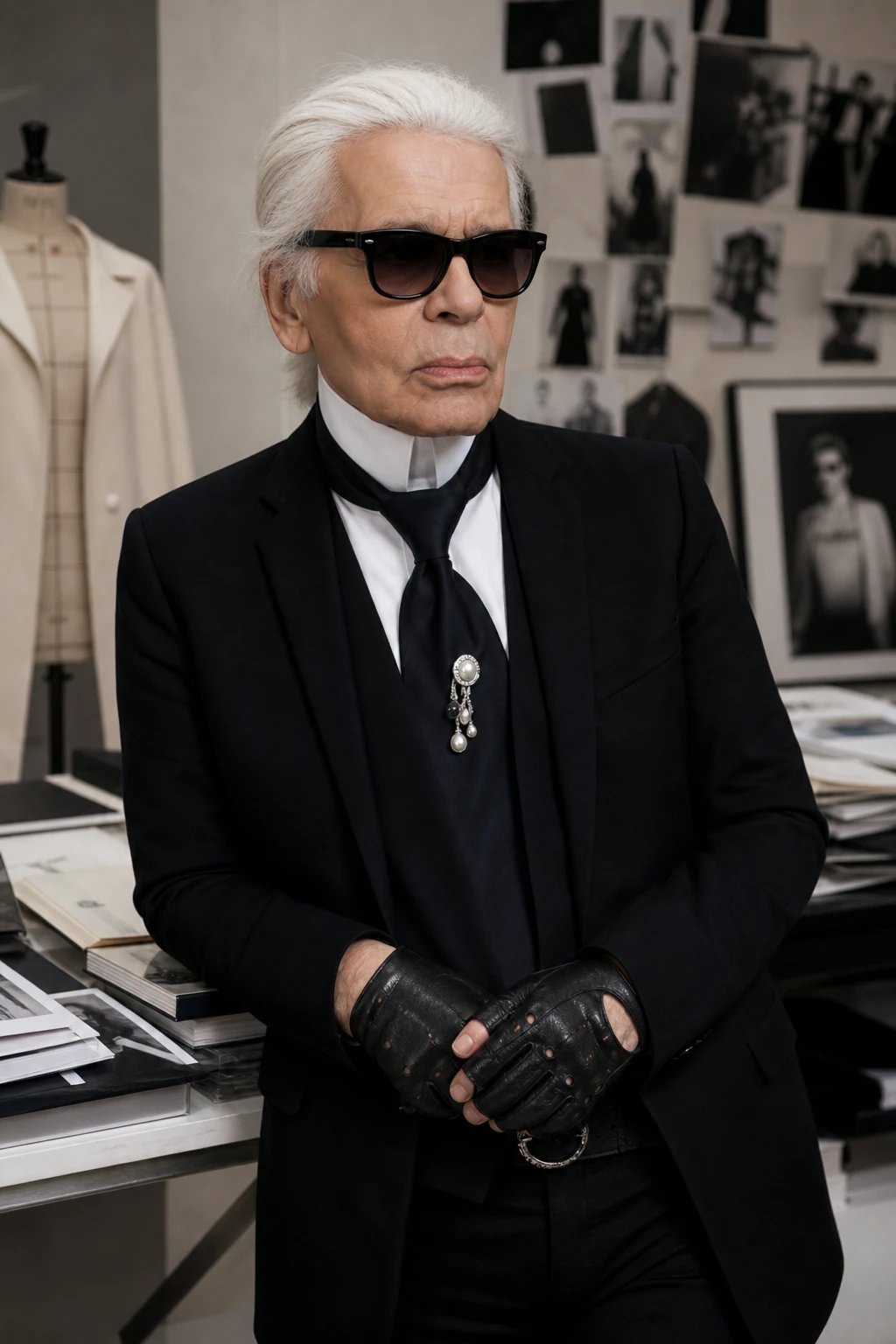
Lagerfeld turned legacy from a museum constraint into a production system: the archive could be quoted, enlarged, ironised and reintroduced into mass culture — season after season.
Editorial thesis
Karl Lagerfeld's historical significance is defined not by a single style and not only by the revival of Chanel. He created a way of working in which the designer at once manages the archive, the product, the show, the advertising image, his own public figure and several parallel brands. His method joined technically precise drawing, visual memory, speed of production, irony and commercial discipline. This system became the prototype of the contemporary creative director of a global luxury house.
Reader question
How did a designer working at once for Chanel, Fendi, Chloé and his own brand learn to turn legacy into a constantly renewed language — and at what cost was this unprecedented productivity achieved?
To trace Lagerfeld's career as a history of labour, drawing, archival thinking, photography, brand management and the creation of a public image. The material distinguishes his contribution to different houses, does not attribute corporate decisions to him alone, and separately examines his contested public statements.
The core subject is Karl Otto Lagerfeld and his professional practice from 1954 to 2019.
Chanel, Fendi, Chloé and Karl Lagerfeld are treated as different institutions with different owners and teams.
The date of birth was long a subject of confusion in historical publications; the article uses 10 September 1933, adopted by The Metropolitan Museum of Art.
The formula 'revived Chanel' is used as a shorthand for a complex process that included the owners, management, ateliers and métiers d'art.
His public statements about the body, age, migration and the #MeToo movement are examined critically and are not mixed with the assessment of the design.
The media plan is separated from the text: the use of archival images requires a rights review.
Short answer
Karl Lagerfeld was born in Hamburg in 1933 and moved to Paris in the early 1950s. In 1954 he received the International Wool Secretariat prize for a coat sketch; soon Pierre Balmain hired him as an assistant. After working at Jean Patou he chose the model of the independent designer and collaborated with several houses at once. In the Chloé of the 1960s and 1970s he created an intellectual, fluid ready-to-wear; from 1965 began an almost sixty-year collaboration with Fendi, where he rethought fur as a light, experimental material.
In 1983 Lagerfeld became artistic director of Chanel. He did not try to restore Gabrielle Chanel's clothing literally: he enlarged the logos, shortened the skirts, mixed tweed with denim, plastic and sporting codes, turning the archive into an open grammar. In parallel he developed his own brand, shot campaigns as a photographer, created books, films and large-scale show sets. His career lasted about 65 years and formed the model of the designer-impresario who manages not a single collection but a whole media system. He died on 19 February 2019 in Paris.
1. Hamburg, the family and a self-invented biography
Karl Otto Lagerfeld was born on 10 September 1933 in Hamburg into the wealthy family of the entrepreneur Otto Lagerfeldt and Elisabeth Bahlmann. His father was connected with the production and sale of condensed milk; the family's material independence allowed the future designer to focus early on languages, reading, drawing and the history of art.
Lagerfeld deliberately managed his own biography. He changed the details of his age, origin and family history, avoiding a fixed image of the past. Biographical material about him therefore requires more caution than an ordinary chronology: self-staging was part of his professional method, not only a habit of hiding his age.
As a teenager he perceived Paris as a centre of fashion, art and publishing culture. The move to France was not a romantic escape but a strategic entry into an industry in which drawing could become a professional language.
2. Paris and the International Wool Secretariat competition
In 1954 Lagerfeld took part in the International Wool Secretariat competition and received an award in the coat category. In the same competition system the young Yves Saint Laurent won in the dress category. This episode is often presented as a symbolic meeting of future rivals, yet its immediate significance was practical: Lagerfeld's drawing was seen by couture professionals.
Pierre Balmain realised the awarded coat and invited Lagerfeld into the house. The competition demonstrated one of his chief abilities — to translate an idea into a drawing expressive enough for an editor and precise enough for an atelier.
3. Balmain and Jean Patou: the school of couture
At Balmain Lagerfeld worked as an assistant, observing the full cycle of Parisian couture: the development of the collection, interaction with the premières, fittings, the selection of fabrics and work with clients. In 1958 he moved to Jean Patou and created collections under the name Roland Karl.
The critical reception of the early collections was mixed. This period matters not as an early triumph but as an understanding of the limits of the post of staff couturier. Lagerfeld soon chose a more flexible model in which he could sell ideas and collections to several companies.
4. The independent designer as a new professional model
In the 1960s Lagerfeld became one of the early notable freelance designers of high fashion and ready-to-wear. He collaborated with Krizia, Tiziani, Charles Jourdan and other companies, without tying his career to a single institution.
This parallelism later became his distinctive quality. He knew how to separate the visual vocabularies: the romantic fluidity of Chloé was not the same language as Fendi's experimental fur or Chanel's archival pop system. The independent model taught him to recognise quickly the core of a brand and to produce variations without losing identity.
5. Chloé: the freedom of ready-to-wear
Lagerfeld began collaborating with Chloé in the 1960s and by the mid-1970s became the principal author of the house's visual language. Chloé offered designer ready-to-wear at a moment when high fashion was losing its monopoly on cultural influence.
His collections joined soft dresses, historical allusions, art deco, Surrealism and contemporary lightness. A emblematic example was the 1983 dress with the shower motif: an object of everyday infrastructure turned into a witty construction of the surface.
After a long break Lagerfeld returned to Chloé in 1992. The second period confirmed that he perceived the brand not as a personal style but as a role that could be reactivated in another cultural situation.
6. Fendi: fur as a laboratory of material
The collaboration with the Roman house of Fendi began in 1965 and continued until the designer's death. It is one of the longest alliances between a fashion house and a creative head. Lagerfeld is credited with creating the double F sign, connected with the formula Fun Fur.
At Fendi he contested the idea of fur as a heavy, conservative symbol of status. The material was sheared, dyed, turned, perforated, combined with fabric and lightened. Fur became a surface for experiment, not only a demonstration of value.
Contemporary ethical criticism of the fur industry requires a separate context. The historical innovation of material processing does not cancel the questions of animal welfare and the environmental impact of production.
7. 1983: arriving at Chanel
In 1983 Lagerfeld was appointed artistic director of Chanel. The house kept its symbolic weight, but after the death of Gabrielle Chanel in 1971 its fashion direction needed a new authorial impulse. Chanel's official history connects Lagerfeld's arrival with the renewal of haute couture, the creation of contemporary ready-to-wear and the later development of Cruise and Métiers d'art.
Lagerfeld understood that literal restoration would not return cultural relevance to the house. Instead he took the legacy apart into recognisable elements: tweed, the chain, the camellia, pearls, the two-tone shoe, the quilted surface and the double C. He then began to change the scale, material and context of each sign.
8. The archive as an open grammar
Lagerfeld's method at Chanel can be described as a grammar rather than a set of copies. The archival elements kept their recognisability, but their relations changed. Tweed turned into a mini-dress or a sports jacket; the chain became jewellery, a belt or a print; the logo grew into an independent graphic form.
The Metropolitan Museum of Art stresses that he joined the house's iconography with new technologies and unorthodox materials. This strategy allowed Chanel to look at once historical and immediately contemporary.
Irony was an important instrument. Lagerfeld did not treat the legacy as a shrine that must not be touched. He believed that a house survives only when its symbols continue to circulate and change.
9. Tweed, chains, the camellia and the double C
Lagerfeld strengthened Chanel's sign quality. The contrasting trim, the gold chain, layered pearls and the camellia became so prominent that a garment could be recognised from afar or in movement.
This decision answered the media culture of the 1980s and 1990s. Fashion had to work not only in the salon and the magazine but on television, the red carpet, in the music video and later on the internet. A large sign turned clothing into an easily circulated image.
The risk lay in turning the code into logomania. Lagerfeld deliberately worked on this boundary: sometimes pushing recognisability to caricature, then returning to an almost silent couture construction.
10. Haute couture and the métiers d'art
Alongside ready-to-wear Lagerfeld sustained couture as a laboratory of form and handwork. At Chanel the artistic idea could rely on specialised houses of embroidery, feathers, flowers, shoes, hats and decorative hardware.
From 1985 Chanel began acquiring individual métiers d'art; in 2002 the first special Métiers d'Art collection was presented, stressing their contribution. This process cannot be attributed to the designer alone, but Lagerfeld gave the craft infrastructure public visibility and a contemporary narrative.
His sketch was the linking instrument between an abstract idea and a multitude of workshops. The rapid drawing contained the silhouette, movement and technical instructions comprehensible to a première d'atelier.
11. The show as mass media
Lagerfeld turned the Chanel show into an autonomous media event. The space of the Grand Palais became a supermarket, an airport, a beach, a rocket launch site, a data centre or an urban street. The set did not simply decorate the collection: it created a single easily retold idea of the season.
Scale served the economy of attention. Images of the sets spread faster than a detailed analysis of the clothing, and the brand received a global story for the press and social platforms.
At the same time the spectacle could overshadow the design itself and normalise the excessive production of temporary sets. The legacy of these shows should be assessed at once as the development of fashion communication and as a symptom of the growing resource intensity of luxury.
12. Drawing as an operating system
The Met exhibition Karl Lagerfeld: A Line of Beauty focused on his drawing practice. For Lagerfeld the sketch was at once an expressive image and a detailed instruction for the ateliers.
He drew quickly, using lines of different density, colour washes, annotations and abbreviations. The premières learned to read this personal code and turn it into three-dimensional clothing. The speed of the drawing supported an unprecedented number of annual collections.
Drawing also allowed him to work in parallel: the visual systems of the brands were stored not only in the archive but in his motor memory. The line became an interface between historical knowledge, an instantaneous decision and collective production.
13. Karl Lagerfeld: his own brand
His own brand gave Lagerfeld a space in which he could work without the need to translate another house's legacy. In different periods the company changed owners and positioning, and the visual language became increasingly tied to the designer's own public image.
The black suit, white high collar, fingerless gloves and the profile with a ponytail turned into a graphic sign. This made the figure of the author a commodity code: the designer's silhouette could exist on packaging and accessories independently of a specific collection.
Such personalisation anticipated the creator-brand economy, but created a problem of continuity: what remains of a brand when its principal image is tied to an absent person?
14. H&M 2004 and the designer collaboration
In 2004 Karl Lagerfeld created a collection for H&M. The project became one of the key early examples of a global collaboration between mass retail and a luxury-level designer, and formed the model that numerous brands later repeated.
The collection promised temporary access to a designer name at a mass price. At the same time it strengthened the culture of scarcity, queues and fast consumption. Lagerfeld publicly criticised the expansion of the size range, which became one of the examples of the contradiction between the idea of democratising design and his own statements about the body.
15. Lagerfeld as photographer
From the late 1980s Lagerfeld systematically shot advertising campaigns, catalogues and editorial projects. Chanel's official chronology records his first campaign for the house as a photographer in 1987-1988.
Photography gave him control over the final interpretation of the clothing. He defined not only the collection but the light, pose, casting, set and the way the image circulated. In this way the function of the creative director expanded from the product to the full visual cycle.
His photographic works differed in quality and degree of independence, but institutionally they were important: the brand's author became at once producer and editor of his own image.
16. Books, publishing and the library
Lagerfeld was a passionate book collector. The Met reports that his personal library numbered more than 300,000 volumes. He founded the bookshop 7L and a publishing direction, and worked with photographic albums and cultural publications.
The books were not the decoration of an intellectual image but a working infrastructure. Historical costumes, architecture, illustration, photography and typography supplied material for the collections. His memory functioned as a rapidly accessible visual archive.
This way of working shows the difference between knowledge and direct quotation: Lagerfeld could use the structure of an eighteenth-century sleeve or the composition of an old engraving without turning the collection into a reconstruction.
17. The public image: white collar, gloves and dark glasses
Lagerfeld's own appearance gradually turned into a disciplined uniform. White hair, the ponytail, a stiff collar, a narrow black suit, dark glasses and gloves created an easily reproducible silhouette.
This image solved several tasks: it hid his age, separated the private person from the public role and made the designer recognisable in mass culture. He became a character, a caricature and a logo at once.
Self-invention was not an external addition to the work. It demonstrated Lagerfeld's essential principle: identity can be constantly edited if a clear system of signs is preserved.
18. Muses, models and the system of images
Lagerfeld built long creative relationships with models, actresses and cultural figures: Inès de La Fressange, Claudia Schiffer, Stella Tennant, Kristen McMenamy, Vanessa Paradis, Cara Delevingne and others.
The term 'muse' can hide the professional work of the model, so it is more accurate to treat these connections as a system of jointly producing an image. A face helped fix a certain period of the brand, and the designer provided the platform and the visual role.
For Lagerfeld casting was a way of tuning a historical code to a contemporary generation. A new type changed the perception of an old form even without a radical change of construction.
19. Speed, parallelism and the price of productivity
Lagerfeld's career spanned about 65 years and many annual collections. Such productivity was possible thanks to drawing, memory, a strict regime, delegation and the stable teams of the ateliers.
The myth of the man who 'did everything himself' distorts reality. Behind every project stood premières, studio teams, artisans, producers, casting directors, photographic assistants and management. His peculiarity lay not in replacing the system but in an ability to direct it extremely quickly.
This model influenced the industry, but at the same time raised expectations of the pace of creative directors. Contemporary debates about burnout and the excessive fashion calendar are part of the critical legacy of this era.
20. Contradictions and criticism
Lagerfeld's public speech was often built on provocation. He made derogatory comments about weight, age, appearance, migrants and the #MeToo movement. These statements cannot be justified by historical context or the author's status.
Critical analysis must distinguish the designer's formal influence from the social consequences of his public power. The industry long perceived offensiveness as part of the 'witty' image of the genius, reflecting a wider culture of impunity around influential creative leaders.
Moreover, his work is connected with the questions of fur, hyperproduction, idealised standards of the body and the concentration of authorship. These contradictions do not cancel the achievements, but change the way they are read today.
21. The final collections and death
In his final years Lagerfeld continued to lead Chanel, Fendi and his own brand. His absence from the finale of the Chanel couture show in January 2019 became the first public signal of failing health.
Karl Lagerfeld died on 19 February 2019 in Paris. At Chanel his successor was Virginie Viard, who had worked beside him for many years; at Fendi the further development of the women's line also required a redistribution of creative roles.
His death showed the dependence of the luxury system on a public figure and at the same time the resilience of the collective infrastructure. The houses continued to work, but the single author linking the collections, campaigns and spectacle disappeared.
22. Legacy and the limits of the designer-impresario model
The Met defines Lagerfeld as one of the principal prototypes of the contemporary designer-impresario. He proved that a creative director can manage several aesthetic systems and turn the archive into a long-term source of modernity.
His legacy includes the renewal of Chanel, the technological work with fur at Fendi, the development of Chloé, the institutionalisation of large-scale shows, authorial fashion photography and a new level of the designer's publicity.
The limits of this model are also obvious: the cult of the indispensable author, the accelerated calendar, logomania, dependence on spectacle and the normalisation of harsh public power. Studying Lagerfeld matters not for repeating the whole system but for understanding how contemporary fashion became at once design, media and a global production of attention.