designer profile
Martin Margiela
Deconstruction, anonymity and clothing as a system of time
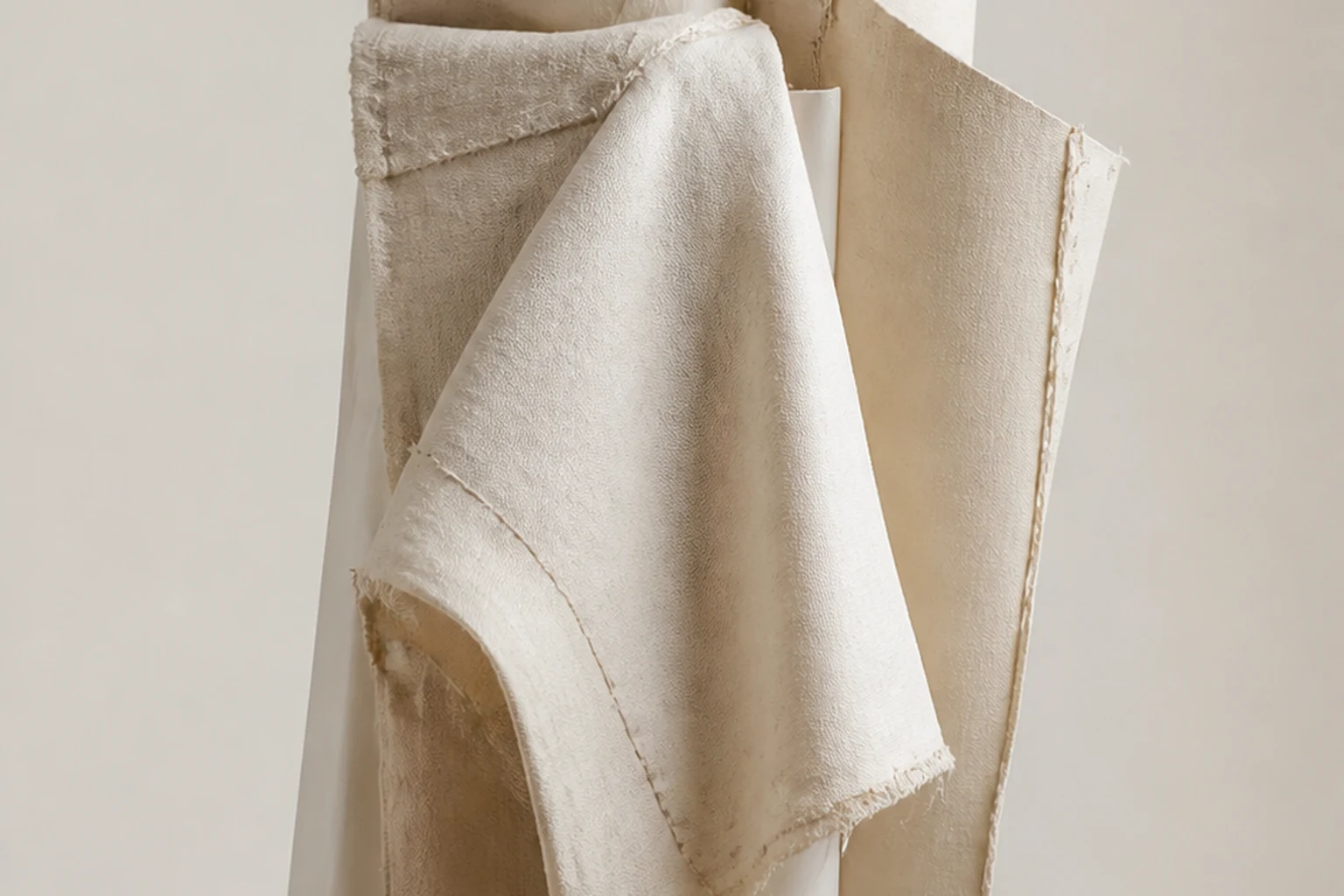
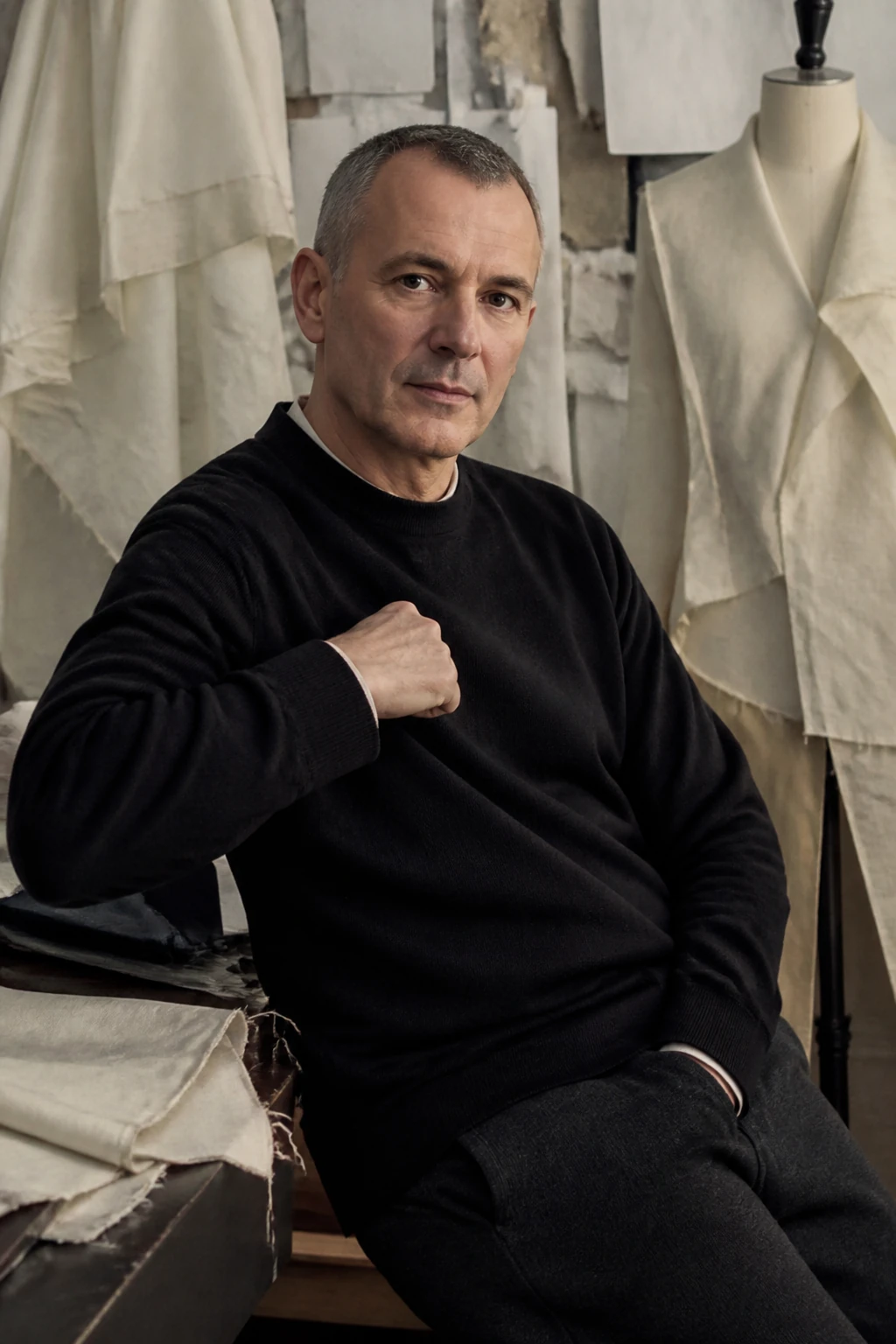
Margiela changed fashion not by proposing a new decorative style. He made visible the structure of clothing, the time of its production, the traces of a previous life and the very system that usually hides collective labour behind the name of a single author.
Editorial thesis
Martin Margiela's significance rests not on a single device of deconstruction. He consistently investigated the archetype of clothing, the scale of the body, the traces of wear, reuse, anonymity and collective authorship. Maison Martin Margiela turned the inner construction of a garment, the production process and imperfection into a full visual language. The parallel work for Hermès proved that the same method can appear not only through a radical gesture but through comfort, durability and an almost imperceptible precision.
Reader question
How did a Belgian designer turn seams, lining, old clothing, an enlarged scale and the refusal of a public image into one of the most influential systems of contemporary fashion?
To trace Margiela as designer, researcher of clothing, co-founder of the house, author of shows and later artist. The material distinguishes the personal biography, the collective work of Maison Martin Margiela, the Hermès period and the history of the brand after the founder's departure.
The core subject is Martin Margiela: his professional activity from the late 1970s until his departure from fashion and his subsequent work in contemporary art.
Maison Martin Margiela is treated as a joint institution of Margiela, Jenny Meirens and the team, not as the product of a single isolated genius.
The active brand Maison Margiela after the founder's departure is included only as context and requires a separate article.
The term 'deconstruction' is used as an analytical designation, not as an exhaustive description of the whole method.
Claims of 'firstness' for recycling, upcycling or anonymity are formulated cautiously and do not displace earlier historical practices.
Archival images are not embedded: they require a separate rights check.
Short answer
Martin Margiela was born in 1957 in Leuven, studied at the Royal Academy of Fine Arts Antwerp and graduated from its fashion department in 1980. After independent work he was an assistant to Jean-Paul Gaultier in Paris from 1984 to 1987. In 1988, together with the entrepreneur Jenny Meirens, he founded Maison Martin Margiela. The first collection was shown in October of the same year, and the spring-summer 1989 season fixed the main elements of the house's language: an elongated silhouette, narrow shoulders, the Tabi, white, visible traces of production and the rejection of the traditional cult of personality.
Margiela turned clothing inside out, enlarged the patterns to the scale of a size 78 mannequin, assembled new clothes from old gloves, socks, plates, belts and vintage objects, reproduced found archetypes in the Replica line and turned the trace of time into part of the design. From 1997 to 2003 he created women's ready-to-wear for Hermès, where instead of demonstrative deconstruction he developed a slow wardrobe based on quality, comfort and bodily freedom. In 2008-2009 he left his own house and the fashion industry. From 2021 Margiela has worked publicly as an artist, keeping an interest in the body, traces, material and the disappearance of the author.
1. Leuven, Hasselt and Antwerp
Martin Margiela was born on 9 April 1957 in Leuven, Belgium, into a family of Polish and Belgian roots. As a teenager he studied at the Sint-Lukas art school in Hasselt, and in 1977 entered the fashion department of the Royal Academy of Fine Arts in Antwerp. He graduated from the academy in 1980.
His education fell at a period when Belgian fashion did not yet have an international status. The Antwerp academy gave a strong foundation in drawing, construction and the historical analysis of clothing, but did not offer a ready industrial model. For Margiela this absence of a stable national canon became an advantage: he perceived the history of costume as material that could be taken apart, enlarged and reassembled.
Margiela is often automatically included in the Antwerp Six. Chronologically he studied alongside that generation, but he was not part of their famous trip to London in 1986 and developed a separate career. It is more accurate to speak of him as an author connected with the Antwerp school but not part of the Antwerp Six group itself.
2. The Academy and the generation of Belgian fashion
At the academy Margiela studied not only the creation of a new silhouette but also the construction of historical clothing. His collections later constantly returned to the archetypes: the jacket, the trench, the evening dress, the glove, the work coat, the army sock and the museum object.
His method differed from the futuristic idea of a complete break with the past. He did not discard history but showed that contemporary clothing already consists of repetitions, translations and traces of previous forms. Hence arose his interest in the replica, vintage, the enlargement of an old pattern and the display of the inner construction.
The connection with the Belgian school appeared in an intellectual discipline, a restrained presentation and a distrust of superficial glamour. Yet Margiela's language quickly became independent and Parisian by context.
3. Jean-Paul Gaultier: training within the Parisian system
After his studies Margiela worked as an independent designer in Belgium and Italy. In 1984 he moved to Paris and became Jean-Paul Gaultier's first assistant, staying in his studio until 1987.
Gaultier also explored archetypes, underwear, the male and female body, mass culture and historical costume. But where Gaultier often turned the quotation into a bright spectacle, Margiela later strove for reduction, anonymity and the exposure of construction.
Working in a successful Parisian house gave him a practical knowledge of seasonal production, shows, the press, suppliers and the commercial structure. His subsequent radicalism arose not from outside the industry: he understood well the mechanism he intended to criticise.
4. Jenny Meirens and the founding of Maison Martin Margiela
In 1988 Martin Margiela and the Belgian entrepreneur Jenny Meirens founded Maison Martin Margiela in Paris. Meirens was not only a business partner: she took part in forming the language of communication, anonymity, labels, packaging and ways of showing.
In the history of the house her role long remained less visible than the designer's name. Contemporary research stresses that Maison Martin Margiela was from the start a collective project. Its visual system arose from the interaction of Margiela, Meirens and the team.
The name of the house kept the full name of the author, but the public behaviour contradicted the standard logic of the personal brand. The company used the first-person plural, rarely singled out individual employees and created the feeling of a shared laboratory.
5. The first show and the new silhouette
The first collection of Maison Martin Margiela was presented in Paris in October 1988 and belonged to spring-summer 1989. The show formulated a key break with the power dressing of the 1980s: instead of wide shoulders and demonstrative expense appeared elongated proportions, narrow shoulders, long sleeves, unfinished edges and Tabi shoes.
The white cloth of the runway was covered with red paint from the soles of the Tabis. The traces of the models became part of the event, and could then be used as material for new garments. Here already clothing, process and documentation joined into a single system.
The new silhouette was not simply anti-glamour. It changed the scale of the perception of the body: the arms seemed longer, the shoulders narrower, and the clothing sometimes looked as if it had been found, unfinished or had lived a previous life.
6. Anonymity as an organisational principle
Margiela almost never appeared before the public, did not take a bow after the shows and avoided portrait communication. Answers to the press were often sent on behalf of the collective. Anonymity was not a complete disappearance: the name remained in the title of the house and created a strong cultural myth.
The principal function of the anonymity lay in shifting attention from the designer's personality to the clothing, the team and the process. It also served as a critique of the fashion system that turns the author into a celebrity and hides the labour of the ateliers.
Over time the absence of a public face itself became a recognisable brand code. Margiela's anonymity therefore contains a contradiction: the refusal of a personal image strengthened interest in the personality and made invisibility one of the strongest elements of the house's marketing.
7. White, four stitches and the numerical label
White was used by Maison Martin Margiela as a work surface, a neutral layer and a way of showing time. Furniture, walls, packaging and objects could be covered with white paint that gradually cracked and revealed the previous life of the material.
An empty white label was attached with four visible white stitches. From the outside they worked as a barely perceptible sign for the knowing viewer. The label could be unstitched, which stressed the secondary nature of the usual logo.
The house later introduced a numerical system of lines: a group of numbers from 0 to 23 was printed on the label, and the appropriate line was marked with a circle. This system joined classification, enigma and the rejection of the traditional hierarchy of branding.
8. Tabi: the footprint as a sign
The split-toe Tabi was presented in the first collection and became the house's most durable object. The source was Japanese work footwear with a separated big toe, connected with the traditional tabi socks and jika-tabi footwear.
Margiela turned a functional form into a high heel and a fashionable ankle boot. The Tabi at once recalls a hoof, the trace of a bare foot, a historical object and industrial footwear. Its recognisability rests on the change of a single fundamental detail — the contour of the foot.
It is important not to describe the Tabi as a neutral 'invention' of Margiela: he adapted an existing Japanese form. The authorship refers to the translation of this archetype into a specific system of Western fashion, not to the origin of the split toe.
9. Deconstruction: showing the construction of a garment
Maison Martin Margiela turned clothing inside out, left seams, linings, darts, shoulder pads, tacking and raw edges on the outside. What traditional technique must hide became the main surface.
Such a device is often called deconstruction. The term is useful because it describes the dismantling of the habitual structure and the disturbance of the hierarchy between the face and the reverse. But it does not exhaust the method: Margiela also reproduced classic garments with high precision, worked with craft and created a functional wardrobe.
The display of the inner construction had an ethical dimension. Clothing ceased to look like an instantaneously formed image and began to testify to the labour, time, fitting and production decisions.
10. Recycling, Artisanal and the time of material
Margiela created garments from old gloves, army socks, belts, plastic bags, broken plates, vintage dresses and other found objects. In the 1990s this practice was formalised as the Artisanal line, later receiving the number 0.
The material kept the signs of its previous function. The gloves remained recognisable inside the waistcoat, and the fragments of porcelain were not disguised as a new neutral decoration. Recycling was not only an ecological gesture but a way of making time visible.
One cannot claim that Margiela was the first in history to use the reuse of materials. Similar practices existed in folk costume, poor fashion, assemblage art and punk culture. His contribution lies in systematically including these methods in the structure of Parisian designer fashion.
11. Replica: copying without the illusion of originality
In 1994 Maison Martin Margiela presented the Replica line. Found garments and accessories from different countries and periods were carefully reproduced, and a special label indicated the type of the original, its origin and its approximate date.
Replica questioned the cult of absolute newness. The house did not hide the copying but turned the origin of the sample into part of the product. The replica did not pass itself off as a museum original, but kept its character, proportions and the trace of the cultural context.
This system also showed that a basic wardrobe forms through a long collective evolution. Many garments do not belong to a single great author: they are perfected through use and repetition.
12. Oversize and the scale of size 78
In the collections of the late 1990s Margiela explored the scale of an Italian size 78 tailoring mannequin. The usual constructions were enlarged to unfamiliar proportions, and the body found itself inside the garment as inside an outer shell.
Oversize here was not simply a loose fit. The patterns, seams, shoulders and details were enlarged, which made the very process of scaling visible. A person looked smaller than the standard model on the basis of which clothing is usually designed.
This device criticised the idea of a single normative body. It also brought clothing closer to architecture and scenography, in which not only the contour of the figure matters but the space between the body and the shell.
13. The show as a social space
Maison Martin Margiela held shows in car parks, warehouses, the metro, abandoned spaces and on wasteland. Especially famous is the spring-summer 1990 show on a playground in a Parisian neighbourhood, where the local children took part in the event.
The choice of the place broke the distance between exclusive fashion and the urban environment. The guests could stand without fixed places, the children moved beside the models, and the imperfect ground became part of the visual language.
These shows should not be romanticised as automatic democratisation: professional fashion remained a closed system. But they widened the idea of where a show can take place and what people are able to influence its atmosphere.
14. Body, mask and the hidden face
The models of Maison Martin Margiela often had their faces covered with fabric, hair, masks or enlarged accessories. The face — the principal carrier of individuality and commercial appeal — ceased to organise the image.
Hiding the face shifted attention to the clothing and the movement of the body, but also created a disturbing effect of depersonalisation. Margiela explored the tension between anonymity, protection, fetish and the turning of a person into a carrier of a construction.
In the late collections wigs, hair and masks became an independent material. The body could look like a mannequin, an archival object or a surface for the traces of another's identity.
15. Hermès, 1997-2003: the quiet side of the method
In 1997 Jean-Louis Dumas appointed Margiela designer of the women's ready-to-wear at Hermès. The appointment seemed unexpected: a radical author came to a house associated with traditional craft and expensive materials.
For Hermès Margiela developed a slowly changing wardrobe. He used cashmere, leather, precise knitwear, detachable elements, adjustable fastenings and layering. The principal criteria became comfort, quality and long-term use.
The Hermès period shows that his method cannot be reduced to visible seams and found objects. It could be almost invisible: remove superfluous decoration, let the material age, give the body freedom and create things that do not depend on rapid seasonal obsolescence.
16. Team, collective authorship and Jenny Meirens
Maison Martin Margiela used collective speech and hid the hierarchy, but this does not mean an absence of authorial direction. Margiela defined the concept, silhouette and methods, and the team realised the complex system of research and production.
Jenny Meirens formed a significant part of the business and communication model. She is credited with an important role in the empty label, the numerical system, the unconventional invitations and the rejection of traditional advertising.
Recognising her contribution helps correct the widespread myth of a wholly solitary author. The house was a laboratory in which a radical idea became a stable organisation through joint work.
17. The sale of the stake and departure from Maison Martin Margiela
In 2002 the controlling stake of Maison Martin Margiela was acquired by the OTB group of Renzo Rosso. Margiela continued to work for several more years, but the relations between the house's authorial culture and the new corporate structure gradually changed.
After the house's twentieth anniversary in 2008 the designer decided to leave. Museum sources usually date the end of his participation to the period 2008-2009. After his departure the house worked for a time under the leadership of an anonymous creative team.
The departure matched the logic of his career: instead of publicly transferring power and turning his own personality into a permanent symbol of the brand, Margiela disappeared from the system. Yet the precise internal chronology of the decisions remained for a long time a subject of discussion.
18. After fashion: visual art
After his departure Margiela did not stop creative work but changed the institutional environment. He worked on objects, drawing, photography, sculpture and spatial installations.
In 2021 Lafayette Anticipations in Paris presented his first solo exhibition as an artist. The project occupied all the spaces of the foundation and continued the themes familiar from fashion: the body, hair, skin, traces of use, scale, disappearance and the transformation of ordinary material.
The transition to art should not be described as a complete break. Many of the art works develop the questions present in the clothing, but free them from the function of the wardrobe and the seasonal production system.
19. Influence on the contemporary industry
Margiela's methods have become part of the common vocabulary of fashion: visible seams, the reconstruction of vintage, oversized, anonymous branding, unconventional venues, masks, archival replicas and the turning of the process into content.
The wide spread of these devices sometimes erases their original critical meaning. A visible seam can become a decorative effect, and upcycling a marketing category without a real reduction of production.
Margiela's legacy appears most precisely not in copying the Tabi or the white paint but in the question to the system: why is a garment constructed in this way, whose time and labour does it hide, how does it age and is it possible to create the new through a careful reading of what already exists.
20. Myths and contested formulations
Margiela is often called a wholly unknown person without photographs or interviews. In reality his biography and professional connections are known, images of different periods exist, and after leaving fashion he took part in projects and publications. It is more accurate to speak of a deliberate limitation of publicity.
The formula 'founder of deconstruction' also excessively simplifies the history. The dismantling and display of construction existed in punk, the Japanese avant-garde, art and experimental costume. Margiela created his own consistent system and made it influential within Paris.
Finally, the idea of the poverty of the materials should not hide the high level of execution. Even the garments from found objects required complex handwork, time and professional knowledge.
21. Conclusion: clothing as proof of time
Martin Margiela made clothing proof of its own origin. The seam testified to the assembly, the wear to the previous life, the enlarged pattern to the standard of the industry, the white paint to the ageing of the surface, and the replica to the existence of the original.
His anonymity did not eliminate authorship, but forced the fashion system to discuss collective labour and the cult of personality. His recycling did not solve the ecological problems of the industry, but changed the attitude to old material and the aesthetic of the trace.
Margiela's chief legacy is an ability to turn doubt into a design method. He did not ask only what a new thing should be. He asked why fashion demands newness, what it hides and whether the future can be built from already existing forms.