designer profile
Miuccia Prada
Intellectual fashion and the aesthetic of contradiction: how nylon, the uniform, 'wrong' beauty, architecture and contemporary art changed the language of luxury
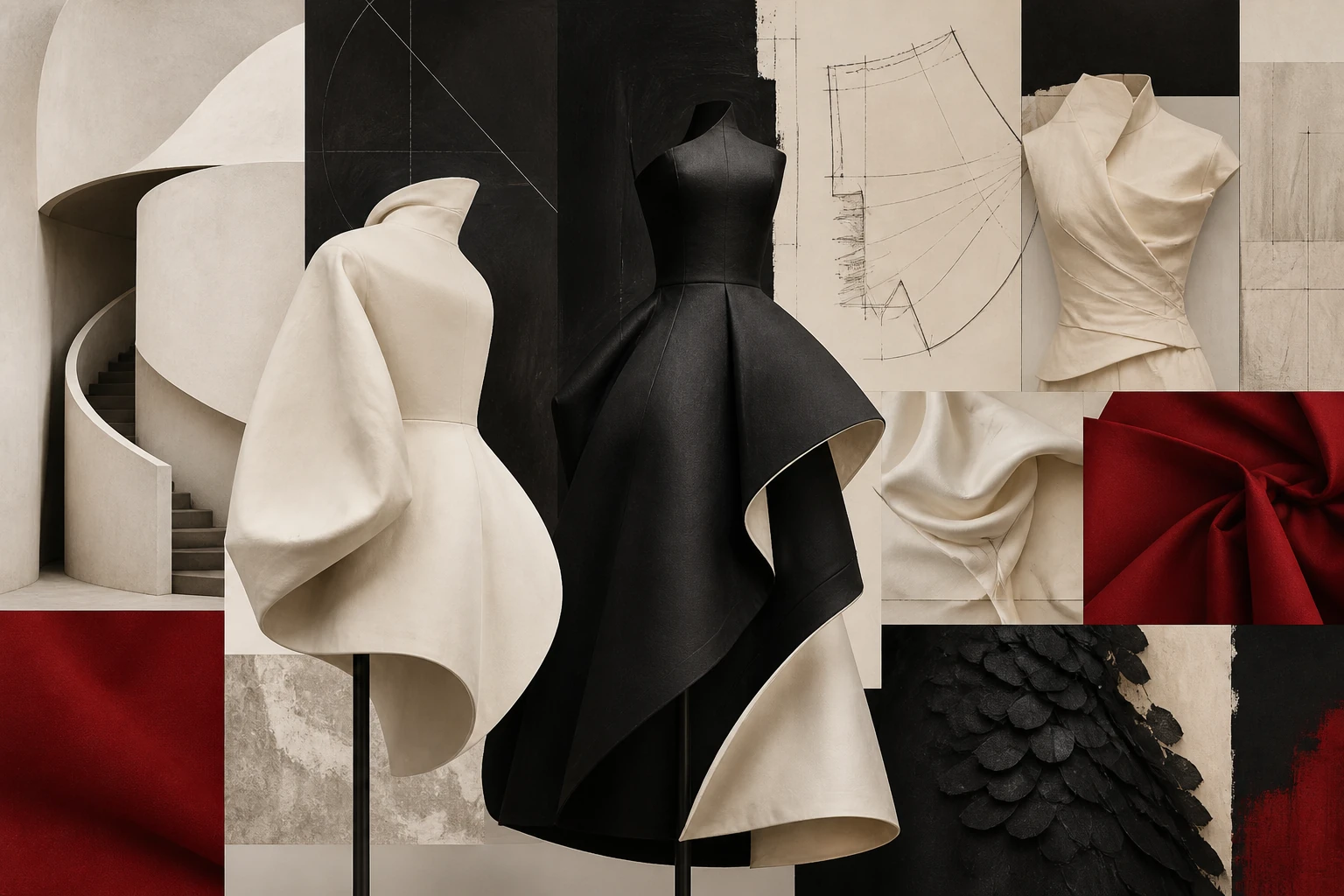
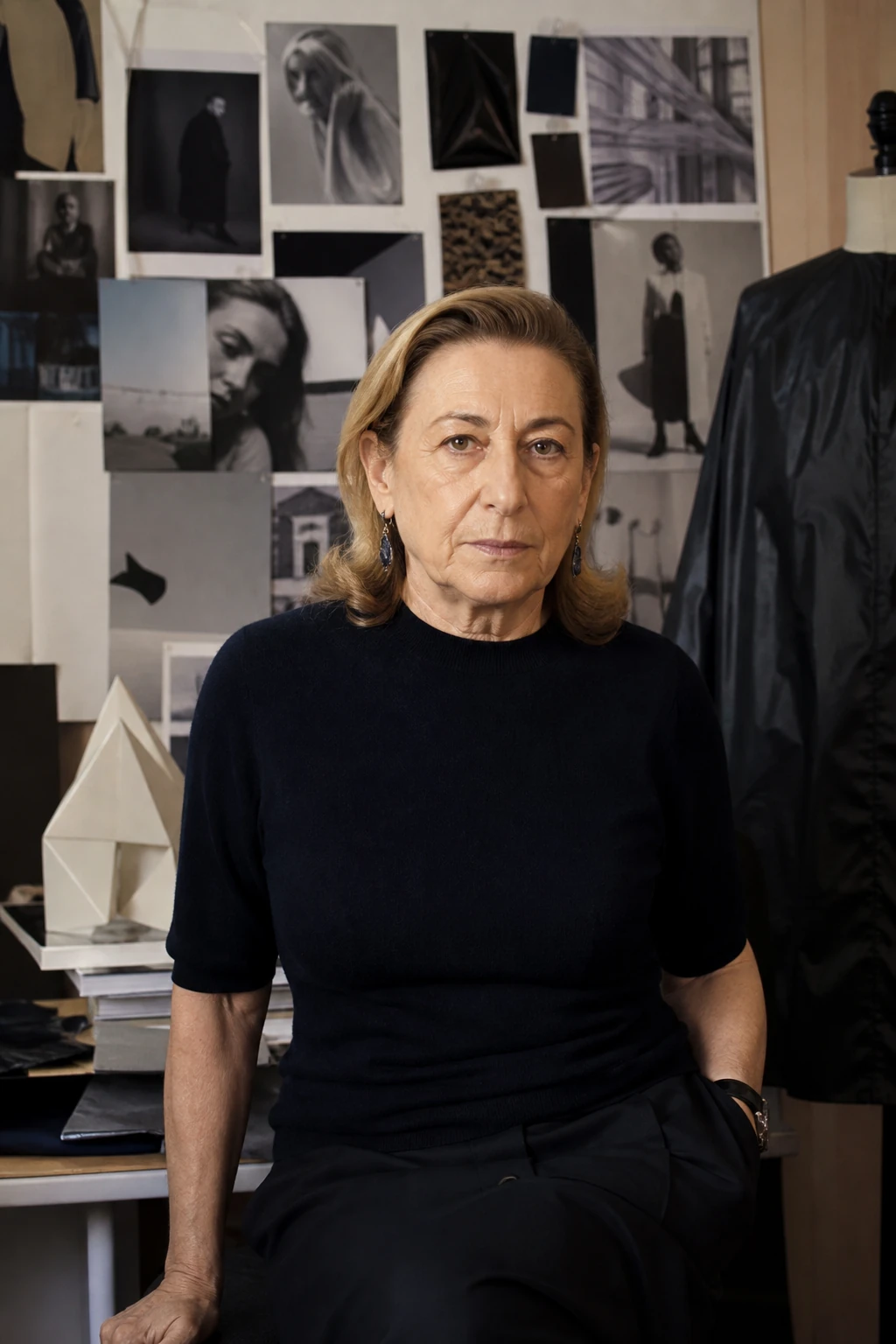
Prada turned contradiction into a working tool: nylon instead of leather, the uniform instead of seduction, 'wrong' beauty instead of the obvious. Her method showed that a designer's intellectual position can be not a commentary on the product but its very construction.
Editorial thesis
Miuccia Prada's historical significance does not lie in creating a single recognisable style. She built a method able to turn contradictory cultural codes into fashion: luxury and utility, severity and strangeness, feminism and bourgeois femininity, the archive and contemporary technology. Her work changed not only Prada's clothing but the idea of what a designer can do — from the product and space to art, architecture and collective authorship.
Reader question
How did the heiress of a Milanese family business, having studied political science and theatre, turn black industrial nylon and deliberately 'non-ideal' combinations into one of the most influential languages of contemporary fashion?
To trace Miuccia Prada as designer, entrepreneur, collector and author of a cultural infrastructure. The material separates her personal practice from the corporate history of the Prada Group, distinguishes Prada and Miu Miu, notes the role of Patrizio Bertelli and Raf Simons, and treats 'ugly chic' as an analytical term rather than an advertising label.
The core subject is Miuccia Prada Bianchi: her biography, design method and creative leadership of Prada and Miu Miu.
The history of the House of Prada is examined only insofar as it explains her decisions; the corporate history is the subject of a separate material.
The terms 'ugly chic', 'intellectual fashion', 'anti-luxury' and 'minimalism' are used with an explanation and are not considered official self-designations of the designer.
The role of Patrizio Bertelli is treated as a co-authorship of the business and production system, not as a secondary biographical detail.
From 2020 Prada works in a model of equal joint creative direction by Miuccia Prada and Raf Simons; the authorship of contemporary collections cannot be attributed to one person.
Archival images and museum objects pass a separate rights review.
Short answer
Miuccia Prada was born in Milan in 1949. She studied political science at the University of Milan, practised mime at the Piccolo Teatro and took part in the left-wing political and feminist movement. In the late 1970s she entered the family leather-goods business founded by her grandfather Mario Prada in 1913. Together with the entrepreneur Patrizio Bertelli she rebuilt the company's production and retail system.
Her key gesture was the introduction of black industrial nylon into a luxury context: a light, practical and visually neutral material contradicted the traditional idea of preciousness. In 1988 Prada showed its first women's ready-to-wear collection, and in 1993 Miu Miu appeared — a more direct and experimental line. In the 1990s Miuccia Prada formed a language that critics called ugly chic: muted 'uncomfortable' colours, bourgeois skirts, synthetics, retro prints and deliberately strange proportions turned into a new form of desire.
Her practice expanded to the architecture of the stores, collaboration with OMA/AMO, cinema, art and the Fondazione Prada. In 2020 Raf Simons became an equal co-creative director of Prada. In 2026 Miuccia Prada continues together with him to define the creative direction of the brand, preserving a model of fashion as an investigative dialogue rather than the repetition of a single style.
-
Milan, family and education
-
Politics, feminism and theatre
-
Entry into the family business
-
Patrizio Bertelli: production and scale
-
Nylon as an intellectual upheaval
-
1988: the first women's ready-to-wear collection
-
Minimalism that was not simplicity
-
Ugly chic: 'wrong' beauty
-
Femininity, power and duality
-
Uniform, bourgeoisness and everyday life
-
Colour and material as a cultural conflict
-
Miu Miu: the designer's other 'I'
-
The architecture of Prada and the collaboration with OMA/AMO
-
The shows as investigative spaces
-
Fondazione Prada: art as infrastructure
-
Cinema, literature and the intellectual culture of the brand
-
Commerce and experiment
-
Raf Simons: joint creative direction
-
Authorship as dialogue
-
Criticism, contradictions and limitations
-
Influence on contemporary fashion
-
Conclusion
A. Chronology
B. Glossary
C. Fact register
D. Related objects
E. Media plan and rights
F. Sources and release checklist
1. Milan, family and education
Miuccia Prada was born on 10 May 1949 in Milan under the name Maria Bianchi. She was later adopted by her maternal aunt and received the surname Prada. She grew up inside the family that owned the Fratelli Prada company, but her professional path was not a direct continuation of the family tradition.
At the University of Milan she studied political science and received a degree in political sciences. This education became not a decorative biographical fact but the basis of her way of thinking about fashion: clothing was treated as a system of power, class signs, gendered expectations and collective habits.
The Milan of the 1960s and 1970s joined industrial design, political mobilisation, radical architecture and rapidly developing ready-to-wear production. In this environment Prada learned to perceive fashion at once as commodity, form and social message.
2. Politics, feminism and theatre
Before actively working in the family company Miuccia Prada took part in the left-wing political movement and was interested in the feminist agenda. She also studied mime and performed in the Piccolo Teatro milieu in Milan. The Metropolitan Museum of Art records her political-science education and theatrical training as part of her professional biography. [2]
The theatre gave her an understanding of gesture, role, mask and costume as an instrument of behaviour. The political culture taught her to see the contradiction between personal freedom and the social code. Her collections later constantly returned to this duality: a woman can look conservative yet act radically; seduction can be not obvious but intellectually tense.
Prada did not build the collections as direct political slogans. Her method was to place familiar forms — a knee-length skirt, a cardigan, a secretary's uniform, a coat, a school collar — in a context where their meaning became unstable.
3. Entry into the family business
In the late 1970s Miuccia Prada entered the family business, which produced leather goods and travel accessories. The sources differ on the exact date of the formal transfer of control; The Met gives 1977 as the moment when she took over the family business. [2]
The company had a prestigious history, but was not a global fashion house of the modern type. Before Miuccia stood the task not of restoring an old catalogue but of defining what the legacy of a travel-goods shop could be in the era of international designer fashion.
She did not abandon the functionality of the original business. On the contrary, it was precisely function — portability, durability, the uniform, repeatability — that became the material of a new language of luxury.
4. Patrizio Bertelli: production and scale
Patrizio Bertelli met Miuccia Prada in the late 1970s and became her key business and life partner. His experience in leather-goods production and his ability to build an industrial system complemented her design thinking.
The Prada story is often personalised around Miuccia, but the scale of the brand arose from the joining of two competences. She formulated a cultural and visual problem; Bertelli turned the experiment into production, a supplier network, retail and international expansion.
This partnership allowed Prada to keep the complexity of the idea despite commercial growth. What mattered was not only the creation of an unusual product but the control of the environment in which it was sold and interpreted.
5. Nylon as an intellectual upheaval
The principal early symbol of the new Prada was black nylon. The material was associated with industry, military and technical equipment, not with traditional preciousness. Miuccia Prada introduced it into accessories and clothing, keeping the functionality and stressing the visual neutrality.
The Met describes her as a designer who received early recognition through the subversive introduction of black nylon into luxury clothing and accessories. [2] Nylon became not simply an economical substitute for leather. Its smoothness, lightness and absence of a decorative 'nobility' raised the question: is luxury defined by the material or by the system of meaning around it?
The triangular metal emblem on the black surface strengthened the contradiction. The logo looked like a technical mark, but gradually became one of the most recognisable codes of luxury.
6. 1988: the first women's ready-to-wear collection
In 1988 Prada presented its first full women's ready-to-wear collection. The clothing did not try to compete with the theatrical sexuality of the 1980s. The silhouettes were calm, the colours restrained, and the forms functional and intellectually distanced.
At first glance these things could seem simple. But the simplicity was built through a precise length, an ambiguous texture and culturally loaded objects of everyday life. A skirt, coat or shirt became not a basic wardrobe but a way of discussing taste and social norm.
From this moment Prada developed as a fashion house, not only of accessories. At the same time the logic of luggage — functionality, modularity, durability — continued to define the clothing.
7. Minimalism that was not simplicity
Prada is often included in the minimalism of the 1990s, but her method differed from pure formal reduction. She could use a laconic silhouette, yet saturated it with uncomfortable associations: office uniform, school clothing, retro-bourgeoisness, cheap synthetics or the colour of an old interior.
Minimalism with Miuccia Prada did not eliminate meaning but concentrated it. The calmer an object looked, the more strongly the proportion, context and material worked. A nylon coat, a midi skirt or a grey cardigan could be at once practical, conservative and provocative.
She cannot therefore be described only as an author of 'quiet luxury'. Prada systematically disturbed the comfort of the viewer, offering things that did not become desirable at once.
8. Ugly chic: 'wrong' beauty
The term ugly chic became fixed to Prada in the 1990s and denoted an aesthetic strategy in which deliberately uncomfortable colours, retro prints, synthetics and 'old-fashioned' forms became fashionable. This is not a cult of ugliness but an investigation of the mechanism of taste.
The spring-summer 1996 collection is especially often connected with this logic: brown, mustard and green shades, geometric prints and bourgeois silhouettes opposed the conventional idea of glamour. The Met's museum collections preserve ensembles of this period as important examples of Prada's design practice. [11]
Ugly chic worked through the delay of desire. The viewer first noticed the strangeness, then the construction and only after that the attractiveness. This mechanism had a substantial influence on contemporary fashion, in which irony, nostalgia and deliberate awkwardness became independent commercial instruments.
9. Femininity, power and duality
Miuccia Prada repeatedly explored the conflict between a feminist consciousness and the pleasure of traditionally feminine codes. Her collections could include lace, fur, embroidery and romantic forms, but deprive them of their habitual softness or place them beside utilitarian objects.
The Prada woman is rarely presented as a single ideal. She can look intellectual, conservative, sexual, cold and vulnerable at once. This multiplicity opposes the marketing model in which a brand offers one easily readable personality.
Clothing becomes not an answer to the question 'what a woman should be' but a field in which different roles can conflict without a final resolution.
10. Uniform, bourgeoisness and everyday life
Prada constantly returned to the uniform: office, school, military, medical and work. The uniform interested her as clothing that regulates the body and social behaviour.
Bourgeois objects — the midi skirt, court shoes, coat, cardigan, bag — were subjected to displacement. An unfamiliar colour, material or proportion made them at once recognisable and strange.
In this way everyday life turned into an intellectual object. Prada's radicalism rarely demanded a fantastical costume; it arose inside a garment that society considers normal.
11. Colour and material as a cultural conflict
The Prada palette rests not only on the beauty of combinations. Miuccia Prada uses shades connected with the interior of the 1970s, the hospital environment, the office, the military uniform and old furniture: olive, brown, dirty yellow, pale pink, industrial grey.
The materials collide in status. Silk is joined with plastic, wool with synthetics, lace with nylon. The Met's objects demonstrate this logic in the collections of 2002-2003, 2007-2008, 2009-2010 and 2015-2016. [3][9][10]
Such a collision destroys the stable hierarchy of materials. Preciousness ceases to be a natural property and becomes the result of context, construction and attention.
12. Miu Miu: the designer's other 'I'
Miu Miu was launched in 1993 and took its name from Miuccia's family nickname. The line is not a simplified Prada. It creates a more immediate, younger and emotionally unstable space.
If Prada is often built around intellectual distance and systemic contradiction, Miu Miu permits naivety, school codes, vintage femininity, open desire and abrupt shifts of mood.
The division of the two brands allowed the designer to develop different types of authorship without reducing them to a single aesthetic. It also shows that a personal creative language can exist as several parallel systems.
13. The architecture of Prada and the collaboration with OMA/AMO
In the late 1990s and early 2000s Prada began collaborating with Rem Koolhaas, OMA and the research unit AMO. The Epicenter stores were treated not as neutral retail spaces but as laboratories of new scenarios of retail, exhibition and communication.
The architecture strengthened the brand's essential method: the store became at once a commercial space, a cultural object and a public stage. The materials, routes, digital interfaces and ways of displaying the clothing were included in a single system.
This collaboration influenced the whole of luxury retail. The branded interior ceased to be only a decoration of status and became an instrument for investigating the behaviour of the visitor.
14. The shows as investigative spaces
The Prada shows are often built on a temporary architecture that enters into complex relations with the collection. The space can recall a parliament, an office, a theatre, a warehouse, an abstract room or a technological infrastructure.
AMO developed many of the concepts for the shows, creating visual systems in which colour, material, sound and the route of the models formed a separate statement.
The scenography does not explain the clothing literally. It creates a tension that forces the viewer to interpret the collection within a wider conversation about modernity.
15. Fondazione Prada: art as infrastructure
Miuccia Prada and Patrizio Bertelli created the Fondazione Prada in the 1990s, and the permanent Milan complex opened in 2015. The foundation works with contemporary art, cinema, philosophy, archives and research exhibitions.
The Fondazione Prada differs from an ordinary corporate gallery in that it forms an independent programme and architectural identity. The complex in Milan was transformed by OMA from a former industrial site.
For Miuccia Prada art does not serve as illustration of fashion. It creates a parallel intellectual environment that influences how the brand understands time, archive, authorship and publicity.
16. Cinema, literature and the intellectual culture of the brand
Prada systematically collaborated with directors, artists, writers and theorists. Short films, publishing projects and cultural discussions widened the communication beyond the seasonal campaign.
This approach does not cancel the brand's commercial function. On the contrary, the cultural capital becomes part of the luxury system. The question matters whether a project keeps its independence or is used only as a symbol of intellectual status.
Prada's strongest initiatives work when the collaboration creates a new object or an investigation, not simply when it attaches a famous name to a product.
17. Commerce and experiment
Prada is an example of how a complex aesthetic can be scalable. The backpacks, shoes, bags and basic items ensure commercial stability, allowing the collections to keep an experimental character.
Miuccia Prada does not oppose business to creativity. She treats the constraint — price, production, repeatability, seasonality — as part of the design task.
Yet scale creates risks: a complex idea can be reduced to a logo, and a contradiction can turn into a recognisable decorative effect. The Prada story constantly balances between intellectual instability and the need to maintain global recognisability.
18. Raf Simons: joint creative direction
In February 2020 Prada announced that Raf Simons would join the brand as co-creative director from 2 April 2020. The official statement stressed equal responsibility for the creative input and decision-making. [1]
The first joint collection — womenswear Spring/Summer 2021 — was presented in September 2020. The partnership offered a model rare for a major fashion house, in which two known authors publicly abandoned the idea of a single creative centre.
By 2026 the official Prada materials continue to list Miuccia Prada and Raf Simons as creative directors. [12] The contemporary collections should be analysed as the result of a dialogue, not by seeking in each garment a separate share of each designer's authorship.
19. Authorship as dialogue
The joint direction changed the habitual mythology of the fashion house, in which one designer is perceived as the ultimate source of meaning. Prada proposed authorship as conversation, dispute and editing.
This approach matches Miuccia Prada's earlier method. Her practice always depended on interaction with Bertelli, the production teams, architects, artists and researchers.
Collectivity does not mean an absence of responsibility. On the contrary, it requires a precise definition of the roles and a rejection of the convenient legend of the genius working in isolation.
20. Criticism, contradictions and limitations
Prada's intellectual reputation does not free the brand from criticism. The use of cultural images, materials of animal origin, ecological claims and the conditions of global production require an independent assessment.
The term 'feminist fashion' also cannot be applied automatically. A collection may explore female subjectivity, but the brand remains part of an industry built on consumption, the depiction of the body and a high price of access.
An editorial analysis must distinguish the designer's intention, the visual result, the marketing interpretation and the actual impact of the business.
21. Influence on contemporary fashion
Miuccia Prada legitimated intellectual ambiguity as the basis of commercially successful luxury. After her, deliberately strange colour, unattractive material, archival awkwardness and the uniform became ordinary instruments of designer fashion.
Her influence is visible in the work of authors who treat taste as a social construction and build collections on the conflict between the attractive and the uncomfortable.
No less important is the institutional model: a brand, architecture, art, cinema and research can work as an interconnected cultural infrastructure.
22. Conclusion
Miuccia Prada remains one of the central figures of contemporary fashion because she does not offer a final definition of beauty. She makes instability productive and forces an object to keep several incompatible meanings.
Her method rests on attention to an ordinary thing. A nylon backpack, a skirt, a cardigan or a coat become radical not through outward fantasy but through a change of context, proportion and cultural hierarchy.
Miuccia Prada's chief legacy is not a specific silhouette but the right of fashion to be complex: attractive and repellent, commercial and critical, personal and collective at once.