designer profile
Rei Kawakubo
Clothing as a conceptual object: how Comme des Garçons destroyed habitual ideas of beauty, the body, authorship and the very boundary between fashion and art
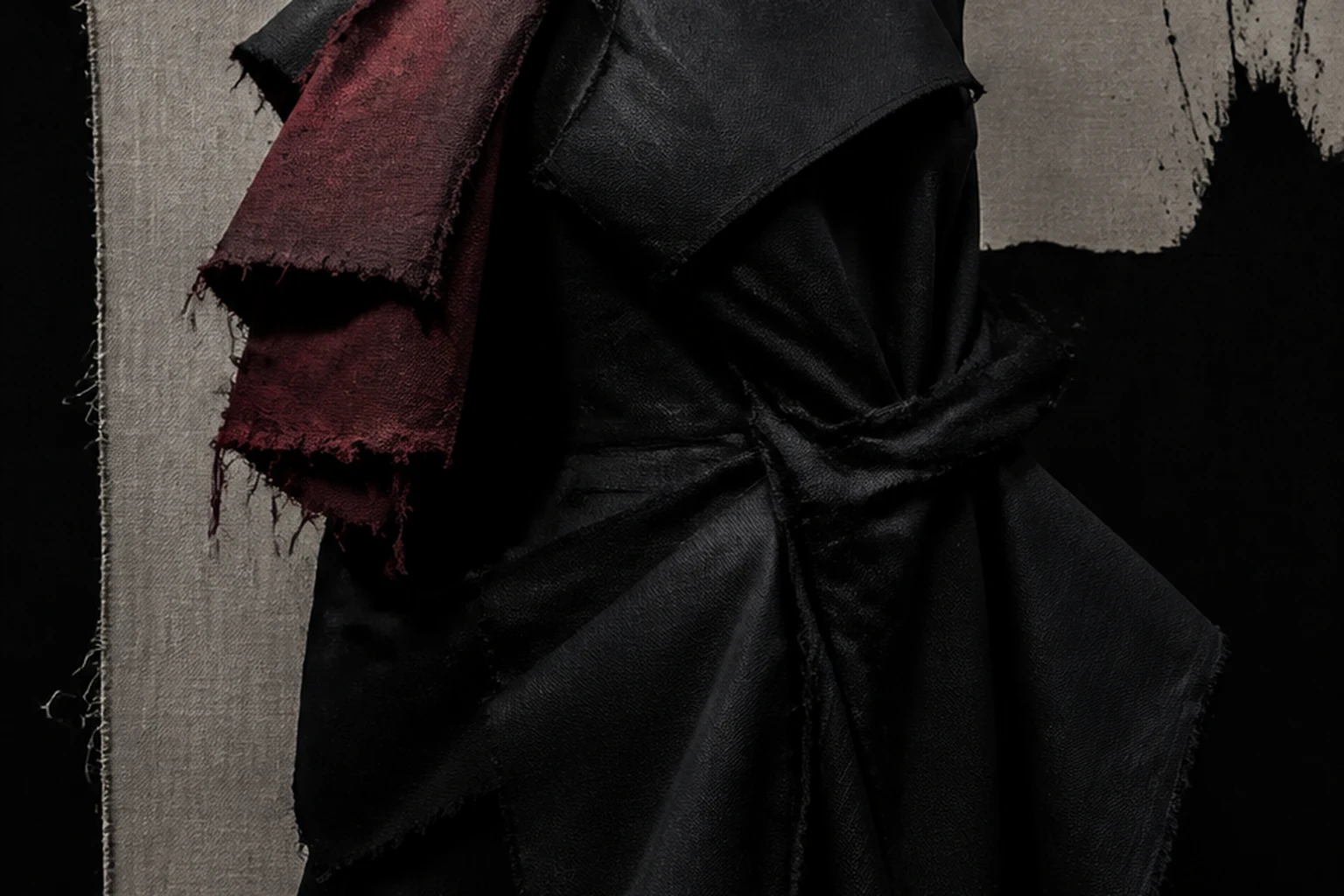
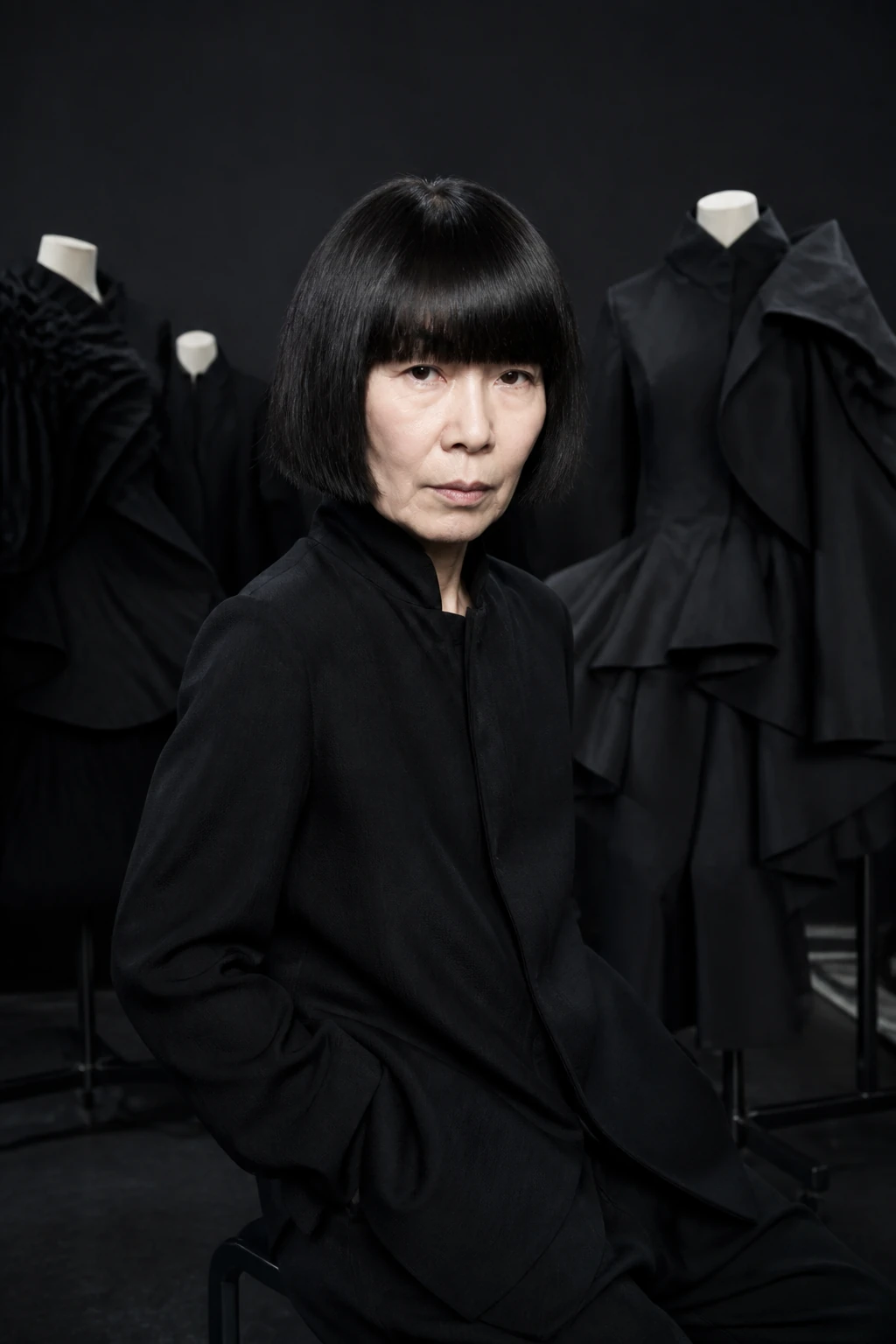
Kawakubo builds collections as a sequence of refusals: of symmetry, of completeness, of the recognisable silhouette, of the demand to be beautiful at all. Comme des Garçons showed that clothing can remain an object and at the same time ask who sets the norm.
Editorial thesis
Rei Kawakubo's historical significance lies not in a single visual style or a set of recognisable black asymmetrical garments. She created a method of continuous negation of entrenched norms: beauty, symmetry, completeness, gender fixity, singular authorship and the commercial separation between brand, shop, magazine and art object. Her work turned fashion into a space of inquiry where clothing can simultaneously be a functional thing, a sculpture, a question and a critique of the industry itself.
Reader question
How did a graduate of the aesthetics faculty with no classical training as a fashion designer create Comme des Garçons, change fashion's relationship to the body and beauty and build an independent system of brands, authors and shops?
To present Kawakubo as a designer, entrepreneur, editor of space and creator of an institution. The material distinguishes the personal practice of Rei Kawakubo, the Comme des Garçons brand, the lines of other designers within the company and Dover Street Market; it explains key collections and does not reduce her method to 'Japanese minimalism' or anti-fashion.
The core subject is Rei Kawakubo, her biography, design method and creative direction of Comme des Garçons.
The history of the entire Comme des Garçons group is considered only in connection with her system of authorship; the separate lines of Junya Watanabe, Kei Ninomiya and other designers require independent articles.
The terms 'anti-fashion', 'deconstruction', 'Hiroshima chic' and 'in-betweenness' are used with historical context and critical qualifications.
The Paris debut of 1981 is examined as an international turning point but not as the beginning of her career: the company was founded in Tokyo earlier.
Body Meets Dress—Dress Meets Body is analysed as an investigation of the body, not as a collection that permits medical or ethnographic simplifications.
Archival images, campaigns and materials from The Met undergo a separate rights review.
Short answer
Rei Kawakubo was born in Tokyo in 1942. She studied aesthetics at Keio University, after which she worked in the advertising department of the textile company Asahi Kasei and as an independent stylist. In 1969 she began using the name Comme des Garçons, and in 1973 she incorporated the company. In 1981 her first Paris show provoked a strong reaction: black, holes, asymmetry, free layers and deliberately unfinished surfaces contradicted the norms of Western luxury fashion.
Kawakubo consistently investigated the space between opposites: clothing and non-clothing, beauty and ugliness, body and object, masculine and feminine, past and future. The Body Meets Dress—Dress Meets Body collection of 1997 changed the habitual idea of silhouette by adding volumes in the 'wrong' places. From 2014 she began to describe part of her work as 'objects for the body', deliberately distancing herself from the task of creating ordinary clothing. In 2017 The Metropolitan Museum of Art devoted the exhibition Art of the In-Between to her — the first monographic exhibition of a living designer at the Costume Institute after Yves Saint Laurent in 1983.
Her influence extends beyond her own collections. Comme des Garçons became a platform for independent designers, and Dover Street Market, opened in 2004 together with Adrian Joffe, proposed a new model of multi-brand space. Kawakubo continues to work as an independent author and the head of a system in which commerce is used not to smooth over experiment but to sustain it.
-
Tokyo, family and education
-
From textile advertising to independent styling
-
1969–1973: the creation of Comme des Garçons
-
Japan in the 1970s: the brand's first language
-
Paris 1981 and the crisis of habitual beauty
-
Black: not a style but a tool
-
Asymmetry, holes and incompleteness
-
Deconstruction and the problem of the term
-
The body without an ideal contour
-
Body Meets Dress—Dress Meets Body, 1997
-
The space 'in-between'
-
The collection as a question, not an assortment
-
"Objects for the body" after 2014
-
Masculine and feminine without a fixed boundary
-
History, ceremony and memory
-
The show, music and scenography
-
Graphic design, magazines and advertising
-
Adrian Joffe and the independent business system
-
A platform for other authors
-
Dover Street Market
-
The Met 2017: fashion inside the museum
-
Criticism, contradictions and cultural context
-
Influence on contemporary fashion
-
Conclusion: clothing as a field of freedom
A. Chronology
B. Glossary
C. Fact register
D. Related objects
E. Media plan and rights
F. Sources and release checklist
1. Tokyo, family and education
Rei Kawakubo was born on 11 October 1942 in Tokyo. Her father worked at Keio University, where she later studied aesthetics — an interdisciplinary field that included philosophy, art and literature. She did not receive a classical training as a fashion designer and did not build her career through the traditional atelier system.
The absence of a professional school does not mean the absence of discipline. On the contrary, her method was formed through the analysis of the image as a whole: clothing, the body, space, photography, sound and the commercial environment were regarded as parts of a single visual system.
Postwar Japan was changing rapidly under the influence of industrialisation, American culture and an internal rethinking of traditions. Kawakubo entered fashion not as a keeper of the national costume but as an author working within the contemporary international city.
2. From textile advertising to independent styling
After university Kawakubo worked in the advertising department of the chemical and textile company Asahi Kasei. This position gave her access to material production, advertising photography and the logic of building an image around a product.
She then became an independent stylist. When suitable clothing for shoots could not be found, she began creating her own pieces. This practical necessity became the point of transition from selecting ready-made products to designing new ones.
This early experience explains why her authorship was never limited to cut. She perceived a collection through photography, campaign, graphics, the shop and the mode of presentation — as a single editorial construct.
3. 1969–1973: the creation of Comme des Garçons
The name Comme des Garçons — 'like boys' — Kawakubo began using in 1969. The company was officially incorporated in 1973. The French name created an international distance, but the brand was formed in Tokyo and initially developed within the Japanese market.
Early collections featured free forms, a restrained palette and a refusal of demonstratively feminine decoration. Yet the subsequent history cannot be read as a straightforward evolution of a single minimalist style: Kawakubo constantly changed her visual language, retaining only the demand for new thinking.
From the outset Comme des Garçons was not only a designer's signature but also an organisation. This distinction became especially important later, when independent lines and authors appeared within the company.
4. Japan in the 1970s: the brand's first language
By the end of the 1970s Comme des Garçons had acquired a prominent position in Japan. The garments differed from the Western status model: a free layer could be more important than an emphasised figure, the surface more important than costly sheen, and black more important than a seasonal palette.
This language was often explained through Japanese tradition, Zen or wabi-sabi. Such parallels can be useful but become a simplification if they turn a contemporary author into a representative of an ahistorical 'Eastern aesthetic'. Kawakubo worked with international modernism, punk, industry and contemporary urban culture.
The key point was not the origin of a particular motif but the refusal to recognise the Western system of beauty as a universal norm.
5. Paris 1981 and the crisis of habitual beauty
The first Paris show of Comme des Garçons took place in 1981. Together with the work of Yohji Yamamoto it marked a noticeable break for the European press: black free forms, asymmetry, holes and uneven edges differed sharply from the glamour and bodily display of the early decade.
Some critics used formulations such as 'Hiroshima chic'. Today this term should be regarded as problematic: it turned Japanese fashion into traumatic exotica and linked visual signs to a national catastrophe without foundation in the author's concept.
The Paris reaction matters precisely as a clash of perceptual systems. Kawakubo's clothing showed that luxury can be built on intellectual complexity, handwork and material without customary polish.
6. Black: not a style but a tool
Black became one of the most recognisable codes of Comme des Garçons, but for Kawakubo it was not simply a signature palette. It neutralised decorative information, allowed concentration on form and simultaneously resisted the seasonal logic of colour.
In the early 1980s the spread of black among young creative communities was linked to her influence. Yet Kawakubo's later collections actively used red, pink, gold, checks, floral fabrics and saturated contrasts.
Her language therefore cannot be defined as monochrome minimalism. Black was one means of removing the habitual signal, after which volume, seam, rupture and emptiness became noticeable.
7. Asymmetry, holes and incompleteness
Asymmetry in Comme des Garçons did not serve as decorative oddity. It disrupted the expectation that a good garment must appear finished, balanced and identically legible from both sides.
Holes, dropped stitches and uneven edges displayed construction and the vulnerability of material. In the traditional luxury system such signs were perceived as defects; Kawakubo turned them into a conscious choice and thereby changed the criteria of quality.
At the same time the effect of incompleteness demanded precise production. Chance was designed and controlled. This contradiction — a discipline that creates the appearance of destruction — became one of the enduring principles of her practice.
8. Deconstruction and the problem of the term
Kawakubo's works are often called deconstructive. The term helps to describe visible seams, fragmentation, the displacement of details and the dismantling of the habitual form of clothing. But it can create the false impression that the designer simply destroys an already existing object.
Her method is broader: she not only shows the inside of construction but also creates forms for which no habitual original object ever existed. In several collections clothing arises as a new volume, not as a disassembled jacket or dress.
It is therefore more accurate to use deconstruction as one analytical tool, not as the full name of her style.
9. The body without an ideal contour
Fashion traditionally constructs an idealised body through the waist, shoulders, bust, hips and leg length. Kawakubo systematically disrupts this map: she hides some zones, enlarges others, shifts the centre of gravity and sometimes makes the body almost indiscernible within the object.
Such an approach does not deny the body but shows that its 'correct' form is culturally constructed. Clothing can refrain from correcting the person to fit a norm and instead propose another mode of coexistence with the body.
The result is not a comfortable 'body-positive' garment in the popular sense. Kawakubo's volumes can be heavy, awkward or physically restrictive. The discomfort is part of the inquiry, not a failure of fit.
10. Body Meets Dress—Dress Meets Body, 1997
The spring-summer 1997 collection received the unofficial name 'lumps and bumps'. Stretch dresses contained soft internal pads that created volumes on the back, shoulders, stomach and hips — in places fashion usually sought to smooth or conceal.
The collection did not simply propose a new silhouette. It posed the question of why some bodily forms are considered beautiful and others erroneous. The additional volume could recall a tumour, a pregnancy, a hump, a carapace or a new organ, but no interpretation was definitive.
The works were used in the costumes for the dance project Scenario by Merce Cunningham. In movement it became visible that the altered envelope shapes new gestures and relations between bodies.
11. The space 'in-between'
The 2017 Met exhibition proposed reading Kawakubo's work through 'in-betweenness' — the space between stable opposites. The display included nine pairs: Absence/Presence, Design/Not Design, Fashion/Anti-Fashion, Model/Multiple, High/Low, Then/Now, Self/Other, Object/Subject and Clothes/Not Clothes.
This scheme is useful because it does not attempt to define her work with a single sign. A thing can simultaneously be clothing and sculpture, a historical quotation and the destruction of history, a commercial product and a refusal of commercial legibility.
Kawakubo does not necessarily reconcile opposites. Often she holds the tension between them without offering the viewer a final answer.
12. The collection as a question, not an assortment
For Kawakubo a seasonal collection is not a set of garments for different occasions but an investigation of a single problem. Titles such as Broken Bride, White Drama, Ceremony of Separation or The Future of Silhouette set a direction but do not explain every object.
Commercial products and the company's main lines support this freedom. The most radical runway pieces can exist as a concentrated statement, while perfume, accessories and other lines provide a broader economic system.
This division does not mean that experiment stands outside business. On the contrary, Comme des Garçons showed that an independent company can use commercial complexity to protect authorial risk.
13. "Objects for the body" after 2014
According to The Met, in 2014 Kawakubo felt that the habitual process of creating clothing was hindering the search for the new. She formulated the task of 'not making clothes' and began to create 'objects for the body'.
These objects may lack ordinary sleeves, fastenings or a scenario of everyday wear. They occupy an intermediate position between a dress, a sculpture, a stage costume and a spatial construction.
The radicalism lies not only in size or complexity. Kawakubo refuses the demand that fashion must immediately be turned into a convenient commodity. At the same time the objects remain tied to the body: it carries them, collides with constraint and becomes part of the form.
14. Masculine and feminine without a fixed boundary
The name Comme des Garçons introduced a play with gender identity from the very start. In her womenswear collections Kawakubo used masculine constructions but was not limited to a direct borrowing of the suit.
She could render the body sexless, multi-layered, vulnerable or monumental. Gender ceased to be read through a set of pre-given signs and became one of the variable parameters of the image.
Yet to describe her as an author of fully 'gender-neutral' fashion would be anachronistic. Her works arose in specific historical collections and often investigated precisely the conflict between cultural ideas of the feminine and the masculine.
15. History, ceremony and memory
Kawakubo regularly turns to the European history of costume — crinolines, bustles, mourning dresses, bridal wear and ceremonial forms. But the quotation is almost always subjected to deformation: enlarged, compressed, collided with another time or stripped of its habitual function.
In White Drama, white linked birth, wedding, religious ceremony and death. Ceremony of Separation investigated the ritual of leave-taking and the ability of form to hold the emotional weight of loss.
For Kawakubo history is not an archive of ready-made beautiful images. It serves as material for investigating how society organises life through clothing and ritual.
16. The show, music and scenography
Comme des Garçons shows are constructed as concentrated spaces of perception. Light, music, speed of movement and the distance between models do not illustrate the clothing but set the emotional mode for reading it.
Models rarely play the traditional role of an attractive personality selling a lifestyle. They can move in a detached manner, exist as parts of a composition or become carriers of a complex object.
The scenography often remains restrained so as not to compete with the form. The effect is created not by the quantity of décor but by the precise tension between the body, sound and empty space.
17. Graphic design, magazines and advertising
Comme des Garçons formed a distinct graphic language through catalogues, invitations, packaging and the magazine Six, which ran from 1988 to 1991. The title alluded to a 'sixth sense', and the publication joined fashion, art and photography without the conventional magazine structure.
The brand's advertising campaigns often did not show the product directly. The image could be built around a found photograph, typography or a cultural association, turning the advertisement into an editorial object.
This approach reinforced the idea of the brand as an environment of thought. The buyer encountered not only a dress or a bag but a coherent system of visual decisions.
18. Adrian Joffe and the independent business system
Adrian Joffe, Kawakubo's spouse and business partner, plays a key role in the international development of Comme des Garçons. Their model rests on a division of functions: Kawakubo's creative autonomy is supported by a complex organisation of production, licensing, sales and new projects.
The company remains independent and is not part of a large luxury conglomerate. This makes it possible to take decisions that might seem too risky or slow for a public corporation.
Independence does not mean a small scale. Comme des Garçons develops multiple lines, perfume, collaborations and retail, but it uses growth as infrastructure for further experiment.
19. A platform for other authors
Within Comme des Garçons a rare system took shape in which other designers were given the opportunity to develop independent languages. Junya Watanabe, Tao Kurihara, Fumito Ganryu and Kei Ninomiya created their own lines with the company's support.
Kawakubo did not demand that these authors copy her aesthetic. What mattered more was the ability to build an independent position and work within a shared production infrastructure.
Such an approach expands the notion of the creative director. She acts not only as the author of the product but also as the creator of conditions in which other authorships can appear.
20. Dover Street Market
The first Dover Street Market opened in London in 2004. The project, created by Kawakubo and Adrian Joffe, proposed a model of 'beautiful chaos': different brands, arts and commercial levels coexisted without a traditional unified luxury environment.
The shop became not a neutral platform but an editable exhibition system. The spaces are regularly reconfigured, and labels create their own installations within a shared scenario.
Dover Street Market influenced contemporary multi-brand retail and showed that a shop can be a cultural platform, an incubator for young brands and an autonomous medium.
21. The Met 2017: fashion inside the museum
The exhibition Rei Kawakubo/Comme des Garçons: Art of the In-Between ran at The Metropolitan Museum of Art from May to September 2017. It was the first monographic Costume Institute exhibition devoted to a living designer since the Yves Saint Laurent show of 1983.
The display was organised thematically rather than chronologically and included around 140 ensembles. Kawakubo took part in designing the white space with geometric structures, where clothing and architecture were meant to be perceived as a single statement.
Museum institutionalisation created an important contradiction: a work that resists definition was classified and turned into a historical canon. It is precisely this tension that made the exhibition a logical continuation of her method.
22. Criticism, contradictions and cultural context
Kawakubo is often described as a solitary genius standing completely outside the fashion system. Such a formula conceals the work of employees, line designers, production partners, stylists, photographers and Adrian Joffe.
Another problem is exoticisation. Western criticism has repeatedly explained her work through generalised notions of 'Japan', Zen or postwar destruction, instead of analysing a specific contemporary practice.
Comme des Garçons is also a commercial company that uses collaborations, licences and global retail. This does not cancel the experiment but demands that radical design be examined together with the economic infrastructure that makes it possible.
23. Influence on contemporary fashion
Kawakubo's influence is visible in deconstruction, oversized forms, gender ambiguity, conceptual shows and the transformation of the shop into a cultural space. But direct visual resemblance does not always prove actual lineage.
The deeper influence lies elsewhere: a designer gained the right not to explain everything fully, not to serve the ideal figure and not to produce a single style every season. The collection became a way of posing a question.
Her organisational model is no less important than the clothing. An independent company supporting several authorial lines and experimental retail became an alternative to the luxury-conglomerate model.
24. Conclusion: clothing as a field of freedom
Rei Kawakubo changed fashion not by replacing one ideal with another. She showed that the ideal itself can be temporarily suspended, dismantled or left unresolved.
Her clothing demands time and permits perceptual discomfort. The viewer first sees the object, then searches for the body, function and cultural support — and does not always find a final answer.
That is precisely why her practice remains relevant. In an industry that quickly turns novelty into a trend, Kawakubo continues to defend a space where form is not yet obliged to be legible, convenient for classification or finished.