designer profile
Yves Saint Laurent
Fashion, art and the women's tuxedo: how a designer turned the menswear wardrobe, painting, the street and ready-to-wear into a new language of the modern woman
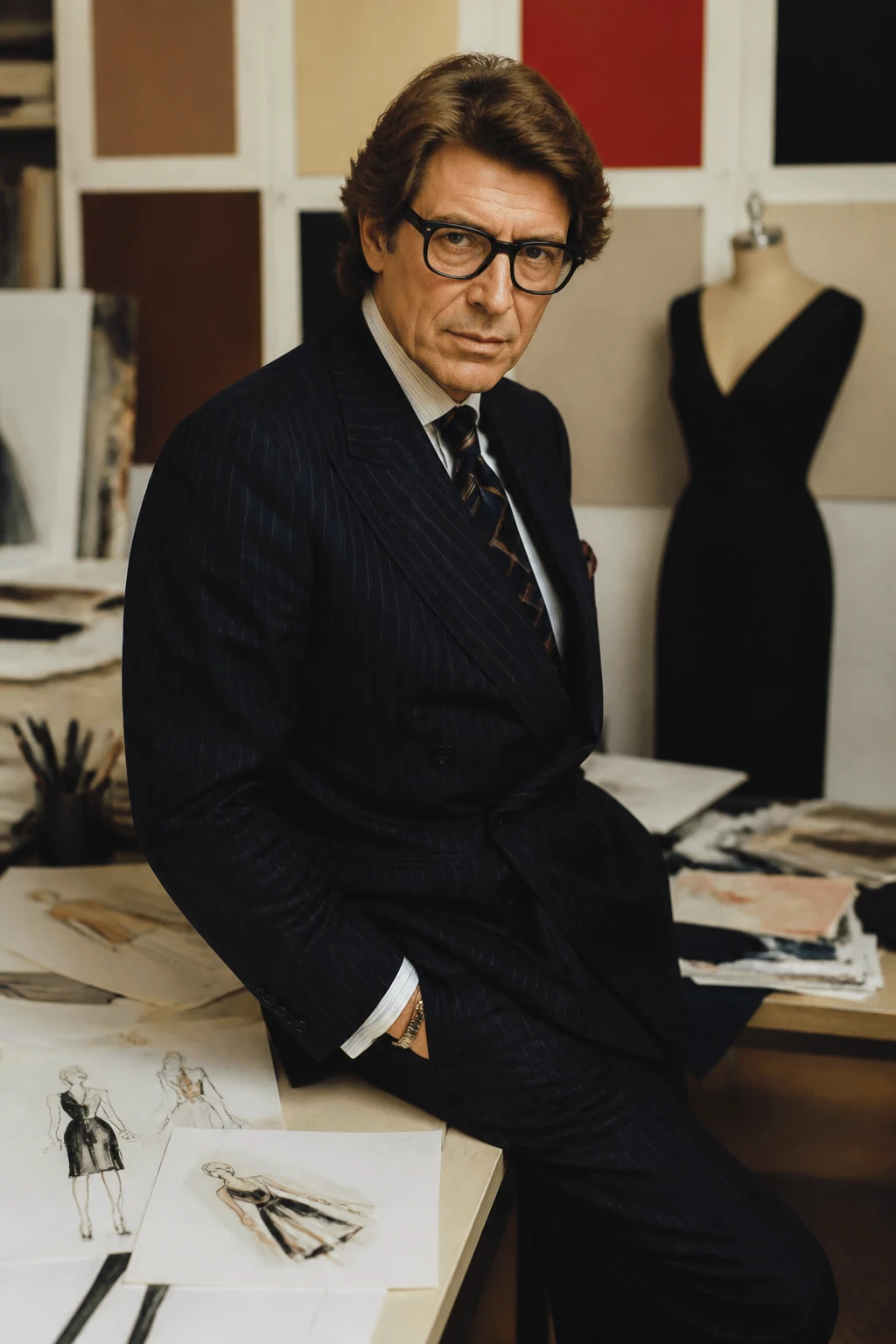
Saint Laurent did not invent women's freedom. He created for her a new set of forms through which freedom could be made visible: trousers, the tuxedo, the sheer blouse, the safari jacket and ready-to-wear with an authorial position.
Editorial thesis
Yves Saint Laurent changed fashion not with a single garment and not with a single gesture. His significance lies in the systematic transfer of forms from the menswear wardrobe, uniform, street culture, painting and theatre into women's clothing, and in the creation of a separate line of designer ready-to-wear. He showed that high fashion can at once work with classical craft, contemporary life, political memory and mass culture.
Reader question
How did a young designer from Oran become the successor to Christian Dior, why did Le Smoking and Rive Gauche change the social role of clothing, and how did his dialogue with art, cinema and non-European cultures shape one of the most durable visual languages of the twentieth century?
To present Saint Laurent as an author working within a complex system created together with Pierre Bergé, the ateliers, the clients, the muses, the photographers and the manufacturers. The article distinguishes the designer's biography, the history of the House of Yves Saint Laurent and the contemporary commercial brand Saint Laurent; it does not repeat advertising claims of 'firsts' without qualification and examines cultural borrowings in historical context.
The core subject is Yves Henri Donat Mathieu-Saint-Laurent: his biography, method, key collections and cultural legacy from 1936 to 2008.
The history of the fashion house after the founder's departure is examined only where necessary for understanding the legacy; it is the subject of a separate material.
Le Smoking is not called the first case of a woman in a men's evening suit; the point is its institutionalisation within haute couture and its long-term influence.
Rive Gauche is not presented as the first ready-to-wear in history, but is described as one of the key early models of designer ready-to-wear under a couturier's name.
The collections inspired by Africa, Morocco, Russia, China and India are analysed with regard to the colonial optic and the problem of turning cultures into aesthetic material.
Images are not embedded without a separate rights check.
Short answer
Yves Saint Laurent was born on 1 August 1936 in Oran, in French Algeria. In 1955 he began working for Christian Dior, and after Dior's death in 1957, at the age of twenty-one, he took over the house. His first collection, Trapèze, lightened the architecture of the New Look and showed a new interest in the movement of the body. After his dismissal from Dior and a difficult period of military service, Saint Laurent, together with Pierre Bergé, founded his own house in 1961.
In the 1960s and 1970s he successively transferred the pea coat, the trench, the tuxedo, the trouser suit, the safari jacket and the jumpsuit into the women's wardrobe. In 1965 the Mondrian dresses turned painting into the construction of clothing; in 1966 Le Smoking offered women a new evening image, and the launch of Rive Gauche made designer ready-to-wear an independent part of the authorial system. In 2002 Saint Laurent ended his career and closed the haute couture house. He died on 1 June 2008. His legacy survives not only in iconic objects but in the very principle: contemporary clothing can change a person's social role if one precisely reworks an already existing cultural code.
1. Oran: family, theatre and early visual culture
Yves Henri Donat Mathieu-Saint-Laurent was born on 1 August 1936 in Oran, a city on the Mediterranean coast of what was then French Algeria. He grew up in a prosperous family; his father ran an insurance business and cinemas, and his mother was interested in clothing and social life. His childhood passed between the sea, the interior of the family home, the theatre and fashion magazines.
Saint Laurent early created paper dolls, costumes and small home performances. These activities matter not as a romantic anecdote but as an early model of his method: for him clothing existed within a scene, a character and a cultural plot. Later he would continue to think of the collections as dramaturgy, in which the silhouette is linked with music, painting and the image of a specific woman.
Oran also became a source of a complex identity. Saint Laurent was a Frenchman born in colonial Algeria, and his later turns to North Africa cannot be separated from this history. Marrakech became for him a space of colour and personal freedom, but contemporary analysis must take account not only of inspiration but of the inequality of the cultural gaze.
2. Paris and the International Wool Secretariat
In 1953 Saint Laurent submitted sketches to the International Wool Secretariat competition. The following year he received the first prize in the dress category. The competition was one of the mechanisms through which young designers could enter the international professional environment.
In Paris he studied at the Chambre Syndicale de la Haute Couture and met Michel de Brunhoff, the editor of French Vogue. He showed his drawings to Christian Dior, after which, in 1955, Saint Laurent was taken into the house as an assistant.
The early years at Dior formed his understanding of the discipline of couture: the seasonal rhythm, the work of the ateliers, the hierarchy of the collection, the relations with clients and the press. At the same time the young designer increasingly sought a way to lighten the heavy construction of postwar fashion.
3. Christian Dior: pupil and successor
After the death of Christian Dior in October 1957, Saint Laurent was appointed artistic director of the house. He was twenty-one. The decision was explained not only by talent but by the fact that Dior had already seen in him a possible successor.
Saint Laurent found himself in a paradoxical position: he had to preserve the commercial and symbolic system of Dior, but at the same time prove his own ability to renew it. His work of this period shows how early he learned to edit a legacy rather than simply copy it.
The career at Dior also gave him international publicity. For the first time the personality of a young designer became part of the house's media image — a model that would later become the norm for the industry.
4. Trapèze of 1958
Saint Laurent's first collection for Dior was presented in January 1958 and was called Trapèze. The silhouette widened from narrow shoulders downwards, loosening the emphasised waist of the New Look. It kept the high quality of couture, but offered the body more air and movement.
Trapèze was not a complete break with Dior: the collection kept the complex construction, expensive fabrics and ceremonial elegance. The novelty lay in a change of the centre of gravity — the form was no longer gathered exclusively around the waist.
The success of the collection created for Saint Laurent the image of a young reformer, but at the same time raised expectations. The following collections were assessed no longer as the work of a pupil but as proof of an ability to run a major house.
5. Military service, dismissal and the alliance with Pierre Bergé
In 1960 Saint Laurent was called up for military service during the Algerian War. He suffered a severe psychological crisis and underwent treatment. While the designer was in hospital, the House of Dior replaced him with Marc Bohan.
The dismissal became a legal and personal rupture. Saint Laurent and his partner Pierre Bergé contested the decision and received compensation. These funds, together with the investment of the American entrepreneur J. Mack Robinson, helped found a new house.
The alliance of Saint Laurent and Bergé was one of the key structures of twentieth-century fashion. Bergé was not simply a manager: he created the conditions in which an unstable and intense creative process could turn into a stable organisation.
6. Founding the house in 1961
The House of Yves Saint Laurent was founded in 1961, and the first collection was presented on 29 January 1962. The salon was on rue Spontini in Paris. The logo of interlaced letters YSL was designed by the graphic designer Cassandre.
The new house began with the need to form its own language quickly. Saint Laurent could not rely only on the recognisability of his name after Dior; he needed a system of objects distinguishable from the romantic architecture of the New Look.
That system became the reworked forms of contemporary life: uniform, menswear outerwear, trousers, blouses, short dresses and elements of street culture. Haute couture was used not to separate from everyday life but to edit it precisely.
7. The first collection: the pea coat and the trench
The first look of the debut collection — a dark pea coat with white trousers — became programmatic. The pea coat came from naval functional clothing and already had a long history; the novelty lay in its transfer into a women's couture collection and in the change of proportions.
The trench worked on the same logic. Saint Laurent took an object with a clear social function, cleaned it and placed it in a new system of materials, fit and context. Such an operation became one of the designer's principal methods.
Instead of creating a wholly fantastical wardrobe he formed a contemporary base: a coat, trousers, jacket and blouse could return from season to season, changing their meaning along with a woman's way of life.
8. The menswear wardrobe as a resource of women's fashion
Saint Laurent systematically worked with menswear: the tuxedo, the suit, trousers, the trench, the safari jacket and the jumpsuit. He did not simply reduce men's garments in size but rebuilt them for a different body, a different shoulder line and a different scenario of behaviour.
These forms gave women access to the visual codes of power, profession and the evening ritual. But the clothing did not destroy femininity; the designer often joined a strict jacket with a sheer blouse, a deep neckline, a belt or jewellery.
Thus arose a tension between protection and vulnerability, discipline and sensuality. It was precisely this that made Saint Laurent's language durable.
9. Mondrian 1965: painting becomes construction
In autumn 1965 Saint Laurent presented dresses dedicated to Piet Mondrian. The best-known models were built from coloured and white wool planes divided by black lines. This was not a simple printing of a painting onto fabric: the elements were assembled as parts of a construction.
The straight silhouette of the dress matched the planar logic of Neo-Plasticism. The body became a carrier of a moving composition, and the seams performed at once a technical and a graphic function.
The collection fixed a model of fashion's dialogue with art in which the work is not copied literally but translated into a different material and scale. Yet it also raised the question: where does the boundary lie between interpretation and the appropriation of an artist's cultural capital?
10. Le Smoking 1966
Le Smoking was presented in the autumn-winter 1966 haute couture collection. The name denoted a women's version of the men's evening tuxedo. The set included a jacket, trousers, a white shirt or blouse and elements of the evening suit.
Saint Laurent was not the first to dress a woman in trousers or a men's suit. His contribution was that he made the tuxedo a durable part of high fashion and returned it repeatedly to collections, advertising and portraits.
In the 1960s women in trousers could still face restrictions in restaurants and formal spaces. Le Smoking therefore worked not only as an aesthetic object but as an instrument of negotiation with the social code. Helmut Newton's photographs later turned it into one of the most recognisable images of twentieth-century fashion.
11. Rive Gauche and the new system of designer ready-to-wear
In 1966 the Saint Laurent Rive Gauche boutique opened. The ready-to-wear line allowed the sale of authorial design to a wide urban audience without an individual couture order.
Rive Gauche cannot be called the first ready-to-wear in history. Its significance lies in the institutional model: a famous couturier created a separate, conceptually important line that was not reduced to a cheap copy of haute couture.
The boutique also changed communication. The interior, music, graphics, window displays and the choice of district created a new type of contact between the designer and the young public. Fashion became part of urban culture rather than only of a closed salon.
12. Trousers, safari, jumpsuit and transparency
In the late 1960s Saint Laurent developed a wardrobe based on the freedom to choose a role. The trouser suit could be daytime, business or evening; the safari jacket translated colonial and military functionality into a fashion image; the jumpsuit joined utility and the body.
Sheer blouses and dresses created the opposite gesture. They did not protect the body with a strict construction but made visibility part of the composition. Combined with the tuxedo, transparency heightened the tension between power and vulnerability.
Contemporary analysis must take account that liberation through clothing was not equally accessible to all women. The house's images were built around a certain class, bodily standard and cultural environment.
13. Muses, photographers and the collective authorship of the image
Saint Laurent's visual world was formed together with the women who wore his clothing: Catherine Deneuve, Betty Catroux, Loulou de la Falaise, Talitha Getty and others. Each represented a particular type of modernity — from cinematic distance to androgyny and bohemian decorativeness.
The photographers also determined the meaning of the clothes. The portraits and campaigns of Richard Avedon, Helmut Newton, Irving Penn and others turned the collections into cultural images, often more influential than the runway.
The authorship of Saint Laurent was therefore collective. The designer created a system, but its social life arose through the models, stylists, editors, photographers, makeup artists and clients.
14. Marrakech and cultural geography
Saint Laurent and Pierre Bergé first visited Marrakech in 1966 and later acquired houses there, including the Villa Oasis next to the Jardin Majorelle. Moroccan light, gardens, colour and clothing became a constant visual resource.
Marrakech allowed the designer to work with rich combinations that differed from the Parisian palette. Kaftans, jewellery, draperies and decorative surfaces entered the collections as part of a wider geography of inspiration.
Yet the term 'exotica' here is insufficient and problematic. Saint Laurent looked at Morocco from the position of a wealthy European author; his interpretations were personal and influential, but did not replace the real complexity of the local culture.
15. Libération 1971: uncomfortable memory
The spring-summer 1971 collection, later called Libération or the 'forties', turned to the fashion of occupied Paris, the black market and wartime images. Short skirts, platforms, heavy makeup and deliberate vulgarity drew a sharp reaction from the press.
Critics perceived the collection as an inappropriate aestheticisation of recent trauma. Saint Laurent, by contrast, turned to the style of young people who already wore 1940s vintage. He showed that fashion can work with history not only through a respectful museum image.
Libération became an important example of using memory as conflicted material. It anticipated the practice of postmodern fashion, in which quotation can be deliberately uncomfortable and ambiguous.
16. Ballets Russes, China and the historical theatre
The Ballets Russes collection of 1976 became one of Saint Laurent's most theatrical projects. It joined images of the Russian aristocracy, peasant clothing, scenography and the Orientalist tradition of the Ballets Russes.
In 1977 a collection connected with China continued the large-scale work with historical and geographical images. Rich fabrics, embroidery, volume and colour turned the runway into a decorative theatre.
These collections demonstrate the designer's power of imagination, but require a critical language. Vast cultural territories were gathered into Parisian fantasies, in which the accuracy of the source yielded to the stage effect.
17. Colour, material and decoration
Saint Laurent worked with colour differently from many French couturiers of his generation. He joined rich pink with orange, blue with green, black with gold. Contrast became an active emotional instrument.
The materials supported the role of the image: velvet created evening depth, chiffon transparency, wool a graphic plane, brocade and embroidery historical richness. Decoration was not only the ornamentation of a surface; it defined the cultural register of the object.
At the same time the designer could be extremely strict. The best tuxedos and day suits rest on the precision of the line, not on decorative complexity. His language existed between asceticism and excess.
18. Pierre Bergé: organisation and the defence of authorship
Pierre Bergé was responsible for strategy, finance, negotiations, licences and the defence of the house. He created the institutional frame within which Saint Laurent could work in his own rhythm.
Their partnership was at once professional and personal. After the end of the romantic relationship they kept the business alliance. Bergé also shaped the public narrative about the designer and, after his death, actively took part in preserving the archive.
The history of the house shows that the image of the solitary genius hides managerial labour. Without Bergé, the seasonal system, international expansion and museum legacy of Saint Laurent would have looked different.
19. The 1980s: museum recognition
In 1983 The Metropolitan Museum of Art presented a retrospective of Yves Saint Laurent. It was one of the first major museum exhibitions devoted to a living designer. The event confirmed the transition of a fashion designer from the commercial industry into the cultural canon.
Museum recognition strengthened the status of individual objects — Mondrian, Le Smoking, the safari jacket — and helped form a durable set of icons. At the same time it began to simplify a complex career into a few easily recognisable symbols.
In the 1980s the house remained a large commercial system, but the designer's health and his dependence on alcohol and drugs increasingly affected the work. Public success coexisted with personal instability.
20. The end of haute couture in 2002
In January 2002 Saint Laurent presented a farewell retrospective show at the Centre Pompidou. After it the haute couture house ceased activity. The ready-to-wear brand continued to exist within a different corporate structure.
The closure of couture was a conscious end of the authorial system. The designer spoke of a fashion world changed under the influence of marketing, speed and commercial pressure. These words should be read as a personal position, not as an objective description of the whole industry.
The division of the legacy became institutional: the archive and cultural memory of Saint Laurent were concentrated in the foundation and the museums, while the commercial house continued to work under other designers.
21. Illness, dependence and the price of the authorial myth
Saint Laurent's biography includes depression, psychiatric treatment, and alcohol and drug dependence. These themes are often romanticised as the price of genius. Such a formula is dangerous, because it turns suffering into an aesthetic resource and hides real harm.
The high intensity of the seasonal system, public pressure and personal vulnerability did affect his life. But there is no simple causal link between illness and talent.
An accurate biography must neither hide these facts nor make them the principal explanation of the creativity. At the centre remains the work — the specific objects, collections, methods and institutions.
22. Legacy and influence
Saint Laurent fixed the idea of the contemporary designer wardrobe as a system of durable types: the tuxedo, trousers, the trench, the safari jacket, the sheer blouse, the short dress and the evening suit. These forms could change, but kept their social recognisability.
His influence is visible in fashion design, art direction, photography and retail. He showed that a house can at once create haute couture, ready-to-wear, fragrance, a graphic image and a cultural archive.
No less important is the influence on the profession of the creative director. Saint Laurent became one of the early figures whose personality, taste, house, art collection and circle of muses formed a single media system.
23. Myths and contested formulations
The phrase 'Saint Laurent liberated women' is too broad. Clothing can offer a form of freedom, but does not replace political, economic and social change.
Le Smoking was not the first women's suit and not the first use of trousers. Its historical role lies in its durable presence within haute couture and in the creation of a strong evening code.
The Mondrian dress is not a literal transfer of a painting onto a dress: its constructive complexity matters more than the outward resemblance. Rive Gauche also requires a precise formulation — it is not the beginning of all ready-to-wear but a key turn in the relation between couture authorship and mass production.
Finally, the image of Saint Laurent as a solitary genius is incomplete without Pierre Bergé, the ateliers, the muses, the photographers and the production infrastructure.
24. Conclusion: why Saint Laurent remains contemporary
Saint Laurent remains contemporary because he worked not only with form but with role. His clothing allowed a woman to change the code of behaviour: to occupy space in a tuxedo, to join severity and transparency, to use the uniform as personal style.
He understood culture as an archive that can be translated into clothing. Painting, theatre, the menswear suit and the street became design material. At the same time such a translation was never neutral and today requires a critical reading.
Saint Laurent's chief legacy is not a set of quotations but a method: to observe attentively already existing forms and to change their social meaning precisely.