interior designer profile
Andrée Putman
Restraint, graphic rhythm and a new luxury of public interiors
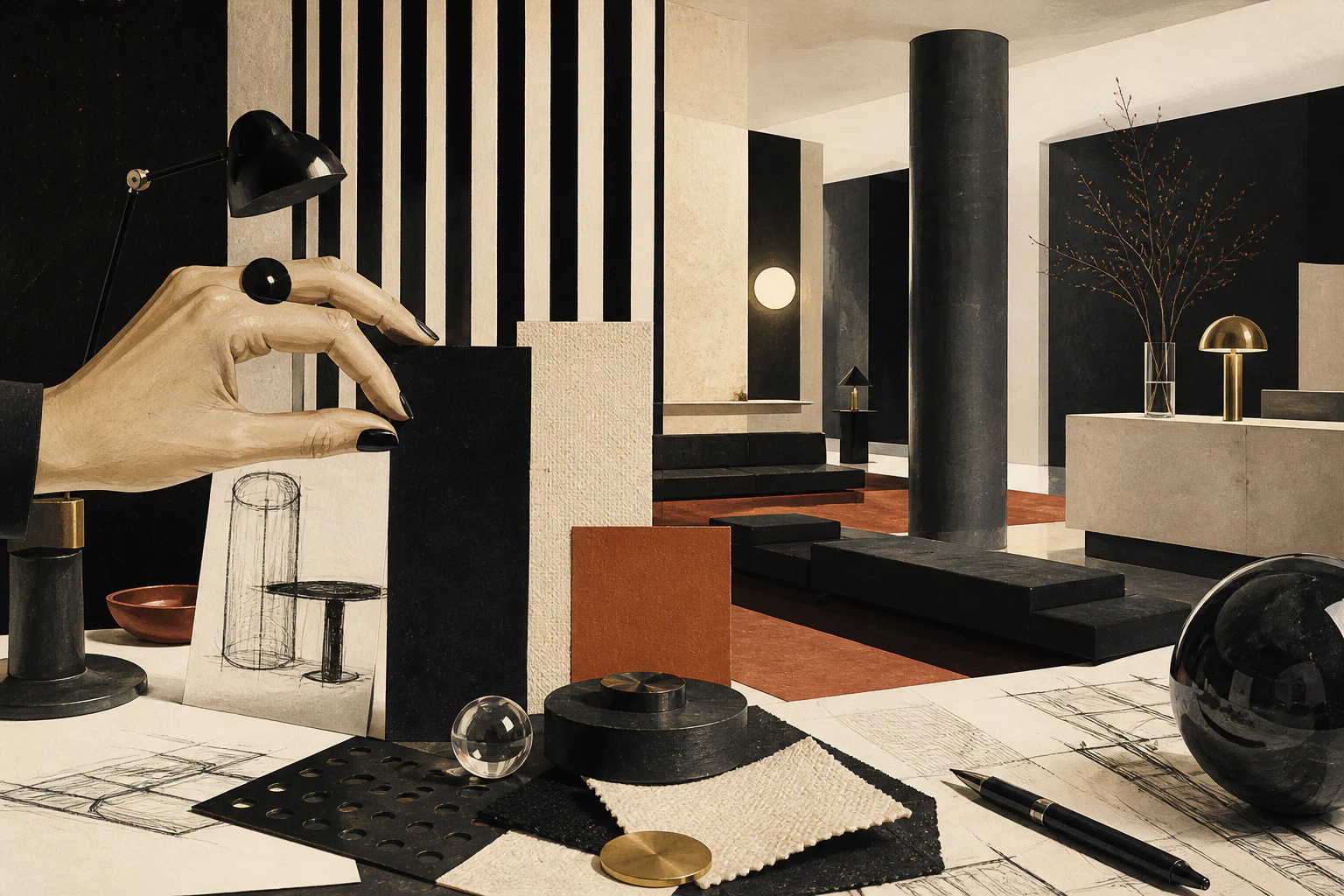

Andrée Putman changed the idea of the luxury interior by rejecting compulsory expensive decoration. Black-and-white graphics, precise materials, light, historical design and an ability to work across hotels, shops and aircraft allowed restraint to become a form of status in its own right.
Editorial thesis
Andrée Putman changed the idea of the luxury interior by rejecting compulsory expensive decoration. Black-and-white graphics, precise materials, light, historical design and an ability to work across hotels, shops and aircraft allowed restraint to become a form of status in its own right.
Reader question
How can an interior feel luxurious without displaying wealth through decorative excess?
Short answer
Putman came to interior design through music, fashion and cultural work. Her company Écart International brought forgotten modernist objects back into production, while hotels and shops of the 1980s and 1990s showed that luxury could be built from proportion, contrast and intellectual selection.
1. A path through music, fashion and culture
Putman did not begin as a conventional interior architect. Musical training and work across cultural and fashion environments shaped an interdisciplinary perspective. [source]
2. Mechanism: spatial rhythm
Her interiors operate as rhythm and sequence rather than collections of beautiful objects. The point is not an isolated gesture but a way of organising practice. The decision connects author, material, institution, technology and audience, so it cannot be reduced to a personal signature or a polished result. For VANSMITHLAB this episode functions as a mechanism that can be compared across neighbouring practices. [source]
3. Significance: spatial rhythm
This episode explains why Andrée Putman belongs in VANSMITHLAB’s map of authors. The significance lies in changing professional rules: who decides, how authorship is distributed, what counts as the result, and how the work enters public culture. The profile therefore keeps context attached to achievement instead of turning biography into a list of milestones. [source]
4. Écart International, 1978: the archive becomes a contemporary resource
In 1978 Putman founded Écart International, which helped bring works by Eileen Gray, Jean-Michel Frank and other modernists back into production. [source]
5. Mechanism: re-edition as curation
Re-edition is not neutral copying of the past; it reshapes the canon and educates a new generation of taste. The point is not an isolated gesture but a way of organising practice. The decision connects author, material, institution, technology and audience, so it cannot be reduced to a personal signature or a polished result. For VANSMITHLAB this episode functions as a mechanism that can be compared across neighbouring practices. [source]
6. Significance: re-edition as curation
This episode explains why Andrée Putman belongs in VANSMITHLAB’s map of authors. The significance lies in changing professional rules: who decides, how authorship is distributed, what counts as the result, and how the work enters public culture. The profile therefore keeps context attached to achievement instead of turning biography into a list of milestones. [source]
7. Black and white: contrast as architecture
Checkerboard and graphic black-and-white schemes became one of Putman’s recognisable tools, particularly in bathrooms and public spaces. [source]
8. Mechanism: graphic rhythm
Contrast works not as surface decoration but as a way to measure plane, movement and boundary. The point is not an isolated gesture but a way of organising practice. The decision connects author, material, institution, technology and audience, so it cannot be reduced to a personal signature or a polished result. For VANSMITHLAB this episode functions as a mechanism that can be compared across neighbouring practices. [source]
9. Significance: graphic rhythm
This episode explains why Andrée Putman belongs in VANSMITHLAB’s map of authors. The significance lies in changing professional rules: who decides, how authorship is distributed, what counts as the result, and how the work enters public culture. The profile therefore keeps context attached to achievement instead of turning biography into a list of milestones. [source]
10. Morgans Hotel, 1984: a small room gains a large identity
The interiors of Morgans Hotel in New York became one of Putman’s defining projects and an important moment in the development of the small design-led hotel. [source]
11. Mechanism: hotel as identity
Limited budget and area can strengthen a project when identity is built through precise repeatable decisions. The point is not an isolated gesture but a way of organising practice. The decision connects author, material, institution, technology and audience, so it cannot be reduced to a personal signature or a polished result. For VANSMITHLAB this episode functions as a mechanism that can be compared across neighbouring practices. [source]
12. Significance: hotel as identity
This episode explains why Andrée Putman belongs in VANSMITHLAB’s map of authors. The significance lies in changing professional rules: who decides, how authorship is distributed, what counts as the result, and how the work enters public culture. The profile therefore keeps context attached to achievement instead of turning biography into a list of milestones. [source]
13. Luxury without gilding
Putman repeatedly challenged the idea that expensive interiors must display cost through rare materials and decorative excess. [source]
14. Mechanism: restrained luxury
Status shifts from the price of a surface to the quality of proportion, detail, light and selection. The point is not an isolated gesture but a way of organising practice. The decision connects author, material, institution, technology and audience, so it cannot be reduced to a personal signature or a polished result. For VANSMITHLAB this episode functions as a mechanism that can be compared across neighbouring practices. [source]
15. Significance: restrained luxury
This episode explains why Andrée Putman belongs in VANSMITHLAB’s map of authors. The significance lies in changing professional rules: who decides, how authorship is distributed, what counts as the result, and how the work enters public culture. The profile therefore keeps context attached to achievement instead of turning biography into a list of milestones. [source]
16. The shop as spatial image of a brand
Putman’s work with shops and brands showed that retail space could convey a company’s character without literal repetition of its logo. [source]
17. Mechanism: shop as brand image
Spatial identity emerges through circulation, material and the relationship between product and emptiness. The point is not an isolated gesture but a way of organising practice. The decision connects author, material, institution, technology and audience, so it cannot be reduced to a personal signature or a polished result. For VANSMITHLAB this episode functions as a mechanism that can be compared across neighbouring practices. [source]
18. Significance: shop as brand image
This episode explains why Andrée Putman belongs in VANSMITHLAB’s map of authors. The significance lies in changing professional rules: who decides, how authorship is distributed, what counts as the result, and how the work enters public culture. The profile therefore keeps context attached to achievement instead of turning biography into a list of milestones. [source]
19. From hotel to aircraft: scale does not change the principle
Putman worked across private and public interiors of different types, including transport and corporate projects. [source]
20. Mechanism: editing the environment
A consistent method appears not through repeated furniture but through editing a complex environment down to a few clear decisions. The point is not an isolated gesture but a way of organising practice. The decision connects author, material, institution, technology and audience, so it cannot be reduced to a personal signature or a polished result. For VANSMITHLAB this episode functions as a mechanism that can be compared across neighbouring practices. [source]
21. Significance: editing the environment
This episode explains why Andrée Putman belongs in VANSMITHLAB’s map of authors. The significance lies in changing professional rules: who decides, how authorship is distributed, what counts as the result, and how the work enters public culture. The profile therefore keeps context attached to achievement instead of turning biography into a list of milestones. [source]
22. A woman author and the interior canon
Putman achieved international status in a field whose public history long privileged male architects and authors of individual objects. [source]
23. Mechanism: the autonomy of interiors
Her career helps establish interior design as an authored field rather than a secondary layer within architecture. The point is not an isolated gesture but a way of organising practice. The decision connects author, material, institution, technology and audience, so it cannot be reduced to a personal signature or a polished result. For VANSMITHLAB this episode functions as a mechanism that can be compared across neighbouring practices. [source]
24. Significance: the autonomy of interiors
This episode explains why Andrée Putman belongs in VANSMITHLAB’s map of authors. The significance lies in changing professional rules: who decides, how authorship is distributed, what counts as the result, and how the work enters public culture. The profile therefore keeps context attached to achievement instead of turning biography into a list of milestones. [source]
25. Renewed attention in the 2020s
Exhibitions, re-editions and publications in the 2020s renewed interest in Putman and her influence on contemporary restrained luxury. [source]
26. Mechanism: canon and rediscovery
An author’s return to the canon shows how design history is continually edited by new generations. The point is not an isolated gesture but a way of organising practice. The decision connects author, material, institution, technology and audience, so it cannot be reduced to a personal signature or a polished result. For VANSMITHLAB this episode functions as a mechanism that can be compared across neighbouring practices. [source]
27. Significance: canon and rediscovery
This episode explains why Andrée Putman belongs in VANSMITHLAB’s map of authors. The significance lies in changing professional rules: who decides, how authorship is distributed, what counts as the result, and how the work enters public culture. The profile therefore keeps context attached to achievement instead of turning biography into a list of milestones. [source]
28. Legacy: interior design as the art of selection
Putman’s central lesson is not to copy a black-and-white checkerboard but to practise disciplined selection and refusal of excess. [source]
29. Mechanism: selection over decoration
Restraint becomes convincing when the absence of decorative noise is backed by exact work on proportion and use. The point is not an isolated gesture but a way of organising practice. The decision connects author, material, institution, technology and audience, so it cannot be reduced to a personal signature or a polished result. For VANSMITHLAB this episode functions as a mechanism that can be compared across neighbouring practices. [source]
30. Significance: selection over decoration
This episode explains why Andrée Putman belongs in VANSMITHLAB’s map of authors. The significance lies in changing professional rules: who decides, how authorship is distributed, what counts as the result, and how the work enters public culture. The profile therefore keeps context attached to achievement instead of turning biography into a list of milestones. [source]