interior designer profile
Jean-Michel Frank
Emptiness, Material and the Discipline of Understatement
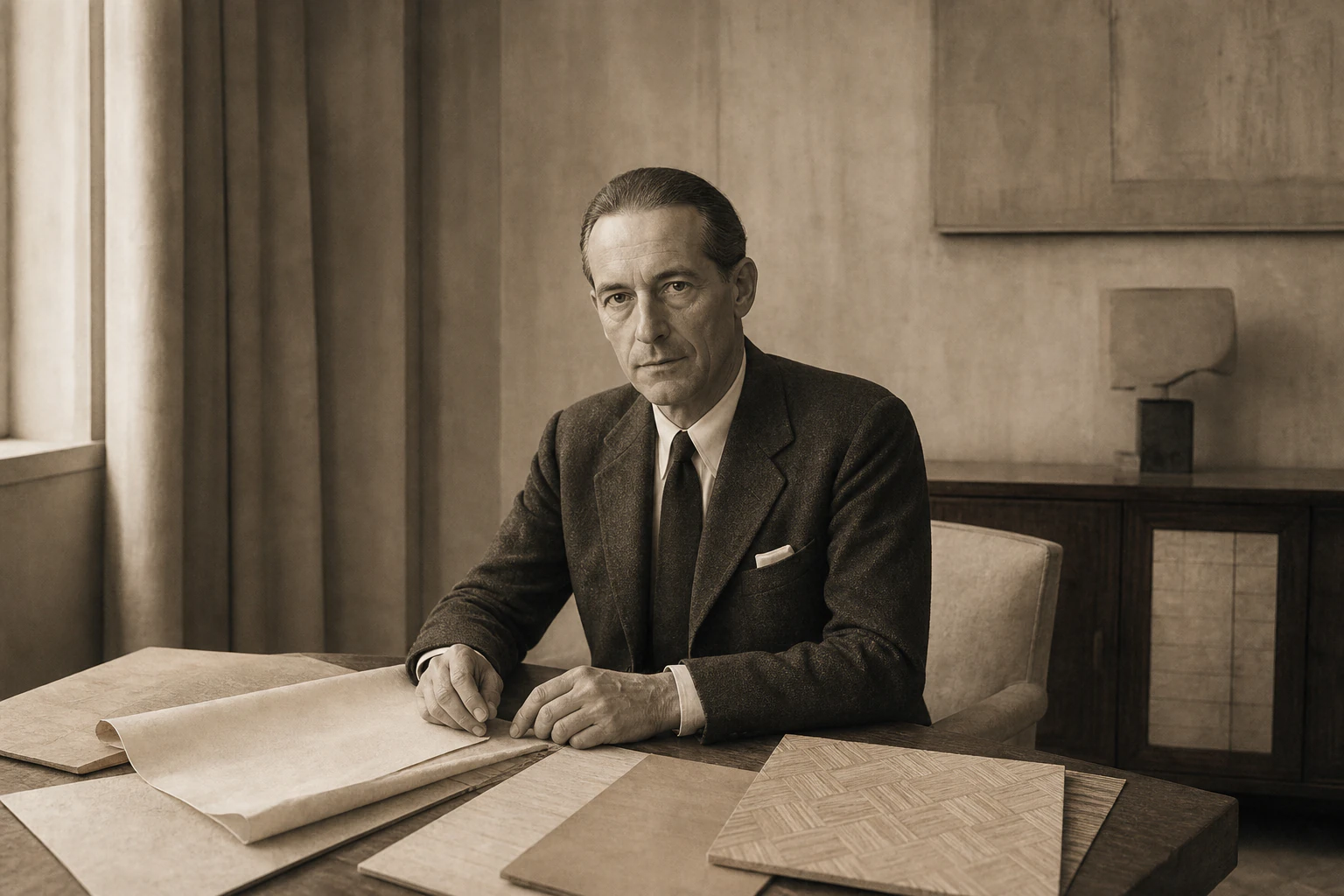
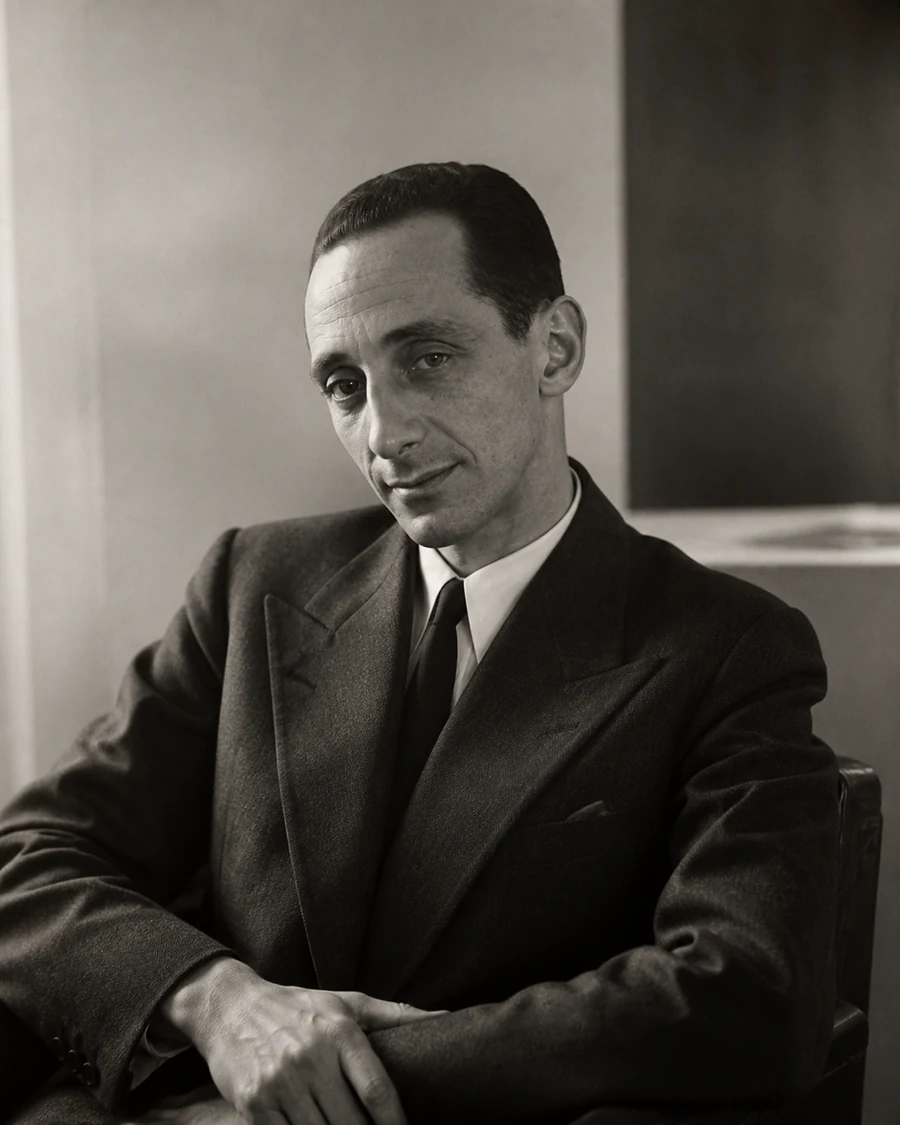
Frank transformed luxury from a display of cost into a system of proportion, emptiness and surface: parchment, straw, leather, plaster, simple form and rare artistic objects worked because every element received exact distance.
Editorial thesis
Jean-Michel Frank matters not simply as an early minimalist or ancestor of contemporary beige luxury. His method is more complex: he reduces visual noise so material, proportion and a single artistic object gain intensity. Luxury becomes not quantity but precision of relations.
Reader question
How can an interior look almost empty while being among the most expensive and craft-intensive spaces of its period?
Short answer
Because Frank moves value from ornament to surface and production. Parchment, rye straw, leather, plaster and handmade objects reveal cost through light, touch and execution rather than overt display.
1. Paris, 1895: luxury begins without displaying wealth
Jean-Michel Frank was born in Paris in 1895 into an affluent Jewish family connected to international banking. Historical accounts from the Comité Jean-Michel Frank and Ecart trace his path from private interior experiments after the First World War to professional practice at the end of the 1920s and beginning of the 1930s. [source]
His later language is especially paradoxical against that background. Frank worked for some of the wealthiest clients in Europe and the United States yet systematically removed conventional signs of display: gilded furniture, heavy ornament and decorative excess. Value moved toward proportion, surface, light and touch.
2. Family catastrophe and the limits of biographical interpretation
The First World War and its aftermath brought severe losses to Frank’s family. Biographers connect these events to his reserve and difficult psychological life, yet it would be reductive to derive his restrained interiors directly from trauma. [source]
For VANSMITHLAB the distinction between biography and method matters. History may help explain sensitivity, but it cannot replace analysis of how a designer actually organised plan, object and material.
3. 1919–1920s: first interiors before the professional firm
Ecart dates Frank’s first interior work to 1919. During the 1920s he gradually established clients and craftspeople before his formal partnership with Adolphe Chanaux. [source]
The early period reveals an important trait: Frank does not begin by producing a furniture collection. He begins by organising a room—removing excess, choosing surfaces, controlling scale and only then deciding what objects are necessary.
4. Marie-Laure and Charles de Noailles: “emptiness” becomes a cultural position
In the mid-1920s Frank worked for Marie-Laure and Charles de Noailles in their Paris hôtel particulier on place des États-Unis. Period publications showed rooms using parchment, straw marquetry, mirrors and sharply reduced quantities of furniture. [source]
The interior is often treated as proto-minimalism, but controlled emptiness is more precise. Frank did not reject luxury; he changed its carrier. Wealth moved from number of objects to the quality of silence between them.
5. Parchment: a costly material behaves almost like a neutral wall
Parchment became one of Frank’s most recognisable materials. Cooper Hewitt records its use across walls, ceilings and furniture beside straw, leather, shagreen and plaster. [source]
Its paradox is that an expensive, labour-intensive surface produces visual calm. The cloudy finish does not announce cost loudly, yet it changes continuously with light and viewing distance.
6. Rye straw: a humble material becomes high craft
Rye-straw marquetry became another defining surface. A cheap agricultural material is transformed through handwork into a precise system of reflection, grain and tone. Ecart and Hermès still preserve the material in authorised re-editions. [source]
This is where Frank’s strange luxury is clearest: value comes not from raw material price alone, but from labour, precision and optical effect.
7. Plaster, gypsum, sackcloth: deliberately low-status materials
Frank used plaster, gypsum, sackcloth, rattan and sanded oak beside more costly leather, shagreen and ivory. Ecart explicitly documents this broad palette. [source]
Material acquires status through adjacency. A rough surface beside immaculate leather makes both more vivid. This is not an aesthetic of poverty but a management of tactile contrast.
8. 1927–1929: Templeton Crocker and an American test of modern luxury
For Charles Templeton Crocker in San Francisco, Frank participated in a major penthouse interior at the end of the 1920s. The Met and Cooper Hewitt preserve the project context, while Vogue in 1929 presented it as an exceptional example of a fully modern luxurious American apartment. [source]
Frank was no longer working only within a Paris circle. His language had to survive a different scale of wealth and publicity without becoming decorative spectacle.
9. Crocker as a collective project: Jean Dunand, Pierre Legrain, Madame Lipska and Frank
The Templeton Crocker interior cannot honestly be attributed to Frank alone. The Metropolitan Museum of Art notes that different rooms were created by Jean Dunand, Pierre Legrain, Madame Lipska and Jean-Michel Frank. [source]
This matters for interior history. A large residence is often a distributed authorship system. A coherent total effect does not mean every room belongs to one designer.
10. 1929: Man Ray Chess Table — furniture becomes infrastructure for another author
MoMA credits the 1929 Chess Table jointly to Jean-Michel Frank and Man Ray: Frank designed the table specifically for Man Ray’s chess set. In 2025–2026 the object is on view in MoMA’s collection galleries. [source]
The table is a useful collaboration model. Frank does not decorate an artist’s work; he creates the infrastructure that gives another authorial object the right height, scale and material frame.
11. Adolphe Chanaux: decorative intention becomes a production system
In 1930 Frank entered the Chanaux company and soon became artistic director; Adolphe Chanaux’s workshop provided technical development and manufacture. Cooper Hewitt notes that Frank, as design director, worked with a substantial team of craftspeople. [source]
Jean-Michel Frank furniture is therefore not the story of a solitary sketch. Parchment, straw marquetry and leather require workshop intelligence. Chanaux belongs to the authorship of the result.
12. 1935: the Frank & Chanaux boutique as public manifesto
In 1935 Frank opened a shop on rue du Faubourg-Saint-Honoré. Ecart and Fondation Giacometti describe the place as a meeting point for Christian Bérard, Alberto and Diego Giacometti, Emilio Terry, Paul Rodocanachi and other collaborators around Frank and Chanaux. [source]
It functioned as more than a furniture showroom. The boutique made the interior designer an editor of a cultural environment where object, artist, material and client could meet.
13. Alberto Giacometti: utilitarian objects inside the restrained interior
Fondation Giacometti documents Frank and Alberto Giacometti’s collaboration from the early 1930s: lamps, sconces, vases, fire dogs, bas-reliefs and other utilitarian objects were created for projects and distributed through Frank. [source]
It is misleading to describe this as a decorator ordering ornaments from an artist. The rough plaster and bronze surfaces of Giacometti became structural counterpoints within Frank’s pale, emptied rooms.
14. Diego Giacometti and the less visible material side of collaboration
Fondation Giacometti notes that Diego Giacometti assisted Alberto in executing decorative objects and also developed some models produced for Frank. [source]
This corrects the romantic “Frank + Alberto” story. Real production passes through workshop, maker, foundry, upholsterer and material specialist. Interior authorship is usually more collective than a catalogue signature suggests.
15. Christian Bérard: colour enters Frank’s supposedly white world
Christian Bérard was a recurring artistic collaborator. Comité Jean-Michel Frank and Fondation Giacometti place him within Frank’s circle, while later research stresses that Frank increasingly allowed colour and historical references into his work. [source]
This disrupts the cliché of a designer of endless beige. Restraint for Frank is not the absence of colour but control over its dosage.
16. History of styles: modernism without compulsory rupture from the past
Ecart stresses that Frank drew actively on historical styles rather than trying to begin design from zero. His furniture uses archetypal forms, neoclassical echoes and classical proportions stripped of conventional ornament. [source]
That separates him from dogmatic functionalism. Modernity means allowing an old form to receive a new surface, scale and silence.
17. Parsons table: a legend is more useful as an authorship question than as a tidy myth
The so-called Parsons table is frequently associated with Frank and the Paris branch of Parsons School, but origin accounts differ. Sources bring in Frank, American designer Joseph B. Platt and a teaching context, making single authorship difficult to prove. [source]
For VANSMITHLAB the object is a warning: once a typology feels inevitable, the market wants to give it one author. Historians should preserve uncertainty where documents remain ambiguous.
18. Hermès from 1924: upholstery as technological collaboration
Hermès traces its relationship with Frank to his 1924 meeting with Jean-René Guerrand. The house adapted saddlery and leather-working expertise to furniture upholstery and wall coverings and today continues authorised Rééditions J.-M. Frank par Hermès. [source]
Here a luxury house is not simply a later manufacturer. The historical connection shows how Hermès craft participated in forming Frank’s language in the first place.
19. Elsa Schiaparelli, 21 Place Vendôme: interior design enters Surrealism
In 1935 Schiaparelli moved into the Hôtel de Fontpertuis at 21 Place Vendôme. The Maison’s official history and the V&A record that Jean-Michel Frank designed the interiors in collaboration with Alberto Giacometti. [source]
The restrained Frank sits beside one of fashion’s most theatrical figures. The contrast shows the flexibility of his method: neutral architecture can frame shocking colour, surrealist objects and fashion spectacle.
20. La Cage, 1937: Frank can also be theatrical
For Schiaparelli’s perfume space Frank created a giant birdcage installation in gilded bamboo and black metal. Maison Schiaparelli states that La Cage is still installed at 21 Place Vendôme. [source]
The object is important because it contradicts the simplified minimalist image. Frank could work with bright, scenographic form when a retail and theatrical task required it.
21. Boutique and couture: interior design becomes part of brand experience
Projects for Schiaparelli, Lucien Lelong, Marcel Rochas and other fashion clients show Frank working beyond private residences. Comité Jean-Michel Frank documents his activity in showrooms and commercial interiors. [source]
Interior design begins to shape brand identity before the contemporary term retail experience. Material, furniture, light and customer route extend the fashion house’s image.
22. Villa Bontoc: a unified interior survives through a group of objects
Cooper Hewitt preserves a substantial group created primarily for Villa Bontoc in Saint-Jean-Cap-Ferrat: armchairs, desks, tables, lamps and a bed. The museum emphasises the value of the group as evidence of unified interior treatment. [source]
It is a rare chance to analyse not one iconic table but a system of things originally intended to work together. Interior design returns from the market of isolated lots to the context of the room.
23. Nelson Rockefeller, 1938–1939: the last major American project
At the end of the 1930s Frank received a major commission from Nelson Rockefeller in New York. Sotheby’s and Cooper Hewitt describe an interior combining Frank furniture, Hermès leather, Giacometti lighting and modern art. [source]
The project represents a mature version of his method: a room can be rich in art and material without being visually overloaded. Editing the collection becomes as important as making new furniture.
24. Wallace Harrison and Rockefeller: the interior exists inside another author’s architecture
In the Rockefeller commission, the architectural shell was not Frank’s; sources connect the apartment to architect Wallace K. Harrison. [source]
This is a crucial distinction between architecture and interior authorship. Frank transforms atmosphere, scale, light and the object layer without becoming architect of the entire building or apartment by retrospective inflation.
25. Jorge and Matilda Born: Paris designs Buenos Aires
In 1938 Frank received a major commission from Jorge and Matilda Born for a villa in San Isidro outside Buenos Aires. Fondation Giacometti documents new bas-reliefs, consoles, fireplaces and lighting developed for the project, while the complete décor was tested in Paris before shipment. [source]
It is an early model of global interior production: design, prototype and fabrication happen in one city; installation takes place on another continent; authorship is distributed among designer, artist, workshop and client.
26. 1939–1940: war destroys the production infrastructure
With the outbreak of war the Frank & Chanaux workshops closed. Ecart and Comité Jean-Michel Frank record Frank’s departure from France; as a Jewish and homosexual man he faced direct danger in occupied Europe. [source]
This is not external biography. War destroys not only the author’s life but the chain of craftspeople, suppliers, clients and workshops on which the material precision of his interiors depended.
27. Buenos Aires: exile does not immediately end the work
By late 1940 Frank was in Argentina and personally supervising completion of the Born interiors; Fondation Giacometti confirms this stage. The Comité also records renewed professional activity in Buenos Aires. [source]
Exile does not instantly turn him into a former designer. The method continues, but without the stable Paris infrastructure that had supported much of the practice.
28. New York, March 1941: the biography ends, but the profile should not collapse into tragedy
Jean-Michel Frank died in New York on 8 March 1941. The Comité and historical studies record his suicide after exile and severe emotional crisis. [source]
The death often becomes the dramatic end of biographies, but design history should not let it consume nearly two decades of professional work. Frank’s legacy remains in objects, interiors, workshops and models of collaboration, not only in a tragic legend.
29. After 1941: re-edition, market and the problem of the “eternal original”
Today Frank furniture exists simultaneously in museum collections, the vintage market and authorised re-editions by Hermès and Ecart. Hermès explicitly presents its Rééditions as a continuation of the historical relationship, while Ecart maintains a dedicated Jean-Michel Frank line. [source]
Re-edition preserves typology but changes context. A piece made for one room and one client becomes an independent collectible product. Publication should therefore distinguish original commission, authorised re-edition and market reproduction.
30. 2026: Frank returns not only through “quiet luxury” but through collective authorship
In 2026 interest in Frank’s environment is supported by more than the market. Institut Giacometti presents Surrealist Giacometti. Objects like Sculptures, explicitly returning decorative objects created for Jean-Michel Frank to dialogue with Giacometti’s art practice. [source]
This is more precise than the contemporary label quiet luxury. Frank matters as an editor of relations among emptiness, rare surfaces, historical form, artist collaboration and craft production.