interior designer profile
Pierre Chareau
Interior as mechanism: furniture, glass, movement and the architecture of Maison de Verre
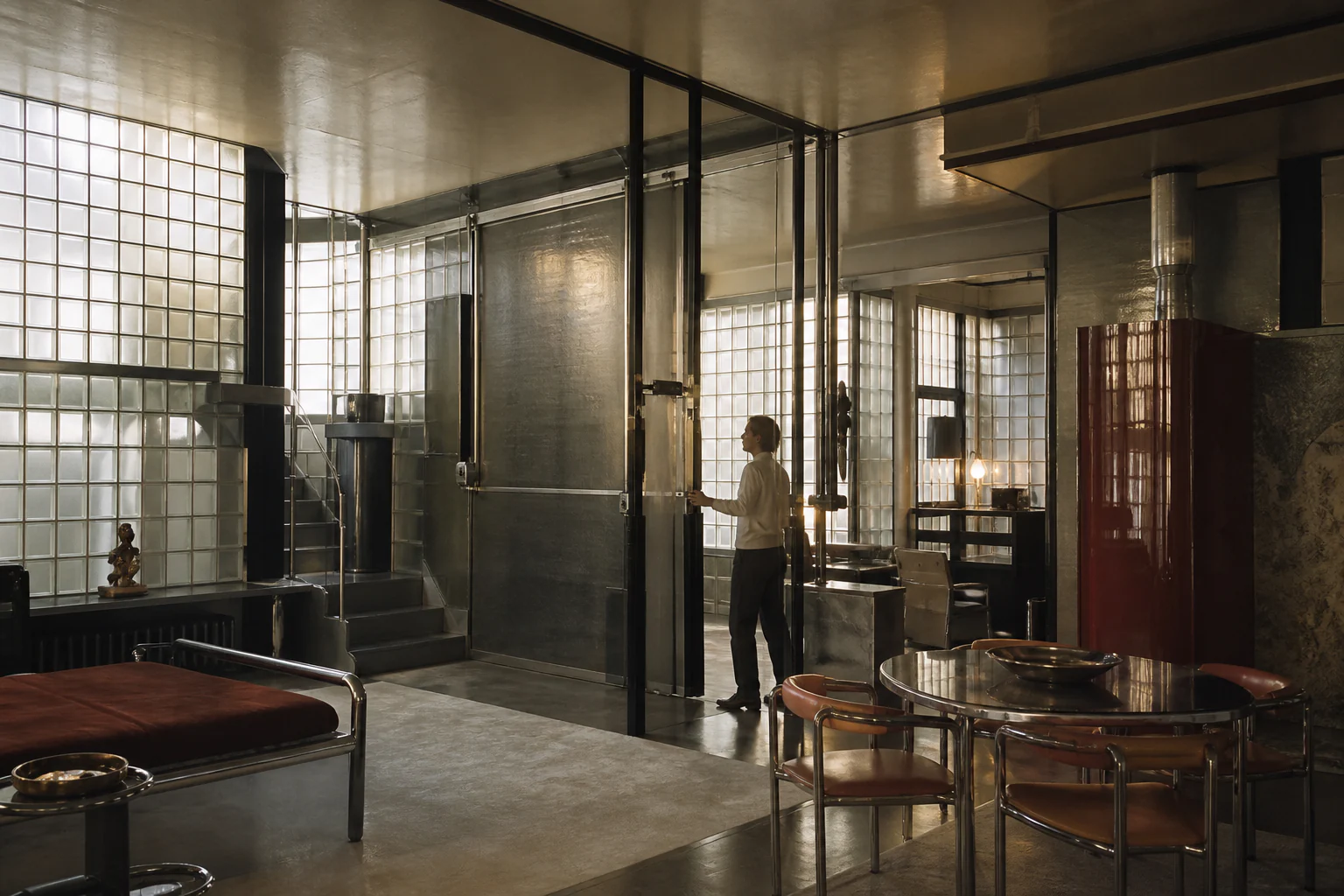

Pierre Chareau matters because furniture, partition, light and architecture cease to be separate categories in his work. In the Maison de Verre and elsewhere, the interior becomes a mechanism of behaviour: panels move, light is filtered, furniture changes function and industrial details enter domestic space without disguise.
Editorial thesis
Pierre Chareau matters because furniture, partition, light and architecture cease to be separate categories in his work. In the Maison de Verre and elsewhere, the interior becomes a mechanism of behaviour: panels move, light is filtered, furniture changes function and industrial details enter domestic space without disguise.
Reader question
How did an interior designer turn a house into a complex machine of privacy, movement and light without losing human scale?
Short answer
Chareau worked in furniture and interiors in France during the first half of the twentieth century. His major work, the Maison de Verre, made with Bernard Bijvoet for the Dalsace family, combined glass block, metal structure, moving elements and purpose-designed furniture into one spatial system.
1. Furniture before the architectural icon
Chareau first became known as a designer of furniture and interiors, producing objects, built-ins and rooms for private clients. [source]
2. Mechanism: interior begins with action
Architectural scale grows from knowing how a person opens a cabinet, sits, moves and changes the position of objects. The point is not an isolated gesture but a way of organising practice. The decision connects author, material, institution, technology and audience, so it cannot be reduced to a personal signature or a polished result. For VANSMITHLAB this episode functions as a mechanism that can be compared across neighbouring practices. [source]
3. Significance: interior begins with action
This episode explains why Pierre Chareau belongs in VANSMITHLAB’s map of authors. The significance lies in changing professional rules: who decides, how authorship is distributed, what counts as the result, and how the work enters public culture. The profile therefore keeps context attached to achievement instead of turning biography into a list of milestones. [source]
4. Moving furniture: function need not be fixed
Chareau’s furniture includes hinged, sliding and rotating elements that allow objects to change configuration according to use. [source]
5. Mechanism: mechanism as image
Mechanism becomes part of the object’s language rather than hidden technical equipment. The point is not an isolated gesture but a way of organising practice. The decision connects author, material, institution, technology and audience, so it cannot be reduced to a personal signature or a polished result. For VANSMITHLAB this episode functions as a mechanism that can be compared across neighbouring practices. [source]
6. Significance: mechanism as image
This episode explains why Pierre Chareau belongs in VANSMITHLAB’s map of authors. The significance lies in changing professional rules: who decides, how authorship is distributed, what counts as the result, and how the work enters public culture. The profile therefore keeps context attached to achievement instead of turning biography into a list of milestones. [source]
7. Maison de Verre: collaborative authorship
The Maison de Verre in Paris was made for Annie and Jean Dalsace and is associated with Chareau, Dutch architect Bernard Bijvoet, craftsmen and engineers. [source]
8. Mechanism: the Maison de Verre collective
The canonical house cannot accurately be described as a lone gesture; its complexity emerged through collaboration and technical improvisation. The point is not an isolated gesture but a way of organising practice. The decision connects author, material, institution, technology and audience, so it cannot be reduced to a personal signature or a polished result. For VANSMITHLAB this episode functions as a mechanism that can be compared across neighbouring practices. [source]
9. Significance: the Maison de Verre collective
This episode explains why Pierre Chareau belongs in VANSMITHLAB’s map of authors. The significance lies in changing professional rules: who decides, how authorship is distributed, what counts as the result, and how the work enters public culture. The profile therefore keeps context attached to achievement instead of turning biography into a list of milestones. [source]
10. Glass block: light without full transparency
The glass-block facade admits diffused light without turning private life into a transparent display. [source]
11. Mechanism: light and privacy
The material solves technical, psychological and urban problems at once: light passes while the gaze is held back. The point is not an isolated gesture but a way of organising practice. The decision connects author, material, institution, technology and audience, so it cannot be reduced to a personal signature or a polished result. For VANSMITHLAB this episode functions as a mechanism that can be compared across neighbouring practices. [source]
12. Significance: light and privacy
This episode explains why Pierre Chareau belongs in VANSMITHLAB’s map of authors. The significance lies in changing professional rules: who decides, how authorship is distributed, what counts as the result, and how the work enters public culture. The profile therefore keeps context attached to achievement instead of turning biography into a list of milestones. [source]
13. Metal without disguise
Inside the Maison de Verre, metal stairs, perforated panels, industrial fittings and tracks remain visible. [source]
14. Mechanism: visible construction
Industrial detail does not imitate domestic finish; its precision becomes part of the atmosphere. The point is not an isolated gesture but a way of organising practice. The decision connects author, material, institution, technology and audience, so it cannot be reduced to a personal signature or a polished result. For VANSMITHLAB this episode functions as a mechanism that can be compared across neighbouring practices. [source]
15. Significance: visible construction
This episode explains why Pierre Chareau belongs in VANSMITHLAB’s map of authors. The significance lies in changing professional rules: who decides, how authorship is distributed, what counts as the result, and how the work enters public culture. The profile therefore keeps context attached to achievement instead of turning biography into a list of milestones. [source]
16. Home and medical practice in one volume
The Maison de Verre combined the Dalsace family home with Jean Dalsace’s medical practice, requiring different levels of access, acoustics and privacy. [source]
17. Mechanism: programme as generator
Complex programme becomes a source of architecture as circulation and modes of life shape space. The point is not an isolated gesture but a way of organising practice. The decision connects author, material, institution, technology and audience, so it cannot be reduced to a personal signature or a polished result. For VANSMITHLAB this episode functions as a mechanism that can be compared across neighbouring practices. [source]
18. Significance: programme as generator
This episode explains why Pierre Chareau belongs in VANSMITHLAB’s map of authors. The significance lies in changing professional rules: who decides, how authorship is distributed, what counts as the result, and how the work enters public culture. The profile therefore keeps context attached to achievement instead of turning biography into a list of milestones. [source]
19. The moving partition: room as a condition
Sliding and rotating elements allow rooms to change their degree of openness and connection. [source]
20. Mechanism: the adaptable room
A room stops being a fixed box and becomes a temporary condition of relationships among people. The point is not an isolated gesture but a way of organising practice. The decision connects author, material, institution, technology and audience, so it cannot be reduced to a personal signature or a polished result. For VANSMITHLAB this episode functions as a mechanism that can be compared across neighbouring practices. [source]
21. Significance: the adaptable room
This episode explains why Pierre Chareau belongs in VANSMITHLAB’s map of authors. The significance lies in changing professional rules: who decides, how authorship is distributed, what counts as the result, and how the work enters public culture. The profile therefore keeps context attached to achievement instead of turning biography into a list of milestones. [source]
22. Exile in the United States and late work
During the Second World War Chareau moved to the United States, where he continued working and designed, among other projects, a house for artist Robert Motherwell. [source]
23. Mechanism: architecture of exile
Exile changes access to commissions, materials and professional networks; the late career cannot be read as a simple continuation of Paris. The point is not an isolated gesture but a way of organising practice. The decision connects author, material, institution, technology and audience, so it cannot be reduced to a personal signature or a polished result. For VANSMITHLAB this episode functions as a mechanism that can be compared across neighbouring practices. [source]
24. Significance: architecture of exile
This episode explains why Pierre Chareau belongs in VANSMITHLAB’s map of authors. The significance lies in changing professional rules: who decides, how authorship is distributed, what counts as the result, and how the work enters public culture. The profile therefore keeps context attached to achievement instead of turning biography into a list of milestones. [source]
25. Museum canon and preservation of the house
Exhibitions and research, including a major Jewish Museum project, returned Chareau to a broader international context of architecture and design. [source]
26. Mechanism: archive and canon
The canon is not built only when an object is made; archives, exhibitions and preservation redefine an author’s significance. The point is not an isolated gesture but a way of organising practice. The decision connects author, material, institution, technology and audience, so it cannot be reduced to a personal signature or a polished result. For VANSMITHLAB this episode functions as a mechanism that can be compared across neighbouring practices. [source]
27. Significance: archive and canon
This episode explains why Pierre Chareau belongs in VANSMITHLAB’s map of authors. The significance lies in changing professional rules: who decides, how authorship is distributed, what counts as the result, and how the work enters public culture. The profile therefore keeps context attached to achievement instead of turning biography into a list of milestones. [source]
28. Legacy: the interior as a working machine of relationships
Chareau demonstrated that an interior can be tactile, industrial, adaptable and intimate at the same time. [source]
29. Mechanism: space as relationships
The central lesson of the Maison de Verre is not to copy glass block and metal but to design through real conditions of light, access, movement and privacy. The point is not an isolated gesture but a way of organising practice. The decision connects author, material, institution, technology and audience, so it cannot be reduced to a personal signature or a polished result. For VANSMITHLAB this episode functions as a mechanism that can be compared across neighbouring practices. [source]
30. Significance: space as relationships
This episode explains why Pierre Chareau belongs in VANSMITHLAB’s map of authors. The significance lies in changing professional rules: who decides, how authorship is distributed, what counts as the result, and how the work enters public culture. The profile therefore keeps context attached to achievement instead of turning biography into a list of milestones. [source]