photographer profile
Deborah Turbeville
Memory, decay and the anti-gloss of fashion photography
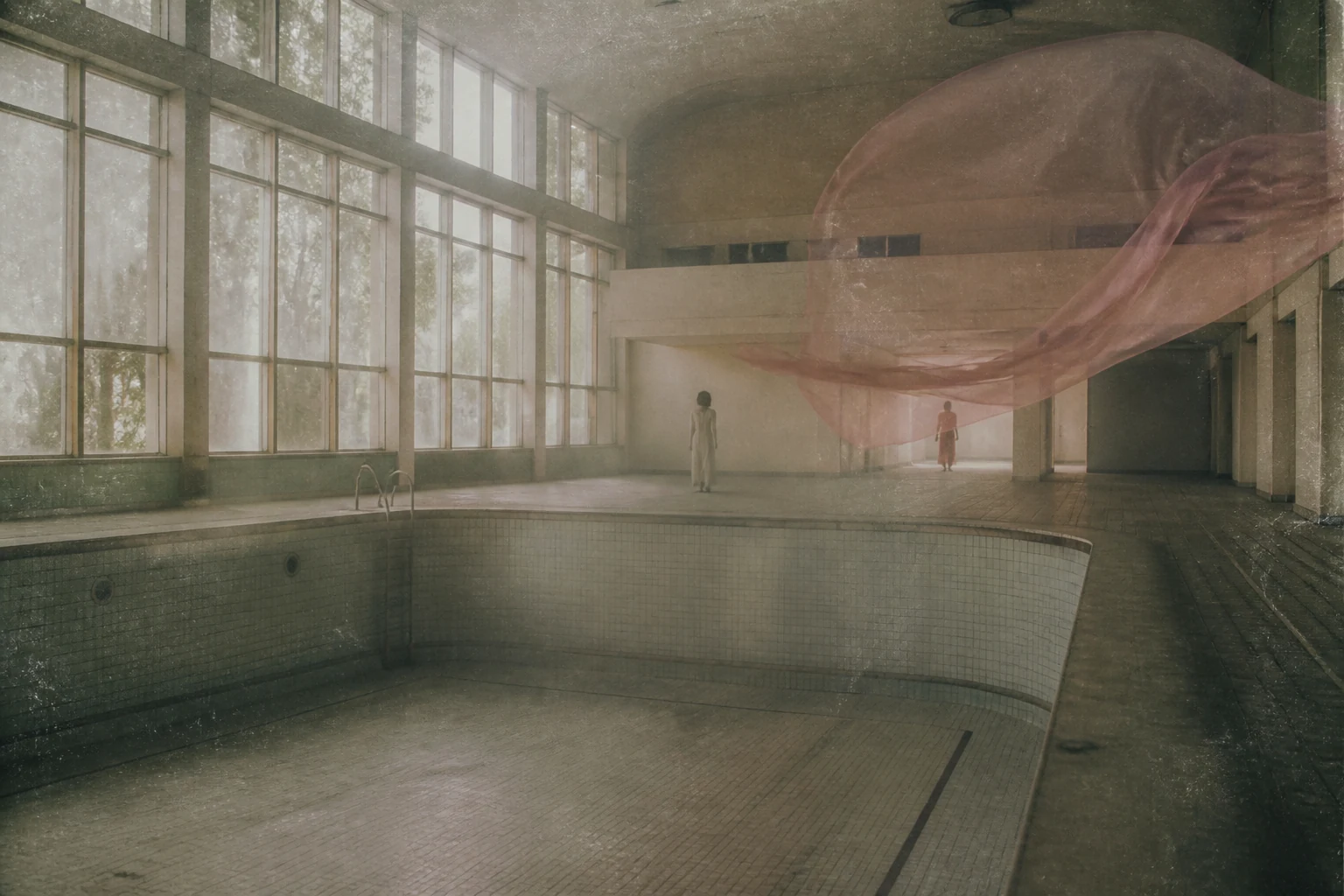
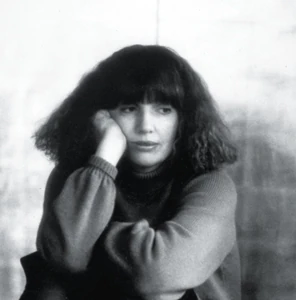
"Turbeville shattered the idea of the fashion image as a flawless surface. Her models do not display the clothes; they exist within memory, architectural decay and psychological pause. Scratches, joins, dust and unfinished gestures become not defects but content of the photograph."
Editorial thesis
Turbeville'"'"'s significance lies in the transformation of fashion photography into a psychological and material environment. She rejected the clear display of the product, the emphatic sexuality and the victorious energy of the genre, and built a language of solitude, historical memory, female distance and manual intervention in the print.
Reader question
Why can a blurred, scratched, faded or otherwise hard-to-read image convey clothing and a state of mind more strongly than a technically flawless fashion frame?
The central subject is Deborah Turbeville — her fashion editorials, personal series, Polaroids, collages, books, video and handwritten material.
Her work is treated not as a "female version" of Avedon or Newton but as an independent break with the dominant fashion photography.
Bathhouse is examined together with the history of the female body, psychiatric and institutional architecture, and the controversy over the alleged "heroin chic".
Blur and damage are treated as authorial processes, not as technical failure.
The models are read as psychological figures and performers, not only as bearers of clothing.
Photo collage is treated as an independent material practice.
All images require clearance from the Deborah Turbeville Estate, the MUUS Collection, the magazine, the brand, the museum and the documentation photographer.
Short answer
Deborah Turbeville was born on 6 July 1932 in Stoneham, Massachusetts. Before turning to photography she worked in fashion and editing, including for Claire McCardell and Harper'"'"'s Bazaar, and then studied photography in Richard Avedon'"'"'s workshop.
In the 1970s Turbeville developed her own language: isolated groups of women, abandoned interiors, muted colour, grain, scratches, joins and the traces of handwork. The Bathhouse series for Vogue in 1975 became one of the key turning points in fashion photography.
1. Stoneham, New England and an early imagination
Turbeville grew up in New England, where family memory, old houses and a sense of the past shaped her visual sensitivity.
In her mature work, architecture almost always carries the mark of time and loss.
Even the most luxurious clothes in her photographs exist as part of a world already disappearing.
2. Claire McCardell and the school of modern dress
At the beginning of her career Turbeville worked for the American designer Claire McCardell.
McCardell built clothing around freedom of movement and modern everyday life.
This experience gave Turbeville a deep understanding of fabric, construction and how clothes behave on the body.
3. Harper'"'"'s Bazaar and editorial work
Turbeville worked as an editor and stylist at Harper'"'"'s Bazaar and other fashion publications.
She learned to think not in single frames but in sequences, spreads and emotional rhythm.
Her editorial experience later showed itself in her books and collages.
4. Richard Avedon workshop
In the 1960s Turbeville attended Richard Avedon'"'"'s workshop.
Avedon helped her understand the professional level of fashion production and the force of an authorial decision.
Yet her mature language developed in almost the opposite direction: instead of clarity, energy and the white background — fog, distance and decay.
5. From fashion editor to photographer
The move to photography was not a sudden break with editorial work.
Turbeville continued to construct the image as an editor, choosing the place, the clothes, the model and the rhythm of the series.
The camera became part of a broader practice of visual montage.
6. First magazine publications
In the late 1960s and early 1970s her photographs began to appear in American and European magazines.
She worked for Vogue, Harper'"'"'s Bazaar, Nova, Mirabella and other publications.
The editors valued her atmosphere, although her images often broke the standard of clothing display.
7. Rejection of energetic fashion photography
The dominant fashion of the 1960s and 1970s was often built on movement, sexuality, gloss and urban energy.
Turbeville slowed the model, softened the gesture and made the space emotionally heavier.
Her fashion image does not promise success; it records uncertainty, waiting and psychological distance.
8. The group of women as a psychological space
She often photographed several women who were physically close but emotionally disconnected.
The models do not form a social scene of friendship or celebration.
The group becomes a space of silence, mutual observation and an unclear shared history.
9. Pause, alienation and the anti-pose
Her models sit, wait, look away, drop their hands or are caught between actions.
The anti-pose resists the traditional fashion gesture designed to show the clothes.
Stillness becomes content, not the absence of direction.
10. Blur and unreliability
Turbeville'"'"'s broken focus undermines the viewer'"'"'s confidence.
The image reads as a memory, a found photograph or a document of unknown origin.
This uncertainty brings the fashion image closer to literature and the cinema of memory.
11. The damaged negative and the handmade print
Turbeville scratched, cut, taped, toned and physically altered her prints.
The damage created a history of the object and broke the illusion of transparent photography.
Each print could exist as a unique material version.
12. Polaroid
Polaroid allowed her to obtain quickly an unstable, soft and physically vulnerable image.
Turbeville used it not only as a test but as an independent medium.
The instant image matched her interest in fragile memory and the private note.
13. Photocollage
She cut up photographs, joined different fragments, used tape, paper and inscriptions.
The collage destroyed the unity of time and space.
Photo Elysée treats this manual work as a central contribution of Turbeville to the history of photography.
14. Bathhouse, 1975
The Bathhouse series was made for American Vogue in 1975 in an abandoned public bathhouse in New York.
The women in bathing suits appear not as active models but as silent figures inside a worn institutional architecture.
The series became one of the best-known anti-gloss gestures in the history of fashion.
15. The architecture of the institution and the female body
Tile, partitions, cold light and empty rooms create the feeling of a clinic, a school, a psychiatric hospital or a prison.
The architecture is not a neutral background: it regulates bodies and the relations between them.
The clothing reads not as liberation but as a thin protection inside an institutional space.
16. Critical reaction to Bathhouse
The editorial team and the audience received the series as troubling and insufficiently attractive.
Later interpretations sometimes linked it to an aesthetic of illness and to heroin chic, although the series appeared long before that term existed.
It is more accurate to read it as an investigation of alienation, the female group and institutional memory.
17. Women in the Woods
In the Women in the Woods series the figures find themselves among trees, fog and vegetation.
Nature does not promise freedom; the forest reads as a space of disorientation and myth.
The women exist between fashion editorial, fairy tale and psychological landscape.
18. Versailles and historical imagination
Turbeville returned repeatedly to the architecture of palaces, manor houses and old European interiors.
What interested her was not the glitter of heritage but the trace of ruin, emptiness and memory.
The historical place becomes an emotional decor for contemporary clothing.
19. Unseen Versailles
The book Unseen Versailles was made in collaboration with Louis Auchincloss.
Turbeville photographed not the official state rooms but the hidden rooms, the marks of time and the fragments of interiors.
For her, Versailles becomes a space of absent people rather than a symbol of absolute power.
20. Wallflower
Wallflower brings together female figures, interior, fabric, flowers and psychological stillness.
The title points to a woman who remains by the wall, outside the centre of social action.
Turbeville turns a marginal position into an independent visual state.
21. Studio St. Petersburg
Projects in Saint Petersburg and Russia connected ballet, imperial architecture, communal spaces and literary memory.
The city was perceived as a layer of history rather than a tourist background.
At the same time, such an aestheticisation requires distinguishing real social history from the Western fantasy of Russian melancholy.
22. Russia, Europe and imagined memory
Turbeville often worked in old European spaces, creating a sense of an indeterminate past.
Her images can look historical even though the clothes and models are contemporary.
This temporal uncertainty is a powerful form, but it can also romanticise class-based architecture and decline.
23. Comme des Garçons
Her work for Comme des Garçons matched the brand'"'"'s interest in asymmetry, black, the unfinished and anti-glamour.
Turbeville photographed the clothing as part of a psychological and architectural space.
The collaboration showed how a fashion image can support a radical design position without literally displaying the product.
24. Valentino, Ungaro and couture
She worked with couture, but avoided the usual luxurious theatricality.
A dress could disappear into a shadow, an old wall or a group of figures.
Haute couture was turned into a trace of memory and social ritual.
25. Maison de Couture
Maison de Couture explores the closed world of the atelier, the models, the fittings and historical women'"'"'s work.
Turbeville shows not only the finished look but also the atmosphere of waiting, labour and hierarchy.
The series brings fashion photography close to archival research on the institution.
26. Chanel and late fashion assignments
Late commissions preserved her authorial language even within a strong brand context.
Turbeville did not aim to make the product as legible as possible.
She sold not a thing but a cultural condition the brand wished to be associated with.
27. Colour as faded memory
Her colour rarely looks clean and contemporary.
Muted pinks, greens, greys and ochres produce the effect of old paper, a wall or a length of fabric.
Colour becomes a carrier of time, not only a stylistic choice.
28. Monochrome, sepia and a muted palette
Black-and-white and sepia images bring her work close to the archive, early cinema and family photography.
Low contrast and soft shadows weaken the clarity of the object.
The photograph begins to act as an emotional document whose origin can no longer be fully established.
29. The woman outside the male gaze
Unlike Newton and Bourdin, Turbeville rarely constructs the woman as an accessible erotic object.
The models often do not address the viewer and keep an inner distance.
The absence of direct sexualisation, however, does not mean automatic freedom: the models still participate in the commercial production of the female image.
30. Vulnerability, agency and enclosure
Her women can seem fragile, ill, lost or psychologically closed.
This vulnerability simultaneously resists the glossy ideal and risks aestheticising passivity.
A contemporary reading must see the model not as a symptom but as a professional performer of a complex state.
31. Body, clothing and architecture
Turbeville constructs the frame through the relations between body, wall, door, window, staircase and fabric.
The clothes are not separated from the architecture; the colour of a dress may continue the colour of a wall or break it.
The figure becomes part of the spatial memory.
32. The book as an authorial form
Books allowed Turbeville to control the sequence, the paper, the scale and the relations between the images.
She built them as visual diaries, not as catalogues of the best frames.
The montage and the materiality of the page were a continuation of photocollage.
33. Past Imperfect
Past Imperfect gathers images, notes, collages and fragments from different periods.
The title describes precisely her relation to the past: it is incomplete, damaged and constantly being rewritten.
The book became an important form of authorial self-archiving.
34. The MUUS Collection and the Estate
After her death, a significant part of her legacy was preserved and catalogued with the involvement of the MUUS Collection.
The archive includes prints, collages, Polaroids, magazine material and personal documents.
Modern museum assessment depends on distinguishing authorial objects, working material and posthumous printing.
35. Photo Elysée: Photocollage
Photo Elysée organised the retrospective Photocollage in collaboration with the MUUS Collection.
The exhibition emphasises the manual work with photography across four decades.
This focus shifts the canon from atmospheric fashion photography to Turbeville'"'"'s material authorship.
36. The 2026 exhibition at Moderna Museet Malmö
The Photocollage tour continues at Moderna Museet Malmö from 2 May to 27 September 2026.
The project presents fashion photography and personal series as a single field of experiment.
The current institutional reception confirms Turbeville as a major figure in the history of photography, and not only a magazine style.
37. Archive, museum gifts and rights
MoMA holds the Bath House works, received as a gift from the Estate of Deborah Turbeville.
The credit lines refer to the active copyright of the Estate.
For publication it is necessary to check separately the rights to the print, the magazine spread, the brand commission and the exhibition documentation.
38. Critique: nostalgia, class and European melancholy
Her aesthetic is often tied to palaces, old Europe, ballet and aristocratic architecture.
Decay can look critical, but it can also turn into luxury nostalgia.
It is necessary to ask whose history of disappearance is shown and who can afford to aestheticise ruins.
39. Influence on contemporary fashion photography
Turbeville influenced Sarah Moon, Paolo Roversi, Tim Walker, Deborah Anderson and many editorial practices.
Blur, the collective female scene, old interiors and handwork became widely reproduced clichés.
The real legacy lies not in the patina but in the ability to use imperfection as a structure of memory and power.
40. Conclusion
Deborah Turbeville turned fashion photography from a demonstration of product into a slow investigation of memory, female distance and the materiality of the image.
She showed that defect, silence and decay can be stronger than technical perfection.
Turbeville'"'"'s principal legacy is anti-gloss — not as a style but as a way of resisting transparency, speed and easy consumption.