photographer profile
Hiro
Light, colour and surreal precision
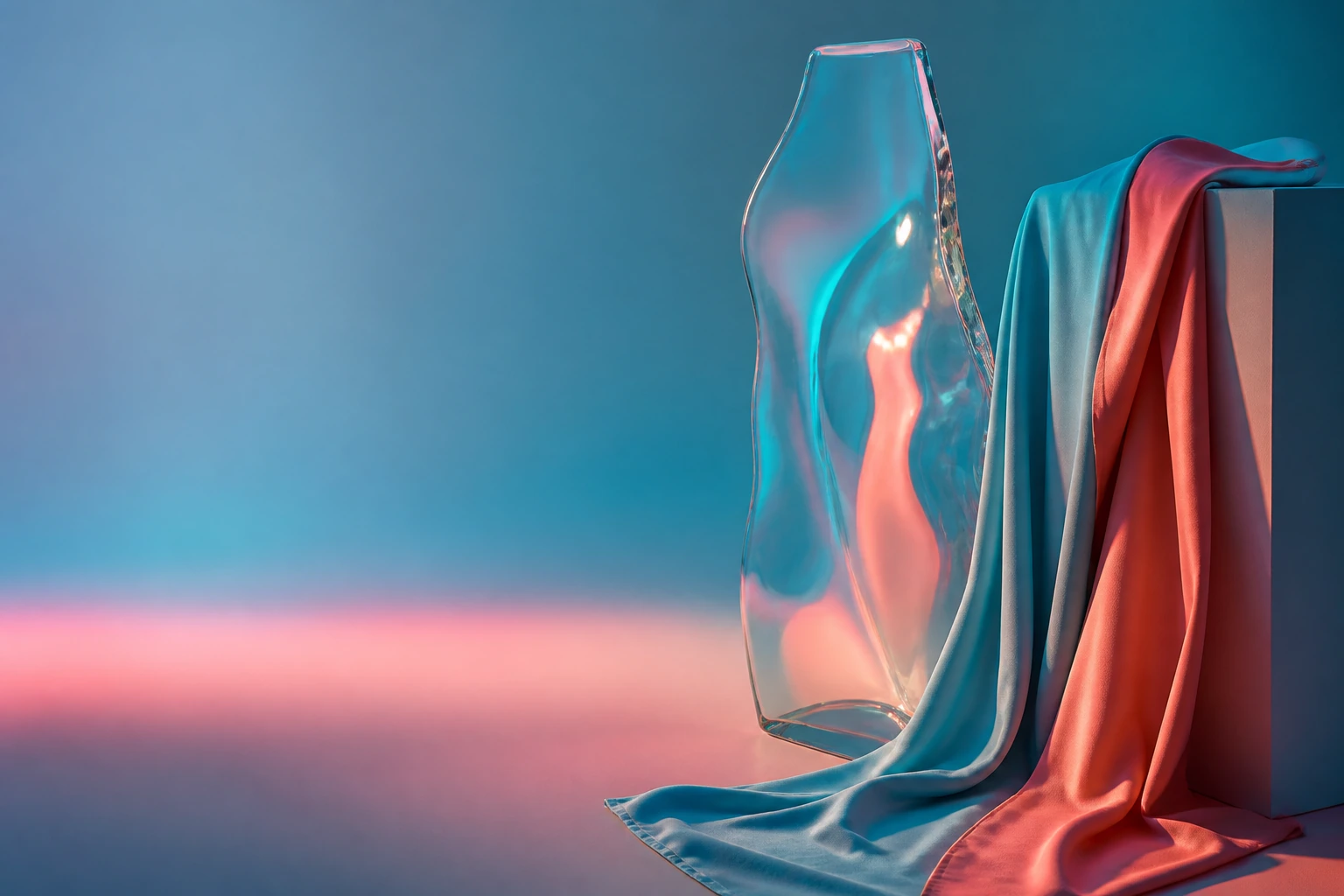
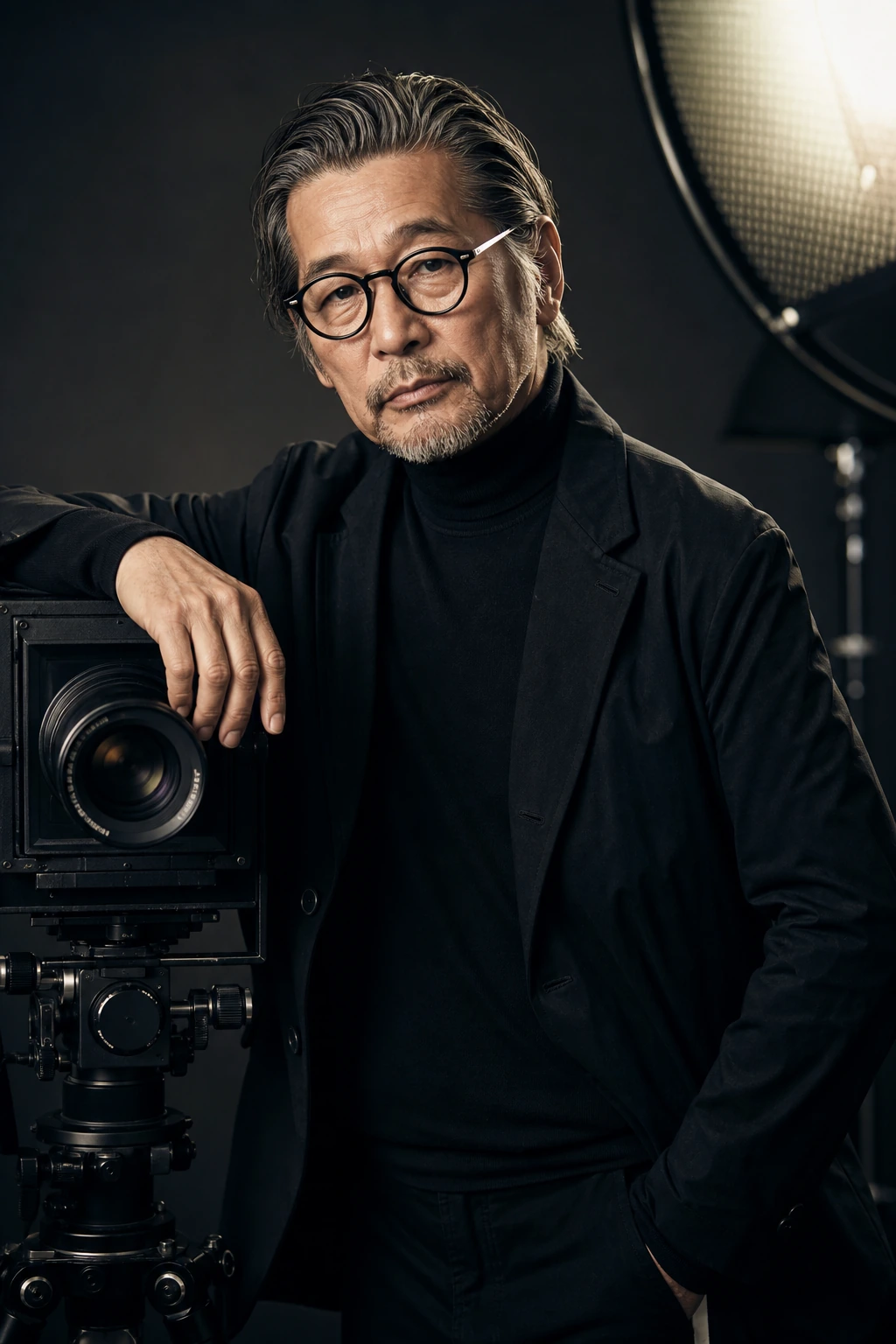
Hiro turned the technical precision of the commercial studio into a method of surprise: a dress, jewel, bird, face or spacesuit appears as if the viewer were seeing the object for the first time.
Editorial thesis
Hiro's significance lies in joining two qualities often treated as opposites: absolute control and genuine surprise. His photographs show that a strong commercial image does not have to choose between product clarity and authorial imagination. [source]
Reader question
How can a photographer turn a dress, jewel or technical object into an almost surreal scene without losing material precision or the commercial task?
Short answer
Through a rigorous system of light, colour, scale, angle and juxtaposition. Hiro does not hide the object beneath effects; he reorganises its context so precisely that the familiar thing begins to look unknown. [source]
1. Shanghai: born between cultures
Yasuhiro Wakabayashi, known professionally as Hiro, was born in Shanghai in 1930 to Japanese parents. The Museum of Fine Arts Boston and Getty record this complex geography: China as birthplace, Japan as the postwar chapter, and the United States as the place where his professional career took shape. [source]
This biography matters less as a romantic myth of an 'exotic eye' than as an experience of repeatedly changing cultural codes. Hiro learned early that what feels ordinary in one environment can appear strange in another. Later, that capacity to make a familiar object unfamiliar became central to his fashion and still-life photography.
2. After the war: Japan and the experience of displacement
After World War II Hiro's family returned to Japan. His youth unfolded while the country was rebuilding its material and visual culture after the destruction of war. [source]
It would be reductive to explain every image through a fixed idea of 'Japanese aesthetics'. More useful is the recurring combination of discipline, emptiness, concentration and disruption. Hiro's pictures are highly organised, yet almost always contain a disturbance: an odd angle, a sharp colour, an insect, metal, skin or sudden movement.
3. America, 1954: photography as a new language
Hiro arrived in the United States in 1954. His official archive and the MFA identify this as the beginning of the American phase, when he pursued photography professionally and soon entered New York's fashion environment. [source]
New York was not simply a new market. Magazine publishing, advertising, art, design and the commercial studio existed in close proximity. That matters for Hiro because he never built a rigid boundary between 'serious' photography and commissioned magazine work.
4. Richard Avedon: the assistant who was released too soon
In 1956 Hiro worked in Richard Avedon's studio. According to the official archive, Avedon quickly recognised that his assistant was capable of independent work and introduced him to Alexey Brodovitch. [source]
It is a rare model of mentorship: a strong photographer does not turn a talented assistant into a permanent technician. Avedon gave Hiro access to a system that demanded an independent position. Their connection did not disappear; their different aesthetics remained part of the same Harper's Bazaar editorial ecosystem.
5. Alexey Brodovitch: the demand to astonish
Alexey Brodovitch served as art director of Harper's Bazaar from 1934 to 1958 and made photography central to the magazine's visual identity. The Barnes Foundation emphasises his influence on a generation of photographers and designers. [source]
For Hiro, the important lesson was not only Brodovitch's famous demand to astonish. Behind that demand was a professional discipline: an image had to bring something to the page that the viewer had not already seen. Newness was not decoration; it was a new organisation of looking.
6. Harper’s Bazaar: entering the magazine laboratory
Hiro's official archive dates his invitation to Harper's Bazaar to 1958. By then the magazine was already a laboratory for the interaction of photography and graphic design, while the 1960s opened a new phase of conceptual fashion images, bold colour and unconventional composition. [source]
Hiro fitted this environment perfectly. He could be commercially exact and visually strange at the same time. The product remains legible, but the act of displaying it becomes a visual problem.
7. 1963: Bazaar’s only photographer under contract
In 1963 Hiro became Harper's Bazaar's only photographer under contract; the International Photography Hall of Fame and his official archive state that he held this distinction for more than a decade. [source]
The importance is not only prestige. The magazine trusted him with fashion, beauty, jewellery, still life and portraiture. This breadth is fundamental to his method: he did not build a career around one type of subject, but transferred the same intensity of attention from face to dress, ring to bird, fabric to spacesuit.
8. A gaze between East and West
Richard Avedon later characterised Hiro as a lifelong visitor, never completely belonging to a single cultural system. The International Photography Hall of Fame presents this distance as part of his capacity to look at East and West from the outside. [source]
The idea can easily become cliché, yet in Hiro's photographs it works as a method of estrangement. An object is removed from its normal context and begins to look unknown, even when it is an ordinary shoe, jewel or piece of fabric.
9. Precision before effect
Hiro's photographs often feel like instantaneous acts of visual concentration, but they are built through complex studio preparation. His official archive stresses technical mastery, attention to detail and precise execution. [source]
The useful lesson is that effect should not feel like accidental luck. Hiro first constructs the conditions — light, material, background, scale and position — and only then allows the picture to appear surprising. Control is not the enemy of fantasy; it makes fantasy believable.
10. Colour as structure
Colour in Hiro rarely functions as decoration alone. The MFA and Hamiltons both identify bold colour as a defining aspect of his work. [source]
Red, blue, green or acidic tones can operate as structural planes, almost like geometry. His colour photographs therefore do not feel 'rich' simply because they are saturated. Colour organises hierarchy: it pulls one object forward, makes another disappear and turns a third into an unexpected accent.
11. Light as physical material
Light in Hiro's studio feels almost physical. It does more than reveal an object; it changes its status. Metal becomes liquid, fabric becomes a graphic plane, skin becomes relief, and transparent material seems to glow from inside. [source]
This is especially important for product and jewellery photography. Light does not have to illuminate quality evenly. It can create tension, mystery and a sense of physical mass while preserving enough precision for the object to remain readable.
12. Angle: looking at an object as if for the first time
One of Hiro's strongest tools is the camera angle. Hamiltons notes unusual perspectives and viewpoints as a consistent characteristic of his photographs. [source]
He can come so close that an object loses its everyday scale, or leave enough empty space for it to become a sign. A strong Hiro angle is not decorative. It changes the object's category: jewellery becomes architecture, fabric becomes landscape, and a face becomes an abstract surface.
13. Surrealism without haze
Surrealism in Hiro's work is not built from fog, dreams or theatrical mist. It is created through very clear incompatibilities between elements. His official archive and the MFA explicitly describe an elegant surrealism as part of his visual language. [source]
He places familiar things in relationships where logic slips slightly: an expensive object meets something organic, beauty meets threat, perfection meets something strange or nearly unpleasant. Precision makes the surrealism stronger because every element is physically convincing even when the relationship remains puzzling.
14. Black Evening Dress in Flight: clothing becomes an event
Black Evening Dress in Flight, New York, 1963 is one of the works through which the MFA introduces Hiro. The black evening dress is not simply worn by a model; it becomes a moving shape, almost an independent object in the air. [source]
The photograph shows how a fashion image can explain construction through dynamics. Instead of listing garment details, the viewer reads mass, inertia and direction. The dress exists in time even though the photograph is still.
15. Balenciaga, 1967: the envelope dress as pure geometry
In June 1967 Harper's Bazaar published Alberta Tiburzi in Cristóbal Balenciaga's famous envelope dress. The V&A uses Hiro's photograph when explaining the radical geometry of late Balenciaga. [source]
It is an unusually precise meeting of photographer and designer. Hiro does not try to 'animate' the dress with unnecessary scenery. He accepts it as an architectural problem already complete in itself and builds an image that lets the viewer feel the strangeness of its four-pointed form and the space around the body.
16. Jewellery photography: Harry Winston, Elsa Peretti and the scale of luxury
The MFA specifically highlights Hiro's work with jewellery by Harry Winston and Elsa Peretti. Jewellery photography is a difficult territory: the object is small, expensive, highly reflective and can easily become either technical catalogue imagery or a crude symbol of luxury. [source]
Hiro chooses a third route. He enlarges the visual importance of jewellery through light, scale and unexpected surroundings. Luxury is coded not through maximum sparkle but through the precision of the material's relationship to space.
17. Still life is not a secondary genre
Still life in Hiro's career should not be treated as a pause between fashion assignments. Museum and gallery retrospectives deliberately place fashion, portraiture and still life beside one another. [source]
This reveals the unity of the method. He treats a living body and an inanimate object with the same seriousness. A thing acquires character through surface, weight, colour temperature and its relationship to neighbouring forms. For contemporary commercial photographers this remains a valuable lesson: a product image can be a complete visual statement.
18. Scale: the small object becomes a landscape
Hiro repeatedly plays with scale. A small object can fill the frame until it stops being 'small' and begins to read as territory. [source]
That is what strong macro and close-up photography can do: it does not merely show additional detail. It changes psychological distance. The viewer stops seeing merchandise on a shelf and starts exploring a surface as an unknown environment. This is one reason many of Hiro's still lifes remain convincing outside their original advertising context.
19. Birds Silhouetted Against the Sun: simplicity after complexity
Birds Silhouetted Against the Sun, made around 1960, is in the collection of The Metropolitan Museum of Art. It is a comparatively simple image: birds become dark signs against a bright sun. [source]
The work is a useful counterweight to the stereotype of Hiro as a photographer of elaborate studio construction. He can reduce an image to light, silhouette and rhythm. Technical invention is not an end in itself; when a simple relation of shape and light is sufficient, he has no need to complicate the frame.
20. Portraiture: a person inside a highly precise construction
Hiro photographed people as well as things. His portrait work preserves the same precision found in his still lifes: the subject enters a clear visual system in which gesture, background and light act together. [source]
A Hiro portrait does not always seek psychological confession. Sometimes plastic presence is more important. The person becomes part of the composition without disappearing inside it — a useful bridge between fashion portraiture and editorial portraiture.
21. The Rolling Stones, 1976: a band as a visual scene
In 1976 Hiro photographed The Rolling Stones on Sanibel Island, Florida; the work appears in Pace's photography program. [source]
He does not switch to the language of casual reportage simply because the subject is a famous band. Celebrity remains constructed. This demonstrates the stability of his method: recognition does not cancel composition. If anything, a famous face or group requires more discipline so that the photograph does not become a mere record of presence.
22. Apollo Spaceflight Training Suits, 1978: fashion meets technology
Hiro's official archive includes Apollo Spaceflight Training Suits, Houston, Texas, 1978 among selected photographs. [source]
A spacesuit is perfectly suited to his eye: clothing, engineered object, bodily shell and technological symbol at once. Hiro can photograph it without choosing between fashion and machine. In his visual system the categories meet in surface, function and scale.
23. Machine, material, skin: the same concentration of looking
Hamiltons describes Hiro's world as one in which men and machines are examined with equal concentration. [source]
That idea explains his range. He does not divide subjects into 'emotional' and 'technical'. Skin, metal, fabric, feathers, plastic or glass become materials to which light gives character. This is why he could move from fashion to industrial still life without losing intensity.
24. The magazine page: photography exists beside design
Hiro developed inside an era when the final object of fashion photography was not an isolated photograph but a magazine page. Brodovitch and subsequent Bazaar art directors created meaning through crop, scale, sequence and white space. [source]
Hiro is therefore best read alongside graphic design. Even a powerful frame had to function inside a spread, next to typography and neighbouring images. It is a discipline often missing from contemporary single-image culture.
25. Popping Pills, 1972: the commercial image becomes ambiguous
Harper's Bazaar remembers Popping Pills, 1972 as one of Hiro's characteristic images from the 1970s. The magazine notes that his pioneering colour and arresting juxtapositions could be inventive and brazenly suggestive at once. [source]
This kind of commercial image works through association rather than direct description. The picture catches the viewer before it can be fully rationalised. That makes precision essential: the metaphor must remain coherent enough not to collapse into random shock.
26. 1969: recognition by the professional community
Getty ULAN records that Hiro was named Photographer of the Year by the American Society of Magazine Photographers in 1969. [source]
The recognition matters because it came from within the applied photographic industry. His experimentation did not first have to leave commercial photography for the museum. Fashion and magazine photography could already function as spaces for serious authorship.
27. 1982: 'America’s greatest photographer?'
The International Photography Hall of Fame recalls that the January 1982 issue of American Photographer was devoted entirely to Hiro and put a provocative question about his status as one of America's greatest photographers on the cover. [source]
The wording is deliberately magazine-like and hyperbolic, but it captures the scale of his reputation. By the early 1980s Hiro was no longer viewed simply as a specialist in fashion; he was a photographer who joined commercial discipline, technical invention and personal imagination.
28. Fish & Fowl: a personal project beyond fashion
During the 1980s Hiro began personal series with Betta splendens and game fowl. Hamiltons later presented them through the Fish & Fowl project, emphasising colour, movement and emotional tension. [source]
There is no fashion product here, yet the method remains recognisable. Fish and birds become almost couture objects: colour behaves like material, movement like drapery, biological form like sculpture. Personal work removes the commission but does not change the logic of the image.
29. Control and movement: why the studio never feels sterile
Hiro's studio photographs are intensely controlled, yet they rarely feel dead. The reason is that control is used to create an event: fabric flies, a fish turns, metal catches a narrow light, or an object meets an unexpected neighbour. [source]
This is the difference between precision and sterility. Sterility removes uncertainty; Hiro carefully manufactures it. He constructs the image exactly in order to leave the viewer with a moment of surprise.
30. The main legacy: surprise through precision
In 2015–2016 the Museum of Fine Arts Boston organised the first major American museum solo exhibition of Hiro, bringing together fashion, portrait and still-life work from several decades. [source]
His legacy feels especially relevant now that technically flawless imagery is far easier to produce. Hiro reminds us that mastery does not end at surface perfection. The harder task is to invent a relationship among light, colour, scale and objects that the viewer has not yet turned into habit. Surprise does not replace precision; it is produced by it.