photographer profile
Juergen Teller
Flash, intimacy and anti-glamour
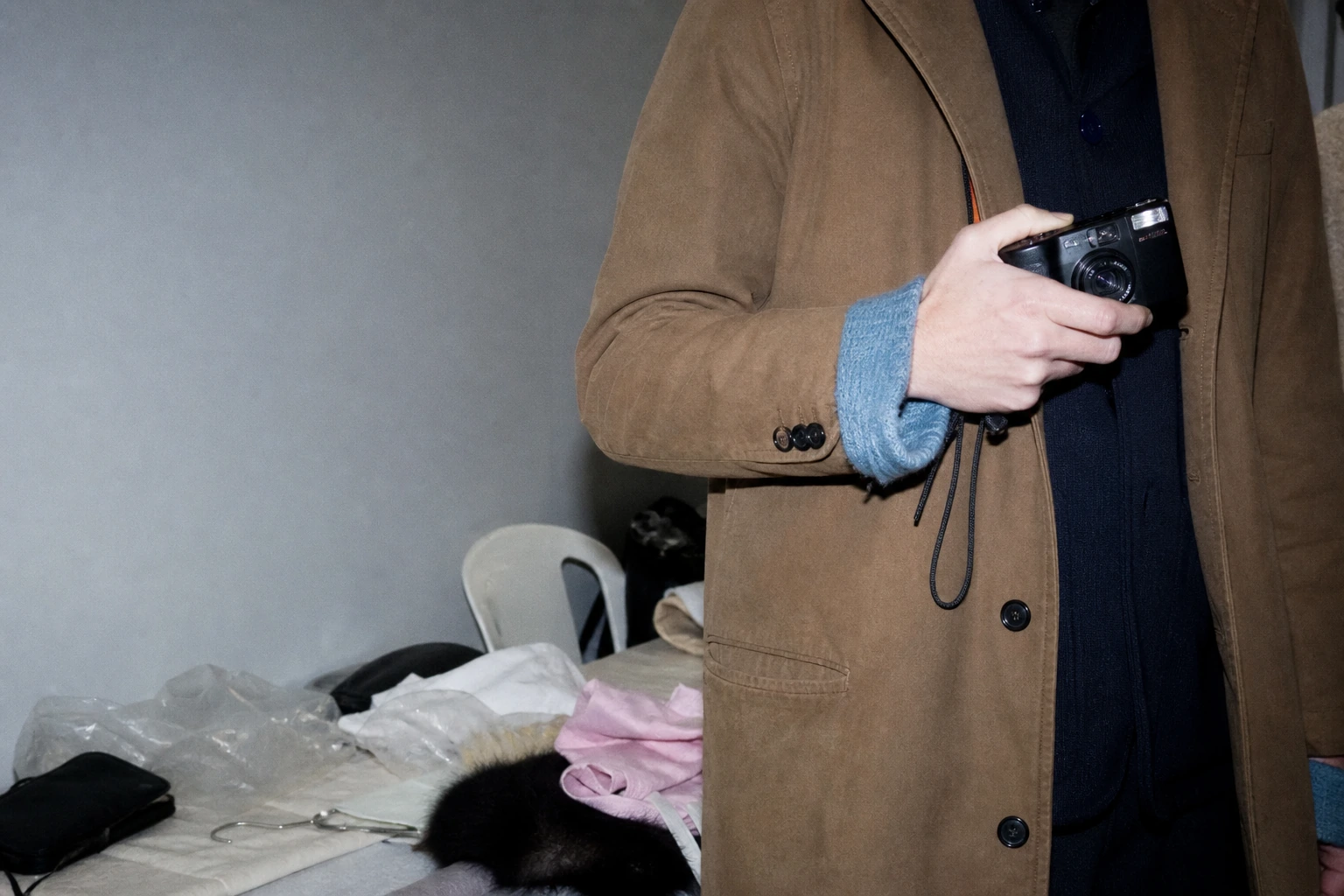
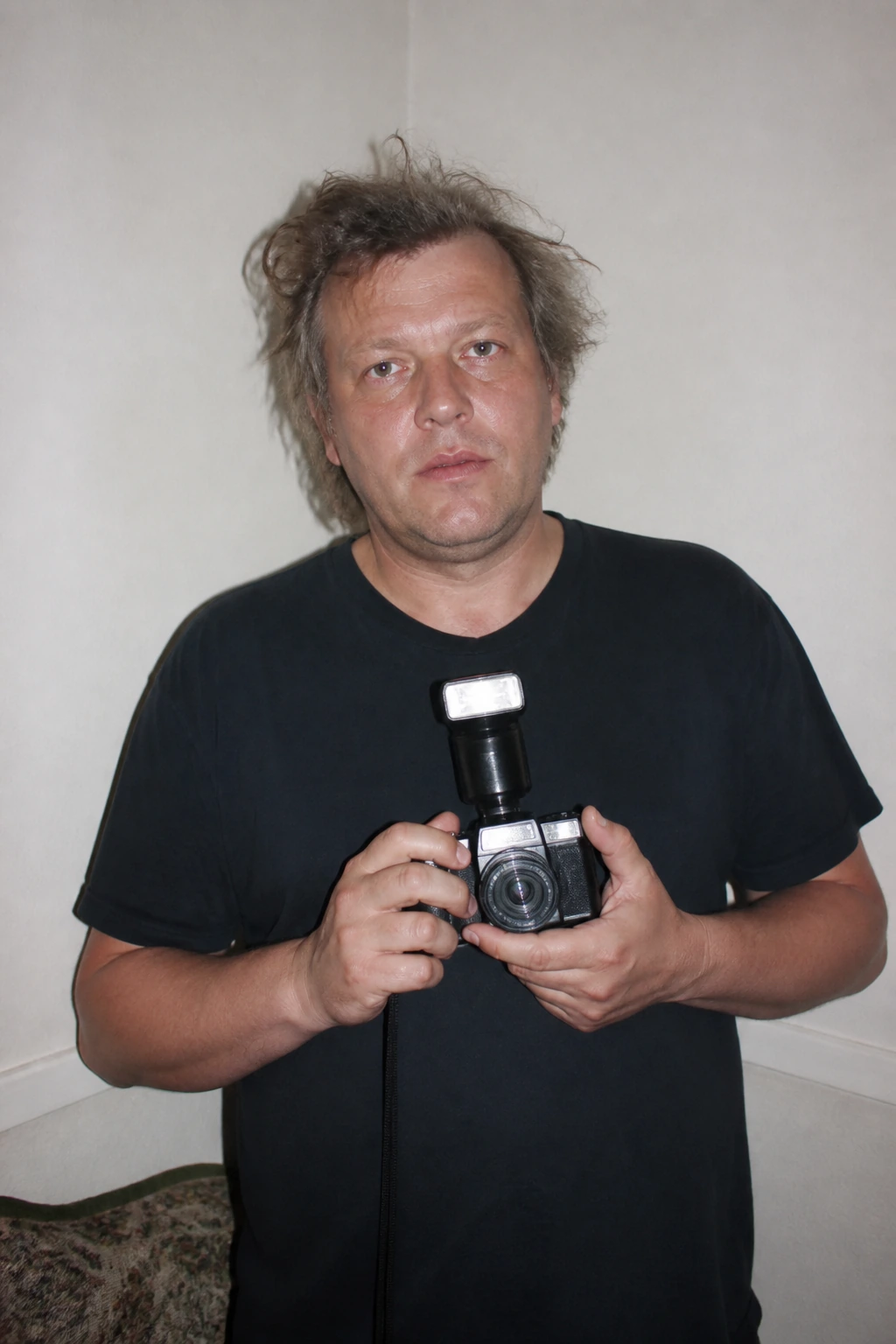
Teller turned imperfection into a tool of trust: hard flash, an ordinary room, an awkward gesture and visible skin do not destroy the fashion image but turn distant luxury into a sense of personal access.
Editorial thesis
Juergen Teller matters not as the inventor of 'bad light' but as an author who demonstrated that commercial photography can persuade without promising perfection. His anti-glamour is not the absence of direction but another form of direction built from proximity, awkwardness, humour and visible physical reality. [source]
Reader question
Why can a photograph with hard flash, an ordinary interior and imperfect skin sell luxury as effectively as a flawlessly polished campaign?
Short answer
Because Teller sells access to a person and a character rather than an ideal world. His images look immediate, but that immediacy is constructed through casting, distance, timing, background, flash and a precise sense of when imperfection becomes credibility rather than accidental failure. [source]
1. Bubenreuth: before the camera came wood and violin bows
Juergen Teller was born in Erlangen in 1964 and grew up in Bubenreuth, a town with a strong tradition of string-instrument making. Before photography he trained briefly in bow making, but an allergy to wood dust forced him to abandon that path. The National Portrait Gallery and biographical sources record this early turn. [source]
The episode matters because Teller did not enter photography from an idealised art-world background. Before the camera came material, manual work, family environment and the experience of a profession that did not work out. Later his photography would also feel physically direct, more like handling people and things than manufacturing flawless surfaces.
2. Munich 1984–1986: photography school
From 1984 to 1986 Teller studied at the Bayerische Staatslehranstalt für Photographie in Munich. The dates are confirmed by the National Portrait Gallery, the Onassis Foundation and gallery biographies. [source]
The school provided technical foundations, yet his mature language is interesting precisely because it does not display academic correctness. He uses professional knowledge to allow a frame to look simple, harsh, accidental or awkward — deliberately breaking expectations of professional fashion photography.
3. London 1986: a new scene instead of a ready-made career
Teller moved to London in 1986 and began working as a freelance photographer. At the time, the British music and magazine scene was one of Europe's most active visual laboratories. [source]
The move matters beyond geography. London gave him an environment where a photographer did not immediately have to choose among music, portraiture, fashion and art. That mobility later became fundamental to his practice.
4. Music as the first professional entry point
Music was Teller's first professional environment. The ICA notes that he entered the London photography scene through music-industry and record-cover work, while the National Portrait Gallery lists subjects from Björk and Elton John to Kurt Cobain. [source]
Music photography taught him a different relationship to fame. The goal was not necessarily to turn the subject into an unreachable icon but to catch physical presence, personality and, at times, awkwardness.
5. Sinéad O’Connor: the portrait that moved the author out of the background
The ICA singles out Teller's portrait of Sinéad O'Connor for Nothing Compares 2 U as an important early moment in his career. [source]
Its significance does not depend on elaborate staging. Teller gradually built a reputation for photographing famous people without making them look more monumental than necessary. That anti-heroic closeness later became one of his great commercial strengths.
6. Nirvana 1991: fame arrives through the person, not spectacle
In 1991 Teller photographed Nirvana around the Nevermind tour; the Bundeskunsthalle and Fotomuseum Winterthur describe these pictures as part of his professional breakthrough. [source]
The Kurt Cobain photographs are especially revealing. Instead of rock-star spectacle, the viewer encounters a nervous, fragile and sometimes almost absent person. Teller became valuable to the industry because he did not make celebrity more 'celebrity' than it already was.
7. The Face and i-D: youth culture without distance
Work for The Face, i-D and related British magazines connected Teller to a visual culture in which street life, clubs, music, fashion and graphic design constantly exchanged languages. In 2025 the National Portrait Gallery again included him in the history of The Face as one of the photographers who shaped British youth culture. [source]
Within that environment, imperfect texture was not automatically a defect. A photograph could be blunt, strange or too close if it retained a sense of actual presence.
8. Hard flash: why 'bad lighting' becomes a method
One of Teller's most recognisable tools is hard flash, often frontal and visually 'unflattering' to skin, fabric or interior. Lehmann Maupin explicitly identifies bright, harsh flash as part of his characteristic language. [source]
This is not simply the aesthetic of a cheap camera. Flash collapses distance, removes atmospheric softness and forces surfaces to answer light literally. Skin reveals pores, fabric its creases, rooms their incidental details. Luxury loses protection from physical reality.
9. Daylight, accidental backgrounds and the visible surface of reality
Teller is equally comfortable with daylight, ordinary rooms, hotels, streets, gardens and spaces that do not look specially constructed for luxury. [source]
The important effect is believable accident: the background seems to have existed before the shoot. Yet this does not mean there is no direction. Where a person stands, what remains in the frame and when the shutter is released still create a precise system.
10. Anti-retouching: beauty without a promise of perfection
Lehmann Maupin emphasises Teller's rejection of retouching and idealised beauty surfaces. His photographs often preserve awkward angles, redness, wrinkles, shine, fatigue and other signs of the body. [source]
Anti-retouching does not equal pure camera truth; selection itself is already editing. But Teller changes the contract with the viewer. The image does not promise perfection, and that refusal can make a commercial picture feel more intimate and convincing.
11. Go-Sees 1998–1999: casting becomes an artistic system
From May 1998 to May 1999 Teller photographed young women arriving for casting go-sees at his London studio. In 1999 the portraits became the book Go-Sees. Steidl describes the series as both a record of the selection process and a critical look at the conflict between individual character and the industry's idealised model abstraction. [source]
The project turns fashion backstage production into a subject in its own right. Before makeup, styling and role, the camera records expectation, hope, nervousness and professional evaluation.
12. The studio door as a stage of power and expectation
Much of Go-Sees is photographed at the studio doorway. A simple architectural threshold becomes a stage: outside lie city and agency; inside lies the possibility of work. [source]
This makes the series more than a typology of young faces. A power system is present in the frame: someone looks, someone chooses, someone waits for a decision. A contemporary reading inevitably includes questions about casting and the vulnerability of an aspiring model.
13. The model before the image: individuality against industrial abstraction
Steidl formulates one of Go-Sees' central ideas: the book is less about fashion than about individual models, their characters and their place in the world. [source]
Teller leaves too much individuality in the image for the model to disappear into a universal carrier of clothes. That contradiction — person versus industrial function — gives the series more force than an ordinary casting archive.
14. Celebrity without a pedestal
Teller photographs celebrities without conventional distance. The Grand Palais and Fondation Cartier emphasise the proximity of celebrity portraits to family photographs, self-portraits and everyday scenes. [source]
Within his language, celebrity does not earn better light or a more ceremonial space. Fame is present, but it does not control the frame. A famous person may look bored, ridiculous, tired or simply ordinary.
15. Marc Jacobs 1998–2009: advertising as a long friendship
From 1998 Teller began a long series of Marc Jacobs campaigns; Steidl collected the 1998–2009 period in a dedicated book. [source]
This is a key case in which anti-glamour becomes a complete brand system. The photographs are genuinely advertising; they sell clothing and the label. Yet desire is produced through imperfection, humour and a sense of personal access rather than distant luxury polish.
16. Unusual casting as a brand language
Marc Jacobs and Teller repeatedly cast people outside the conventional advertising model: musicians, artists, directors, actors and the photographer himself. Steidl lists Sofia Coppola, Charlotte Rampling, Cindy Sherman, William Eggleston, Harmony Korine, Michael Stipe and many others. [source]
Casting becomes brand semantics. The consumer is offered not an ideal body but a cultural network — the sense that the label belongs to a particular community of characters.
17. Victoria Beckham, Winona Ryder, Cindy Sherman: recognition against the ideal
Marc Jacobs Advertising 1998–2009 brings together figures as different as Victoria Beckham, Winona Ryder and Cindy Sherman. [source]
Teller does not make them look alike. The campaign benefits from collisions between recognisability and uncomfortable staging. Celebrity becomes raw material for a new role rather than a guarantee of glamour.
18. Vivienne Westwood: campaign as shared character
From the late 2000s Teller also worked closely with Vivienne Westwood. The National Portrait Gallery notes that he photographed her campaigns from 2007, while Steidl published several books based on the collaboration. [source]
Westwood was particularly suited to Teller's method because she did not require idealising packaging. Photographer and designer could embrace roughness, comedy, age, bodily presence and absurdity, turning those qualities into an extension of the brand.
19. Self-portrait: the photographer enters his own advertising
Teller regularly appears inside his own photographs, including commercial and fashion projects. This breaks the supposedly neutral position of the invisible author. [source]
His self-portraits rarely feel heroic. More often they emphasise physical awkwardness, ageing, fatigue, sexuality or comedy. The author does not grant himself the privilege of looking better than his models; he submits himself to the same harsh optics.
20. Family, children and private life as part of the public archive
Fondation Cartier, the Grand Palais and the later Steidl catalogue i need to live all stress how frequently Teller's family, children, partners, travel and everyday life enter his work. [source]
This makes the archive both powerful and uncomfortable. Private life becomes artistic material, and boundaries among document, family album and public exhibition disappear. For contemporary authors, questions of consent and changing context become essential.
21. Nürnberg: personal history beside collective memory
In Nürnberg, Teller returned to a site near the region of his childhood and photographed former Nazi mass-rally architecture. Fondation Cartier describes how he followed weeds and flowers taking over the Zeppelintribüne while also photographing his growing family. [source]
Personal life and collective history do not illustrate one another directly. They exist side by side: children grow, plants reclaim concrete, ideological architecture decays. Time becomes more important than a spectacular metaphor.
22. Ed in Japan: a family trip instead of an 'exotic' country
Ed in Japan emerged from a 2005 trip with Teller's son and was shown at Fondation Cartier in 2006. [source]
The series is notable because the country does not become a collection of exotic signs. Family intimacy and the specific child remain central. Travel becomes an environment for a relationship rather than a tourist inventory of 'difference'.
23. Commercial and personal: why Teller refuses the boundary
Lehmann Maupin explicitly notes that Teller does not separate commercial and non-commercial photographs into different categories. He applies similar visual directness to family, celebrity, fashion campaign and self-portrait. [source]
This is one of the central ideas of his career. A commission is not automatically less authorial, and a personal photograph is not automatically more truthful. In both cases the same decisions operate: whom to bring close, what not to beautify, which moment is enough.
24. The book: photography becomes sequence rather than a single frame
Teller has published dozens of books, and Steidl maintains a substantial catalogue of both personal and commercial projects. For him, a book is not merely an archive of best images but an independent form of editing. [source]
In sequence, comedy can follow grief, advertising can sit beside a family photograph, beauty beside a domestic detail. This montage explains his practice particularly well: meaning emerges between photographs as much as inside them.
25. Do you know what I mean? 2006: the museum accepts fashion without disguise
In 2006 Fondation Cartier presented Do you know what I mean?, Teller's first major solo exhibition in France, combining fashion photographs, celebrity portraits, personal series and books. [source]
Institutionally, the exhibition was important because fashion photography did not have to disguise itself as 'pure art' to enter the museum. The mixing of commissioned and private work was presented as the basis of the practice.
26. Woo! 2013: a retrospective without polite distance
In 2013 the ICA presented Woo!, placing landmark fashion and celebrity images beside family portraits and landscapes. The exhibition became one of the institution's most highly attended shows. [source]
Woo! demonstrates how dependent Teller is on collisions of register. The viewer is not given a polite staircase from commerce to art. Everything is mixed in the same way that a photographer's actual working life is mixed.
27. Enjoy Your Life 2016–2018: apparent carelessness as construction
Enjoy Your Life travelled through the Bundeskunsthalle, Berlin, Prague and Fotomuseum Winterthur. The institutions emphasised the deceptive simplicity of Teller's imagery: what appears casual or slapdash becomes, on closer inspection, carefully composed. [source]
This is a useful antidote to superficial imitation. Making a photograph look accidental is easy. Making that accident compositionally and psychologically exact is far more difficult.
28. i need to live 2023–2024: life, loss, birth and work in one field
The major exhibition i need to live took place at the Grand Palais Éphémère in Paris in 2023–24 and later at Triennale Milano. The accompanying Steidl book connects personal and commercial work with birth, death, family relationships and the loss of close collaborators including Vivienne Westwood. [source]
The title describes late Teller well: photography becomes less a profession around fashion than a way of physically living through time. Advertising, child, friend, body, cemetery, animal and self-portrait can occupy one field.
29. you are invited 2025: intimate imagery becomes public politics
In 2025 the Onassis Foundation presented you are invited in Athens, Teller's most expansive solo presentation in Greece at that point. The institution stressed the combination of intimate and political, personal and collective, along with new series and videos. [source]
The late work makes clear that anti-glamour was not simply a 1990s youth style. It became a durable way to speak about ageing, family, politics, love, loss and the public role of images.
30. The main legacy: anti-glamour as precise direction of intimacy
Juergen Teller's main legacy is not frontal flash or deliberately 'imperfect' skin. Those signs are easy to imitate and just as easy to turn into an empty preset. [source]
His real method is the direction of intimacy. He constructs situations in which model, celebrity, designer or photographer appears available to the gaze without becoming fully obedient to it. Anti-glamour works only when visual roughness is supported by relationship, risk, humour and a precise choice of moment.