photographer profile
Paolo Roversi
Light, duration and the fragile fashion image
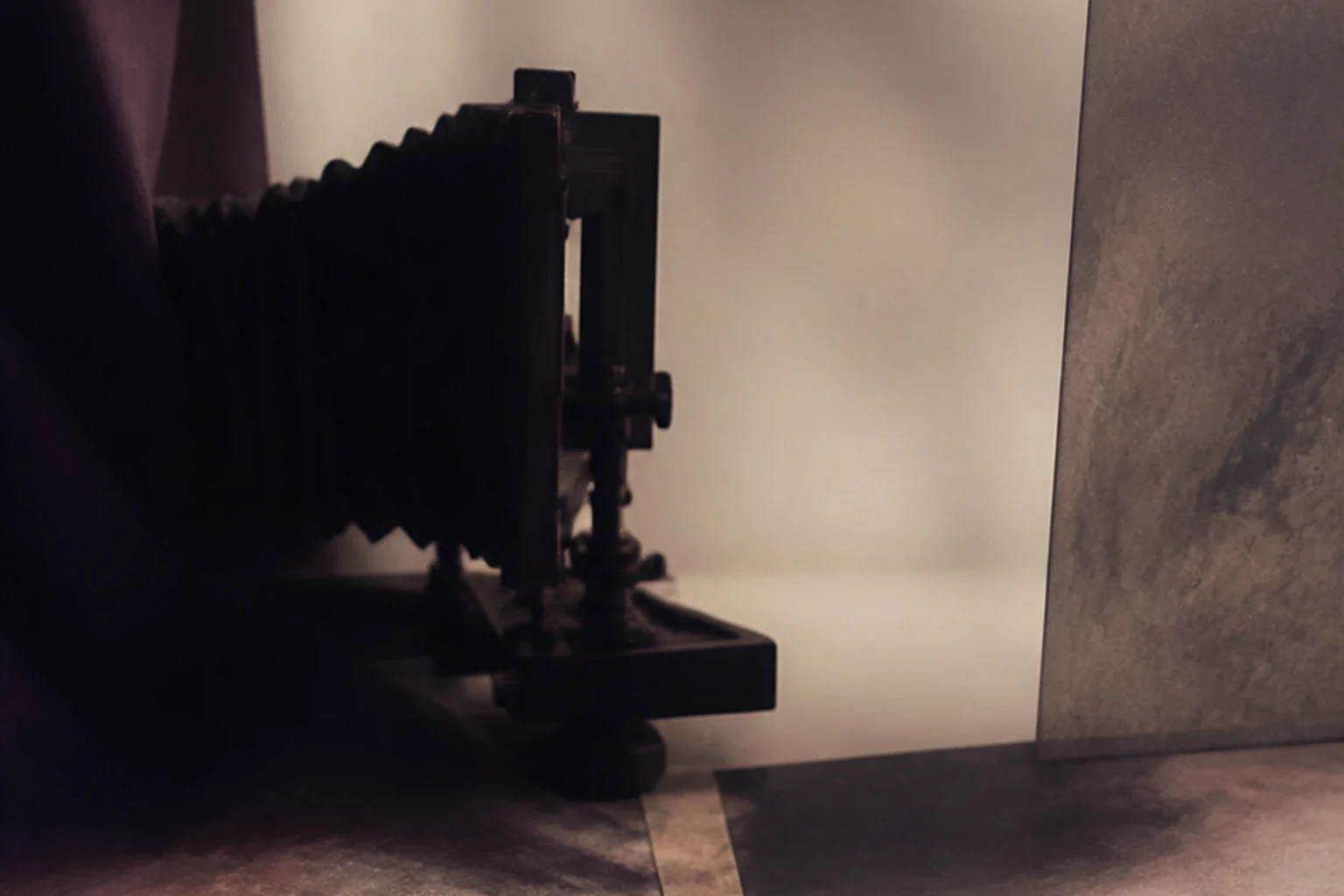
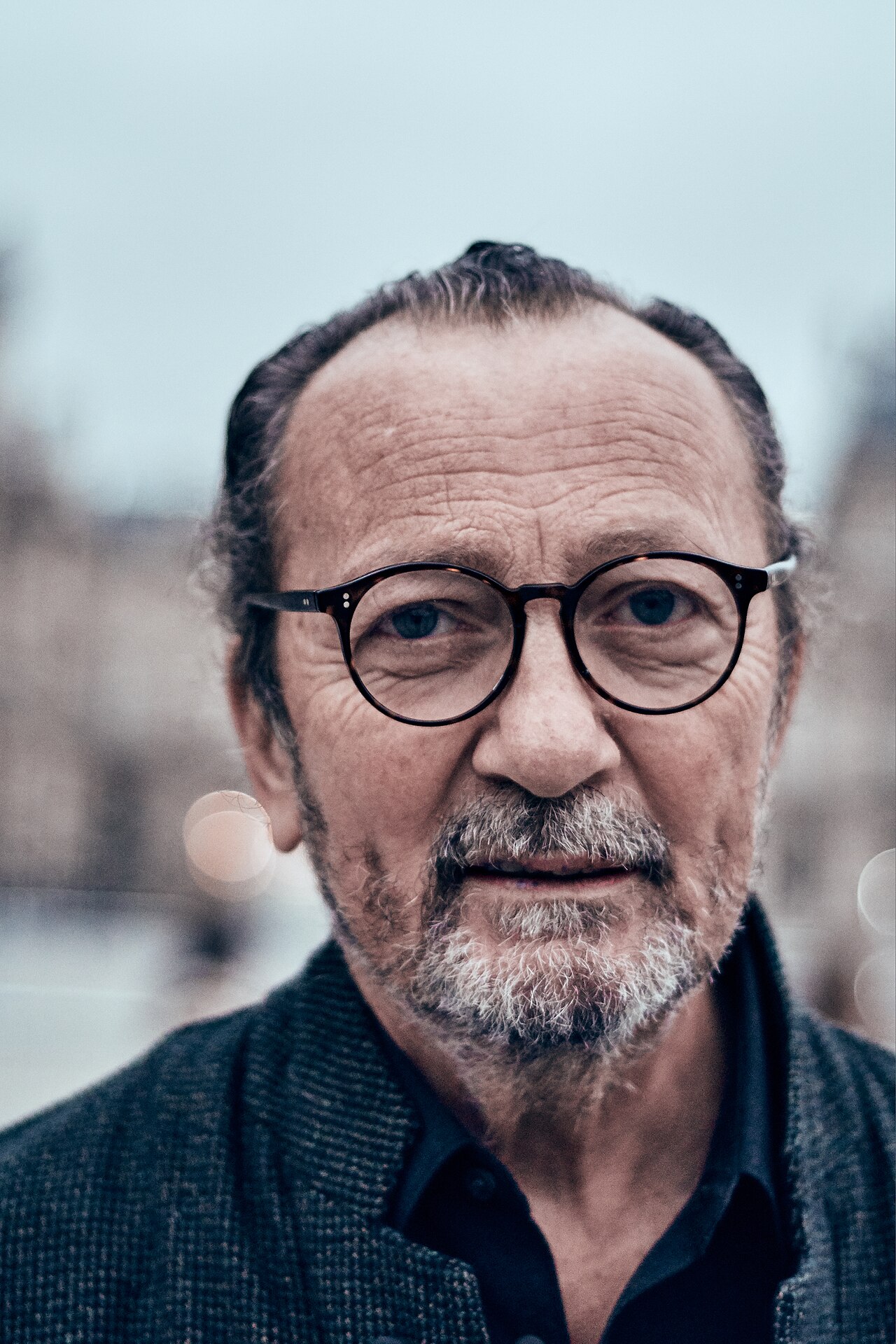
Roversi turns fashion photography into a slow encounter: large format, Polaroid, daylight, hand-shaped colour and the pause between exposures allow clothing to exist as part of a portrait rather than as an isolated product.
Editorial thesis
Paolo Roversi matters not because of an 'ethereal' effect but because he builds the studio as a space of trust and duration. His language connects fashion, portraiture, painterly colour, material Polaroid and controlled chance; his images therefore resist the industry's speed while remaining embedded within it. [source]
Reader question
Why can technically slow shooting, soft sharpness and an almost empty studio produce a more intense fashion image than elaborate scenery and dozens of frames per second?
Short answer
Because Roversi shifts attention from the number of variations to the quality of the encounter. Light, exposure, pause, material and model are given time to influence the image; the fashion product remains visible, but the frame is organised around human presence. [source]
1. Ravenna: light, mosaic and an early sense of image
Paolo Roversi was born in Ravenna in 1947. In later interviews and museum material, the city often appears as a biographical backdrop to his practice: Byzantine mosaics, subdued light, gold, and colour that feels less like surface paint than inner radiance. [source]
Ravenna should not be turned into a simple explanation for every photograph. More useful is the early familiarity with an image that exists between material surface and almost immaterial glow. Later, in Roversi's studio, body, garment and backdrop also emerge from darkness as slowly appearing figures rather than catalogue objects.
2. 1964: a home darkroom and photography as craft
Pace connects Roversi's passion for photography to a family trip to Spain in 1964; after returning home, he built a darkroom in his basement. [source]
The story helps explain his later attachment to process. Photography for Roversi remained more than pressing a shutter: camera, light, chemistry, Polaroid, print and accident formed a material chain. Even after adapting to digital, his method retained the feel of craft, as if an image were assembled rather than instantly obtained.
3. Early reportage: before photography slowed down
Before fashion, Roversi worked in a more documentary mode. Pace notes Associated Press assignments in 1970, while earlier biographies also mention work alongside the local photographer Nevio Natali. [source]
Reportage is especially interesting as a contrast to the mature studio. The later images may look almost motionless, but the ability to wait for unpredictable human presence remains. Roversi slows the process while still waiting for an event — a shift of gaze, breath, balance or light.
4. Paris, 1973: entering the international fashion environment
Roversi moved to Paris in 1973 and has lived and worked there ever since. Palais Galliera, Paris Musées and Pace all identify the move as a turning point toward fashion photography and the international magazine environment. [source]
Paris was more than the geography of couture. Magazines, agencies, designers, laboratories and authorial photography existed in close proximity. Within that system, a commission could be technically professional while remaining open to artistic risk — a defining condition of Roversi's career.
5. Laurence Sackman: technical discipline before a personal language
After arriving in Paris, Roversi assisted the British photographer Laurence Sackman for roughly nine months. Pace describes the experience as a significant technical education. [source]
Assisting teaches more than flattering light. It teaches pace, team organisation, repeatability and responsibility to a client. Roversi would later embrace softness, accident and duration, but those qualities are convincing because they rest on a foundation of control.
6. Studio Luce: the studio as a recurring character
Studio Luce, Roversi's long-running Paris studio, became almost a character in its own right. Palais Galliera describes the studio as a living place of encounters, while the 2024 exhibition scenography transformed the museum into an imagined version of it. [source]
An empty backdrop does not mean an absence of environment. Wall, aged canvas, table, mirror, window and camera distance form a psychological architecture. The model enters a system already familiar to the photographer, yet every meeting rewrites it.
7. Large format: a camera that makes time move more slowly
Large format forces the process to slow down. Palais Galliera and Pace both emphasise the role of large-format cameras, including Roversi's characteristic Deardorff 8×10, in shaping his practice. [source]
Preparation takes time, which means a model cannot exist only as a sequence of rapid poses. Between exposures there is pause, conversation and waiting. The camera becomes less a machine of continuous capture than a device that changes behaviour in front of the lens.
8. Polaroid and the Paoloroid: the image between test and original
Polaroid became one of Roversi's central materials. The Palais Galliera catalogue even includes a dedicated essay on the fusion between photographer and medium — the 'Paoloroid'. [source]
Instant material produced an image quickly but never guaranteed complete control. Colour could shift, surfaces could scar, chemistry could behave unpredictably. Roversi used this instability as part of authorship, allowing the material itself to participate in the final image.
9. Long exposure: time becomes part of the face
Long exposure makes time physically visible. A slight movement of head, hands or fabric becomes a soft trace, while sharpness stops being the only proof of presence. [source]
Roversi should not be reduced to the 'blurred portrait'. Duration works together with stillness, simple backdrops and the model's concentration. Softness appears as a residue of real encounter time rather than as a filter applied afterwards.
10. Daylight: quiet instead of perfect neutrality
Palais Galliera describes Roversi's soft monochrome photographs as made in natural light. [source]
Daylight makes the studio dependent on time of day and weather. Instead of a fully neutralised commercial environment, variability enters the process. This matters psychologically: the photographer does not defeat the world with a lighting diagram but allows external light to become part of the meeting.
11. Mag-Lite and mobile colour
For colour work, Roversi has used a small hand-held Mag-Lite torch, moving the source during exposure. Palais Galliera connects this technique with the distinctive density of his colour. [source]
Colour therefore stops being only a property of fabric or makeup. It is painted through time. One area receives more light, another falls into shadow, a third becomes saturated. The colour fashion photograph begins to behave like painting while retaining photographic contingency.
12. Every fashion photograph is a portrait
One of Palais Galliera's key formulations is that, for Roversi, every fashion photograph is a portrait. [source]
That changes the hierarchy between garment and person. Clothing remains important but is no longer the only thing to be proved. It operates with face, pose and character. A strong fashion image appears when clothing helps the person emerge rather than replacing them.
13. Simple pose: fewer gestures, greater presence
Roversi's models often stand or sit very simply. Less choreography means more attention to micro-events: a glance, breath, the position of a hand, the way fabric settles on the body. [source]
A simple pose is demanding. Once spectacular movement is removed, photographer and model cannot hide behind gesture. Presence has to sustain the frame. Roversi's slow method therefore depends on the model's professional labour as much as on the camera.
14. Rei Kawakubo and Comme des Garçons: four decades of dialogue
Roversi's collaboration with Rei Kawakubo and Comme des Garçons stretches across decades. Dallas Contemporary built its exhibition Birds around this dialogue, emphasising mobility and the exchange of ideas between designer and photographer. [source]
This is not a case of applying a ready-made 'romantic style' to avant-garde clothing. The structural strangeness of Comme des Garçons pushes his images toward movement, broken symmetry and new relationships between body and form.
15. Yohji Yamamoto: black clothing and the architecture of shadow
Yohji Yamamoto is another defining figure in Roversi's career. Paris Musées notes the harmony between their visual worlds. [source]
Black clothing could easily disappear inside a dark studio; that is precisely why shadow becomes architecture. Roversi separates volume through minimal tonal shifts. The garment is read through weight, fold and surrounding space rather than total technical description.
16. Romeo Gigli: romantic physicality without retro theatre
Romeo Gigli offered another kind of fashion romanticism in the 1980s and 1990s: historically inflected softness, fluid form and complex colour. Paris Musées includes Gigli among Roversi's major collaborations. [source]
The dialogue matters because romantic clothing does not become costume reconstruction. The studio remains sparse and historical feeling is produced by light, body and chromatic density. The past is sensed without being literally illustrated.
17. Dior: couture as a memory of form
Roversi's relationship with Dior occupies a distinct place in his career. The house published Dior Images — Paolo Roversi, bringing years of photographs together as an independent visual history of couture. [source]
For Roversi, Dior is less about logo than memory of silhouette. Fabric, construction, pose and model connect different generations of the house. Brand photography can therefore maintain historical continuity without simply styling a shoot 'like the archive'.
18. Vogue Italia and editorial freedom
Roversi worked extensively for Vogue Italia and other major magazines. Palais Galliera and Pace describe him simultaneously as a figure inside the fashion system and an author who keeps a distance from rapid trends. [source]
The magazine matters as a sequential space. One frame may be quiet, but a spread creates rhythm: face, garment, emptiness, colour, pause. Editorial allows slow photography to exist inside an industry based on constant renewal.
19. The model as co-author: Kirsten Owen, Guinevere van Seenus and others
Kirsten Owen, Guinevere van Seenus, Saskia de Brauw and other models are not merely names in Roversi's archive; their testimonies are included in the Palais Galliera catalogue. [source]
This matters for authorship. The photographer controls camera and environment, but presence cannot be fully designed. The model creates rhythm, sustains pauses, offers gestures, resists or trusts. The simpler the frame, the more visible the labour of the person in front of the lens becomes.
20. Colour as painterly density
Colour in Roversi rarely looks 'correct' in the neutral commercial sense. Red can become enamel, blue can glow, skin can acquire the density of pigment. Palais Galliera links that saturation to his hand-shaped moving light. [source]
This is why his colour cannot be reproduced through grading alone. It grows from exposure, material, movement of the source and surface behaviour. The effect is productive, not merely post-productive.
21. Black and white and sepia: time without a fixed period
Roversi's monochrome images frequently drift toward warm sepia. Palais Galliera describes them as soft, naturally lit and immediately recognisable. [source]
Sepia gives a sense of time without fixing a photograph to one decade. A contemporary model can feel archival, while an old silhouette can feel present. That temporal ambiguity helps a fashion image survive its seasonal context.
22. Chance and error: why control must leave a door open
Roversi systematically leaves room for chance. Palais Galliera describes accidents and the unexpected as opportunities for renewal. [source]
Yet chance works only inside discipline. If everything is surrendered to error, the result becomes random. Roversi first builds studio, light, exposure and relationship, then accepts what cannot be fully predicted. Doubt becomes controlled openness.
23. Adapting to digital: the language survives the material
Palais Galliera explicitly notes that Roversi adapted successfully to digital photography. [source]
This breaks the convenient myth that his language exists only because of discontinued Polaroid materials. Large format and chemistry strongly shaped it, but did not exhaust it. Slow direction, a simple set, trust in the model and openness to uncertainty can survive within digital production.
24. Nudi: body, trust and the critical question of power
The Nudi series extends the logic of studio portraiture through the nude body and has held a visible place in Roversi's books and retrospectives. [source]
A soft aesthetic does not remove questions of power. Nude photography requires particular attention to consent, age, future publication context and the historical tradition of idealised femininity. A 'quiet' photograph is still a relationship among person, camera and public system.
25. Looking for Juliet: the 2020 Pirelli Calendar
For the 2020 Pirelli Calendar, Roversi created Looking for Juliet, a Shakespeare-inspired project structured as a search for multiple contemporary Juliets. Pirelli notes that the calendar was accompanied by a short film for the first time in the series. [source]
It expands his slow portrait practice. The literary character receives no single definitive face: Emma Watson, Kristen Stewart, Rosalía, Mia Goth and others propose different inhabiting of the role. Fashion portraiture becomes a casting of identity.
26. Celebrity portrait: softening an already constructed public mask
Roversi has photographed Rihanna, Rosalía, Kate Moss and many other celebrities, yet his portraits rarely amplify the existing celebrity spectacle. Pace and Palais Galliera consistently describe his practice through meeting and presence. [source]
The difficulty of celebrity portraiture is that the camera faces a public mask already constructed by thousands of images. Roversi attempts to soften that shell temporarily. The result nevertheless returns to magazines, campaigns and global circulation — intimacy becomes a public commodity.
27. Palais Galliera 2024: the first Paris monograph
In 2024 Palais Galliera presented Roversi's first monographic exhibition in Paris. It brought together 140 works spanning fifty years, including unseen photographs, Polaroids and magazine archives. [source]
The scenography was especially apt: the museum became an imagined studio and the route moved from shadow toward light. The institution did not separate commissioned fashion work from authorial practice; it presented them as one continuous system.
28. Along the Way 2025: the gallery reads a career through relationships
In 2025 Pace Gallery presented Along the Way in New York, a focused retrospective of work from the early 1990s to the present, centred on Roversi's relationships with collaborators in fashion. [source]
This reading is useful against the myth of a solitary 'master of light'. His images exist inside durable relationships: models, designers, magazines, laboratories and assistants. The more minimal the frame appears, the more important the infrastructure of trust around it becomes.
29. Doubts 2026: doubt as a working method
During summer 2026, the MOP Foundation in A Coruña is presenting Doubts, a major Roversi exhibition running from 20 June to 20 September. The show is organised into nine interconnected themes and foregrounds the experimental possibilities of Polaroid. [source]
Its title formulates a mature working method: doubt opens space for creativity while certainty closes it. For a photographer, this is not an invitation to be unprepared. It means leaving room for the unexpected inside a carefully built process.
30. The main legacy: slow photography as a space of emergence
Paolo Roversi's main legacy is not soft focus, sepia or Polaroid as a visual preset. Those signs are easy to imitate and equally easy to turn into styling. [source]
Harder to borrow is the actual system: slow production down, build the studio as a meeting space, give the model time to become a co-author, understand light as process, and treat error as potential material. His fashion photography remains contemporary because it protects human presence inside an industry that usually demands images immediately.