photographer profile
Guy Bourdin
Desire, colour and the criminal logic of the fashion frame
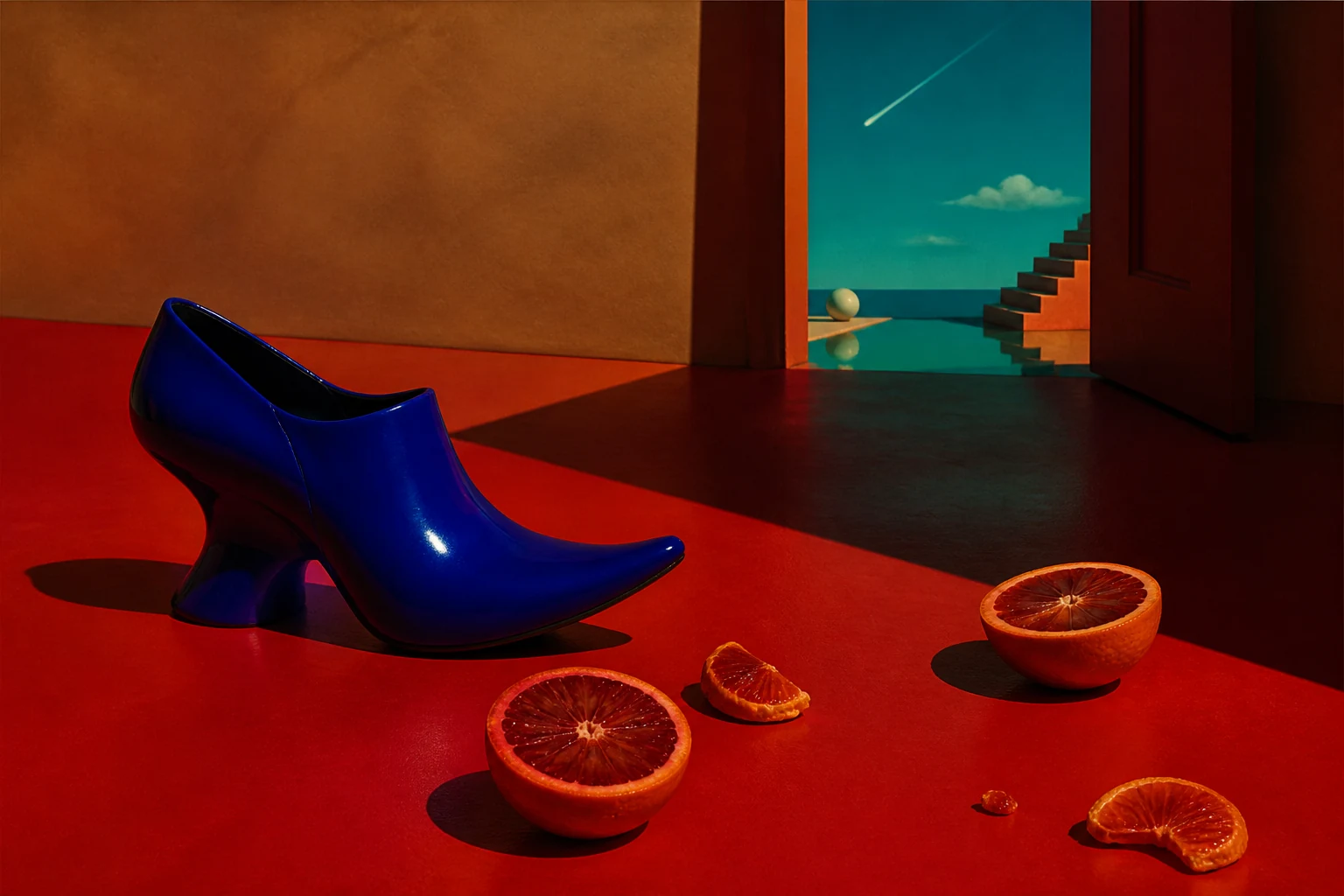
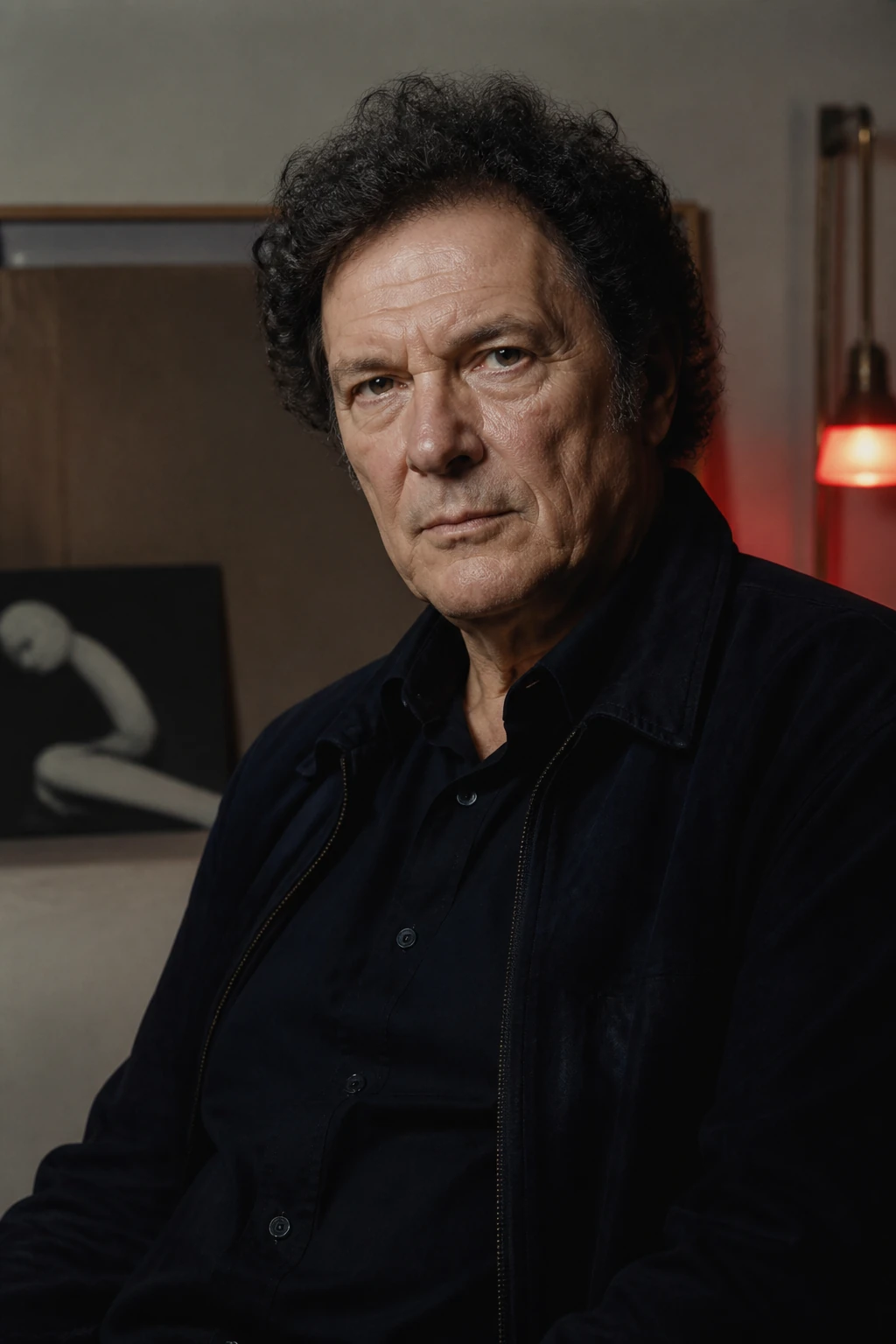
Bourdin photographed not the clothing but the condition it ends up in: an empty hotel corridor, a leg cut off by the frame, a lacquer too bright, a trace left behind. His image does not explain its story; it holds the viewer in unresolved tension between desire, threat and the commercial brief.
Editorial thesis
Guy Bourdin radically altered fashion photography by turning the advertising frame from a demonstration of clothing into an autonomous visual scenario. His legacy cannot be reduced to saturated colour: it is built on surrealism, spatial direction, the cropping of the body, psychological tension, editorial montage and the conflict between a commercial task and an authorial image.
Reader question
How can a photographer almost hide the product, the face and even the model'"'"'s body — and still make the advertising image stronger?
The central subject is Guy Bourdin — his Vogue editorials, his advertising for Charles Jourdan, Chanel, Pentax and Bloomingdale'"'"'s, his drawing, painting, Polaroids and fashion film.
The link with Man Ray is treated as a confirmed early contact and a surrealist influence, not as a simplified "master and pupil" scheme.
The female body is analysed through fragmentation, eroticisation, violence and the agency of the model.
Dark subjects are not read as literal evidence of the photographer'"'"'s biography without sources.
The role of the editor Francine Crescent and of the magazine spread is treated as part of the production of meaning.
Posthumous prints are separated from the photographer'"'"'s lifetime material; provenance and markings must be checked with the Estate.
Short answer
Guy Bourdin was born on 2 December 1928 in Paris. While serving in the French air force in Dakar in 1948–1949 he worked as an apprentice photographer. After his return he drew, painted and made experimental photographs.
In 1952 Man Ray wrote the preface for the catalogue of his first solo exhibition. In February 1955 Bourdin'"'"'s first fashion photographs appeared in French Vogue. His long work for the magazine and the Charles Jourdan campaigns made narrative, anxiety and saturated colour a full language of commercial photography.
1. Paris and the early years
Bourdin grew up in Paris and at first saw himself primarily as an artist. Drawing and painting explain his unusually strict sense of the picture plane, of colour fields and of geometry.
2. Dakar and photography
During his military service in the air force in Dakar he gained practical experience of photography. The early images are not yet Bourdin'"'"'s fashion language, but they built his technical independence.
3. Man Ray and surrealism
Bourdin persistently sought contact with Man Ray. In 1952 Man Ray wrote the introduction to the catalogue of Bourdin'"'"'s first solo exhibition of photographs at Galerie 29. Surrealism would later show itself not as quotation but as a collision of unrelated objects and a disruption of everyday logic.
4. Vogue Paris, 1955
After showing his work to the editor Edmonde Charles-Roux, Bourdin received a Vogue commission. In February 1955 the magazine published Chapeaux-Choc — his first fashion images.
5. Dead rabbits and the breaking of decorum
One frame of the first series placed the model next to skinned rabbits. Even a Vogue-unpublished shot shows an early strategy: the fashion object exists next to visual material that interferes with comfortable consumption.
6. Francine Crescent and the editorial alliance
Particularly important was the collaboration with Francine Crescent, who led French Vogue during Bourdin'"'"'s mature career. The large format of the publications allowed spreads to be built as sequences and visual collisions.
7. The frame as an unfinished crime
Often the event has already happened: the body lies in an illogical pose, the face has disappeared, the object is left without an owner. Bourdin does not tell a complete story — he leaves the viewer with clues.
8. Colour as a psychological weapon
Red, orange, green, violet and artificial skin tones do not function as decoration. The saturation creates a hyperreality in which attractiveness becomes troubling at the same time.
9. Light and artifice
Bourdin did not seek to hide the constructedness of the scene. Hard light, flash, coloured surfaces and deep shadows turn a banal place into a psychological stage.
10. The cropped body
Legs, a mouth, a hand, a shoe or a silhouette can replace the whole person. The crop creates graphic force and fetishisation, but it also raises the question of the depersonalisation of the female body.
11. The face as an optional part of the fashion image
In traditional fashion photography the face supports identification with the model. For Bourdin it is often hidden, turned away or absent. Desire shifts from the personality to the image-system itself.
12. Charles Jourdan
The collaboration with the shoe brand Charles Jourdan became one of the most important advertising laboratories of the twentieth century. A shoe could occupy the smallest area of the frame, while the main space went to a strange narrative.
13. Walking Legs
The series with legs and shoes shows the radical separation of the product from the full human body. The city, the road and the architecture become the stage of an anonymous fragment on the move.
14. Product after narrative
Bourdin'"'"'s main commercial paradox: the viewer first remembers the scene and then discovers the product. It is this delay that makes the product part of a strong memory rather than mere catalogue information.
15. Hotel, bedroom, swimming pool, road
He used banal spaces — hotel rooms, bathrooms, cars, beaches, streets. Precise direction turned them into the scenery of an unknown event.
16. The architecture of the frame
A low horizon, large colour planes, doors, walls, kerbs and furniture create a geometry inside which the body often appears as just one more object.
17. Mirror and double
Mirrors allow the body to be split, the space behind the camera to be shown, or a false depth to be created. Bourdin'"'"'s reflection rarely confirms reality — it makes it less stable.
18. Make-up and hyperreality
Perfectly outlined lips, lacquer, skin and intense colours turn the beauty code into an almost artificial envelope. Perfection becomes a little frightening.
19. Sex, death and humour
Eroticism sits next to signs of danger and absurdity. Yet not every frame should be read literally as violence: Bourdin often uses visual black humour and deliberate ambiguity.
20. The woman and the problem of the male gaze
His women can look powerful and at the same time turned into objects. A contemporary reading must hold both sides: the formal revolution and the historical structure of the commercial male gaze.
21. The model as performer
The complex scenes demanded precision in the position of the body, endurance and the ability to hold an unnatural pose. The history of Bourdin is incomplete without recognising the professional labour of the models.
22. Polaroid and preparation
The archival Polaroids show how carefully the position, the colour and the relation of the body to the set were checked. The spontaneity of the final frame was often the result of many corrections.
23. Fashion film
Bourdin experimented with moving image during fashion shoots. The films confirm that he was interested not in a single beautiful moment but in the direction of space and sequence.
24. Chanel and other clients
Besides Charles Jourdan, Bourdin worked for Chanel, Pentax, Bloomingdale'"'"'s and other clients. The commercial commission did not soften his language; it gave him the infrastructure for experiment.
25. Bloomingdale'"'"'s Sighs and Whispers
In 1976 a lingerie catalogue for Bloomingdale'"'"'s became a rare lifetime book object by Bourdin. His refusal to turn magazine images into a traditional authorial monograph was part of his attitude to the ephemerality of fashion media.
26. Pentax Calendar
Calendar projects allowed him to separate the image even further from magazine narrative. Formal strangeness became the main carrier of attention.
27. Bourdin and Helmut Newton
They are often paired because of the work for French Vogue and erotic tension, but their strategies differ. Newton builds a figure of power and a sexual character; Bourdin more often dissolves the character inside a mysterious scenario.
28. Refusal of fame and exhibition career
In his lifetime Bourdin did not systematically try to turn fashion work into museum prints and books. The main environment of the image remained the page of the magazine — temporary, mass-produced and disposable.
29. The image is more important than the object
Bourdin'"'"'s main shift lay in the understanding that advertising does not only sell the object. It sells a psychological world, and the desire to enter that world can be stronger than the interest in the product itself.
30. Death and the posthumous archive
Bourdin died on 29 March 1991 in Paris. After his death the archive became the basis for exhibitions, research and the formation of the museum canon.
31. Posthumous institutionalisation
The major retrospective at the Victoria and Albert Museum in 2003 and the exhibitions that followed helped translate an ephemeral magazine practice into the history of art.
32. Estate and contemporary prints
The Estate stresses the difference between the few lifetime colour prints and the contemporary estate prints. The new prints are numbered, marked by the Estate and signed by Samuel Bourdin.
33. Influence on the fashion image
Narrative advertising, hyper-saturated colour, the disembodied body, the strange crop and the cinematic clue became part of the shared visual vocabulary of fashion.
34. The problem of imitation
Copying the red lips, the legs and the saturated colour produces only the surface. Bourdin'"'"'s strength lies in the cause-and-effect enigma: the viewer must try to understand why this frame exists.
35. What a contemporary art director can use
From Bourdin it is more productive to take not the visual clichés but the method: one conflict, clear geometry, controlled colour, hidden product, unfinished story and a frame that keeps working after the first glance.
36. Conclusion
Bourdin proved that a fashion photograph can be stronger than the product it is supposed to show. His frame is an advertising surface turned into a psychological thriller, where beauty, desire and danger exist at the same time.