photographer profile
Tim Walker
Fantasy, set design and storytelling in the fashion image
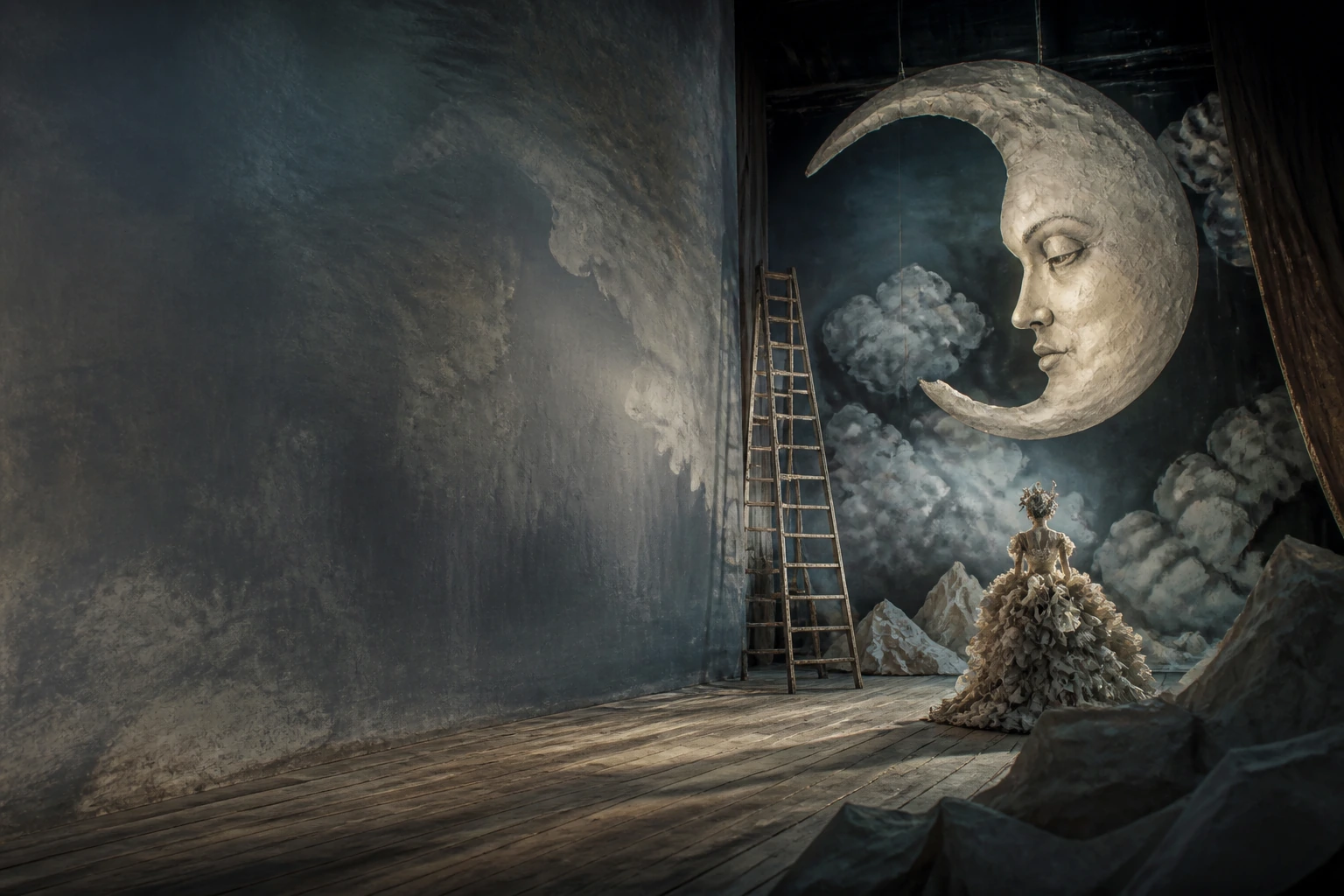
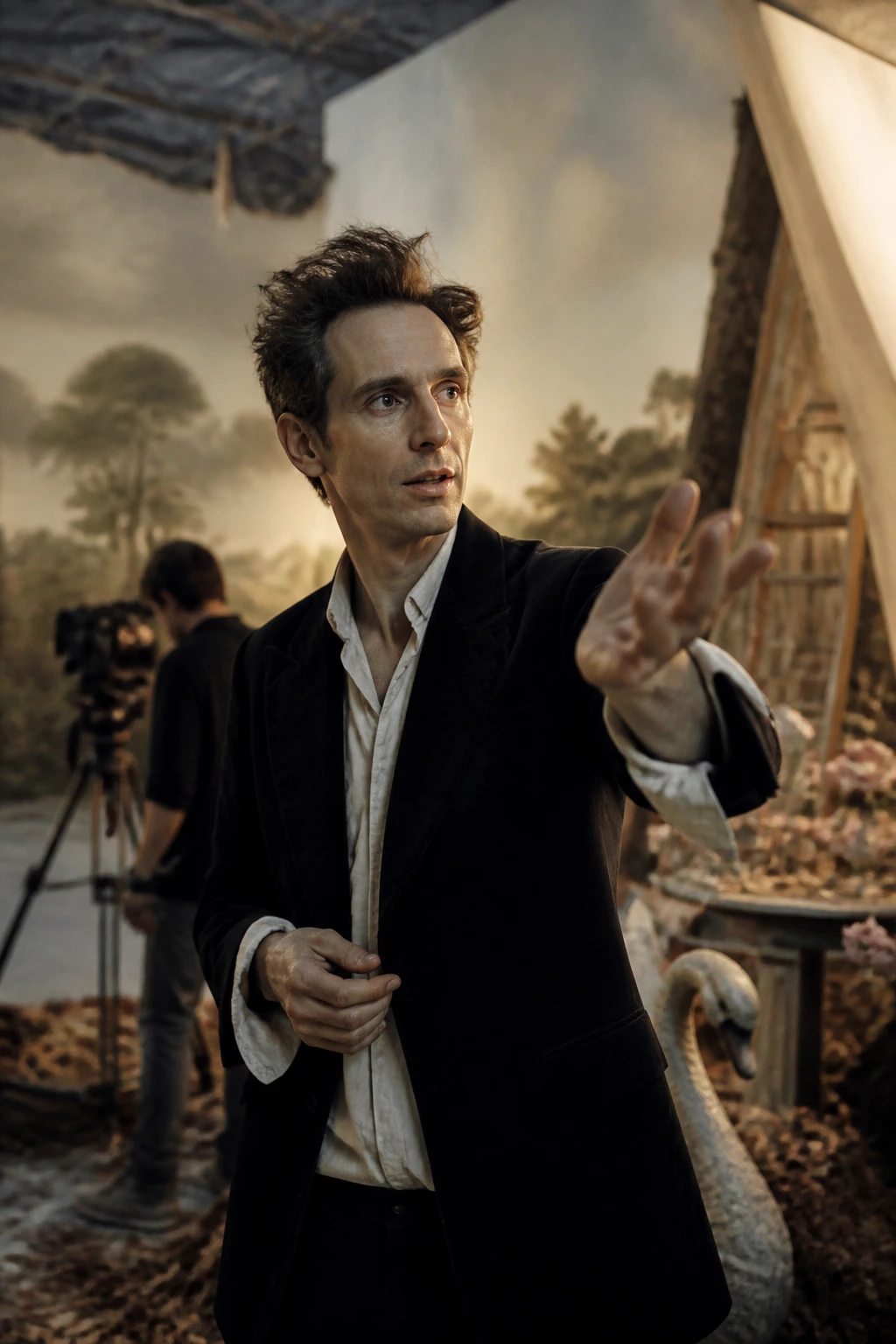
Walker builds fashion photography as a temporary world: archive, fairy tale, giant props, couture, model and collective production combine into a physical scene, making the impossible feel convincing.
Editorial thesis
Tim Walker matters not as a maker of merely “fairy-tale pictures” but as a key architect of modern fashion world-building. His fantasy depends on research, physical sets, collective authorship and a precise understanding of the model as a character. [source]
Reader question
Why do giant props, strange animals, couture and museum objects in Walker’s work not collapse into decorative chaos - and what makes the fantasy convincing?
Short answer
Because he designs the rules of a world rather than a collection of effects. Source material, storyboard, set design, styling, model, light and scale serve one story. Once that system is coherent, even an impossible object appears to belong in the frame. [source]
1. 1970: imagination begins before the profession
Tim Walker was born in England in 1970 and began taking pictures as a boy. His official biography does not revolve around one miraculous early image but around a sustained fascination with pictures, books, adventure and invented worlds. [source]
This is a useful key to the career that followed. Walker does not treat fashion as a catalogue of garments. For him, an image is a door into another reality. A dress, chair, animal, cloud or giant doll can therefore function not as a prop but as part of a complete world.
2. Cecil Beaton: the archive as a time machine
Before university, Walker spent a year at the Condé Nast Library in London working with the Cecil Beaton archive. His official biography identifies that experience as decisive in his choice of photography. [source]
The archive taught him that a fashion image can outlive a season. A photograph preserves not only a dress but the gesture of an era, editorial taste, printing culture and a particular idea of beauty. Beaton offered less a set of retro formulas than a vast visual archive that had to be transformed rather than copied.
3. Exeter College of Art: technique acquires form
Walker went on to study photography at Exeter College of Art. The World Photography Organisation and his official site connect this period with professional technical training and early recognition. [source]
His later pictures can look like uncontrolled fantasy, but they depend on a disciplined photographic base. That is why giant props, complicated staging and unusual lighting do not collapse the frame. Technique remains the invisible structure supporting the fairy tale.
4. Richard Avedon: New York and the discipline of the major magazine
After graduating, Walker worked as an assistant to Richard Avedon in New York. His official biography presents the experience as a continuation of his education after Exeter. [source]
Avedon's studio offered a lesson very different from romantic chaos: timing, editorial responsibility and the ability to make difficult production feel inevitable. Walker does not imitate Avedon's minimalism, but he inherits the idea that even an extravagant image has to be constructed with precision.
5. Age twenty-five: the first fashion story for British Vogue
Back in Britain, Walker shot his first fashion story for British Vogue at the age of twenty-five. The milestone appears throughout his official and institutional biographies. [source]
Vogue became more than a major client. It was a long laboratory in which he could work with sequences instead of isolated advertising frames. A sequence allows entry, development, recurring motifs, shifts of scale and an ending.
6. The fashion story: clothing becomes part of a narrative
Walker became known for lavish tableaux and ambitious narrative-driven shoots, as his official biography describes them. [source]
The distinction from ordinary fashion documentation is fundamental. In a lookbook, clothing is the central information. In Walker's stories, a garment can become a colour block, a character device or a strange object within the plot. Fashion remains visible but is no longer the only meaning.
7. The fairy tale as grammar rather than childish decoration
Fairy tales, children's literature and fantastical visual culture recur throughout Walker's work. Yet the strongest series do not merely illustrate familiar stories. They use fairy-tale grammar: altered scale, transformation, danger, gift, forest, mirror, double and dream. [source]
For contemporary image-makers this distinction matters. Adding a giant flower is not enough. A fantastical object works only when it changes the rules of the scene. Otherwise fantasy becomes decoration.
8. Storyboard and mood board: fantasy begins with research
The V&A shows that Walker comes to a shoot with research, storyboards and mood boards rather than a single beautiful picture in his head. These materials communicate sources of inspiration and allow models to understand the characters they will inhabit. [source]
Fantasy turns out to be a rational process. Visual references, materials, historical objects, character and action come first. The set follows. That order protects an expensive production from its greatest danger: spectacle without an idea.
9. Scale: giant props and the small human figure
One of Walker's most recognisable strategies is to destabilise human scale. Giant gloves, furniture, insects, dolls and architectural props can make the model tiny or unexpectedly monumental. [source]
Scale works psychologically. Once an ordinary thing becomes too large, the viewer briefly loses spatial certainty and must reassess the scene. The oversized prop is therefore not simply an impressive object; it changes the relation between body and world.
10. Shona Heath: set design as the physical architecture of the frame
Set designer Shona Heath is one of Walker's most important long-term collaborators. The V&A describes their work as the translation of a visual idea into a physical environment, and Heath also designed the exhibition space for Wonderful Things. [source]
The collaboration reveals why the title photographer can be too narrow. Walker imagines the image, Heath constructs its space, and the final frame depends on material, weight, scale and the model's physical relationship to the set.
11. The stylist: clothes must enter the world, not merely be worn
The V&A separately documents Walker's work with stylists including Amanda Harlech, Jack Appleyard and Josephine Cowell. Clothing is not selected after the story as a product list; it develops together with the visual world. [source]
Styling therefore changes function. The stylist asks which clothes can survive a particular scale, colour, action and narrative. Sometimes couture is needed, sometimes an improvised element, sometimes something that changes on set.
12. Hair and make-up: the character is built in layers
Hair and make-up operate as part of the same world. The V&A notes that decisions are refined on set in response to lenses, light, staging and the work of other collaborators. [source]
The character is not assembled in a simple order of dress, then face. Hair can alter silhouette, make-up can enlarge the eye or mouth, and light can turn skin colour into part of the environment. The final image emerges through coordination.
13. The model as co-author: believing in the impossible
Walker describes models as people who make the impossible convincing because they begin to believe in the fictional world themselves. The V&A emphasises that models contribute ideas as a shoot develops. [source]
This marks the difference between theatricality and dead staging. If a model only executes a pre-drawn pose, the set can swallow the person. If the character understands its own logic, the photograph begins to live inside the artificial world.
14. Kate Moss: a familiar face inside new worlds
Walker's official biography names Kate Moss among his long-running creative relationships. [source]
Photographing an extremely familiar face is difficult because the audience has already seen it in hundreds of roles. Walker solves the problem not by claiming to reveal the 'real Kate Moss' but by placing the familiar face inside new visual rules. Recognition becomes the entrance, not the destination.
15. Tilda Swinton: performative presence instead of the standard pose
Tilda Swinton is another central collaborator and muse. Walker's official site and the V&A place her within major projects, including Wonderful Things. [source]
Swinton suits Walker's method because she functions less as a model of fixed beauty than as an actor willing to change age, gender coding, posture and genre. Couture becomes costume for a character rather than an object displayed for its own sake.
16. Magic Mirror, 1999: the mirror as a machine of transformation
Magic Mirror for Vogue Italia in 1999 appears in Walker's official Stories archive. The title already reveals one of his basic mechanisms: the mirror does not simply reflect but generates another version of the character. [source]
In a mirrored scene fashion gains another layer. The viewer sees body, reflection, frame and the possibility of disagreement among them. It is almost a ready-made structure for thinking about identity through clothing.
17. Only a Northern Song, 2002: pop culture meets theatrical staging
Only a Northern Song for Vogue Japan in 2002 also survives in the official Stories archive. [source]
The series demonstrates how freely Walker connects fashion with music, pop culture and theatrical staging. He is not interested in historical reconstruction. Reference acts as an emotional trigger from which a new visual situation can be built.
18. Cut & Paste, 2006: collage is built before the page
Cut & Paste for Vogue Japan in 2006 uses the logic of collage, but collage in Walker's work often begins before the page is assembled: cut forms, background, body and objects already coexist as physical layers on set. [source]
That remains useful in the age of generative imagery. Some of the strongest impossible images come not from unlimited digital freedom but from real materials sharing one space and one light.
19. Practical effect versus digital infinity
Walker worked for years with elaborate physical sets and props. The V&A makes clear how much of the 'magic' is produced through practical construction rather than post-production alone. [source]
Practical effects introduce accidents: fabric sags, cardboard has seams, wood reflects imperfectly and a model truly touches the object. Digital work can extend the scene, but physical imperfection often makes fantasy believable.
20. The white studio: what remains when the set disappears
After years of elaborate sets, Walker deliberately challenged himself with portraits made in a simple white space. His official biography describes the shift as a way of concentrating on the sitter rather than the environment. [source]
It is an important test of authorship. If a photographer is recognisable only through giant props, the method depends too heavily on surface. White space reveals what remains: research, relationship, gesture, colour and the ability to construct a character without spectacle.
21. Pictures, 2008: the first major museum summation
In 2008 the Design Museum in London presented Tim Walker: Pictures, his first major museum exhibition. The Design Museum retains it in its official 2008 exhibition history, while Walker's own biography lists it as an important retrospective. [source]
Institutionally, the moment matters because fashion photography is treated not as disposable magazine service but as a coherent form of visual authorship. Editorial context, fashion and set design do not obstruct museum interpretation; they are part of the content.
22. Recognition in 2008-2009: when the fashion image enters the canon
Walker received the Isabella Blow Award for Fashion Creator in 2008 and an International Center of Photography Infinity Award for fashion photography in 2009, according to the World Photography Organisation. [source]
Recognition came not through abandoning fashion but through expanding what it could do. Walker did not need to erase the commercial context in order to prove artistic value. Editorial and commissioned photography could be culturally ambitious on their own terms.
23. The Lost Explorer, 2010: photography begins to unfold in time
In 2010 Walker made his first short film, The Lost Explorer, which premiered at the Locarno Film Festival and later won Best Short Film at the Chicago United Film Festival, according to his official biography. [source]
The move into moving image is logical. His still photographs always imply a moment before and after the shutter. Film simply allows the character to remain inside the world for longer than one exposure.
24. Story Teller, 2012-2013: an exhibition as a walk through the archive
Story Teller ran at Somerset House in 2012-2013 and appears in Walker's official history of major solo projects. [source]
The title describes his method precisely. The photographer is not merely a maker of decorative fairy tales but a storyteller who needs sequence, pause, character and changes of space. The exhibition made clear that a single frame is only one fragment of a larger system.
25. Like a Doll, 2012: doll, body and uneasy beauty
Like a Doll for Vogue Italia in 2012 is preserved in Walker's official Stories archive. [source]
The doll is not merely a cute retro motif. It contains unease: a living person imitates an inert object, and surface perfection becomes too perfect. Fashion works particularly well in this zone between attraction and strangeness.
26. The Granny Alphabet, 2013: age becomes a protagonist of fashion imagination
In 2013 Walker published The Granny Alphabet, a two-volume project about older women combining photographs, illustrations and texts. The Metropolitan Museum of Art discusses the book as an example of his fantastical language addressing age and individuality outside the usual modelling norm. [source]
The project broadens the idea of a fashion subject. Imagination does not belong only to youthful bodies. Age brings biography, clothing habits and character that cannot be replaced by a flawless surface.
27. The Garden of Earthly Delights, 2015-2016: Bosch as a partner across five centuries
In 2015 Walker received a commission from the Nicola Erni Collection for a series inspired by Hieronymus Bosch's The Garden of Earthly Delights. His official site notes that the images were printed on large gesso-coated canvases and exhibited in 's-Hertogenbosch around the 500th anniversary of Bosch's death. [source]
The project demonstrates a productive relationship to art history. Walker does not literally reconstruct Bosch. He extracts density, sensuality, anxiety and impossible biology as emotional material, then rebuilds them through contemporary photography.
28. Björk and Harry Styles: music image as an extension of portraiture
Walker regularly works with musicians and moving image. His official site records the video for Björk's Blissing Me in 2017, Kate Bush's Director's Cut album imagery in 2011 and Harry Styles' Fine Line artwork in 2019. [source]
The music portrait asks for the same thing as a fashion story: a world in which someone can appear both themselves and a character. Album artwork is an especially severe format because one image may need to carry an entire sonic identity.
29. Wonderful Things, 2019-2023: the museum becomes a collaborator
In 2016 the V&A invited Walker to explore its collections. Wonderful Things grew from nine photo shoots based on V&A objects; the Getty later invited him to make a tenth shoot from its own collection. The V&A exhibition ran in 2019-2020 and the Getty presentation in 2023. [source]
This is the culmination of Walker's research method: the museum stops being the place that receives finished photographs and becomes the source of the assignment. Curator, conservator, set designer, stylist, model and photographer together transform a historical object into a contemporary chain of associations.
30. The main legacy: world-building matters more than decorative fantasy
Tim Walker's legacy is easily distorted if it is reduced to a 'fairy-tale style', pastel sets and enormous props. Those signs are easy to copy without understanding the method. [source]
His actual system depends on research, narrative, scale, physical set design, collective authorship and serious attention to the model as character. World-building works only when every visual element knows why it exists. Walker's fantasy is convincing not because reality has disappeared, but because a new reality has been built with precision.