photographer profile
Nick Knight
Image-making, fashion film and digital experiment
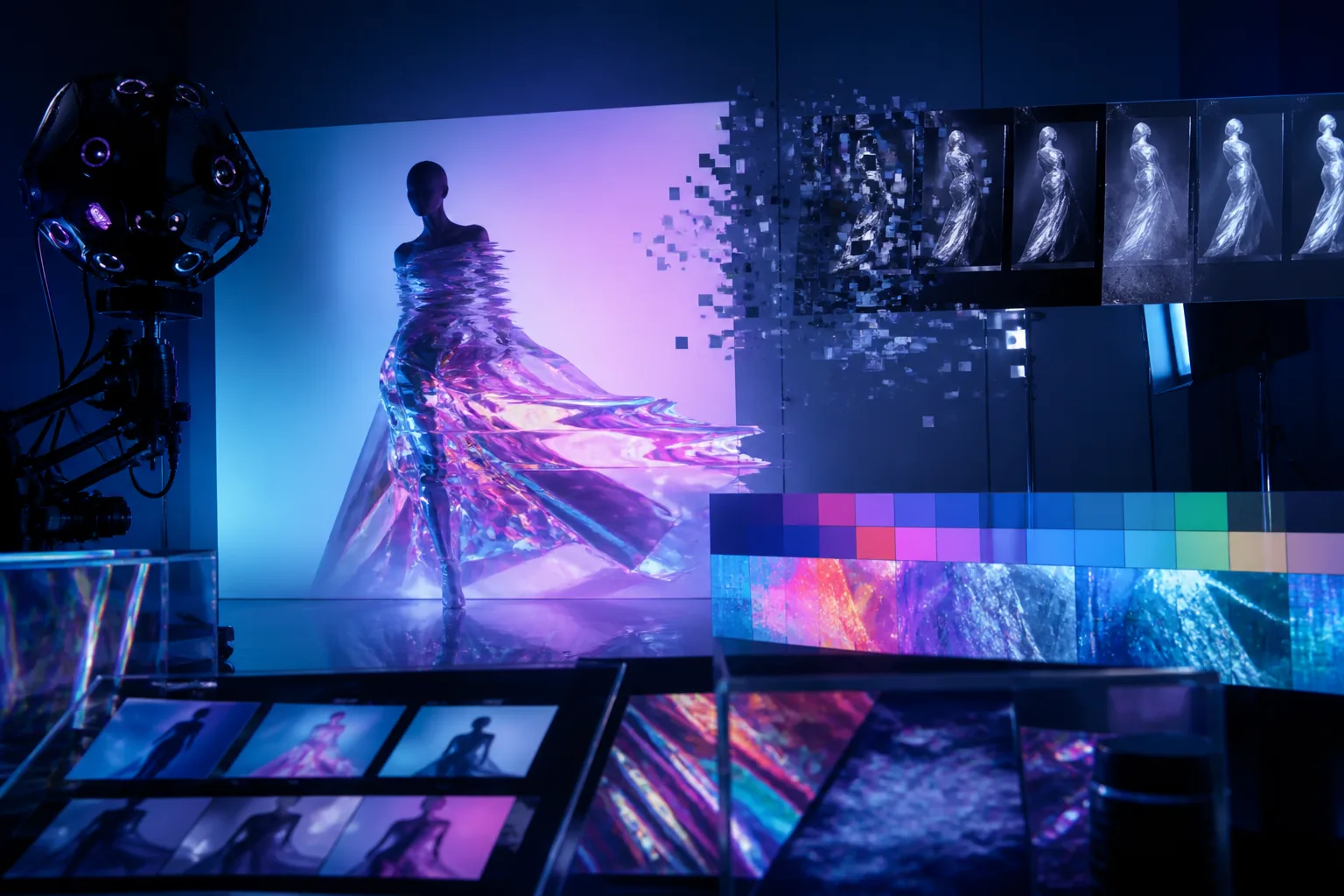
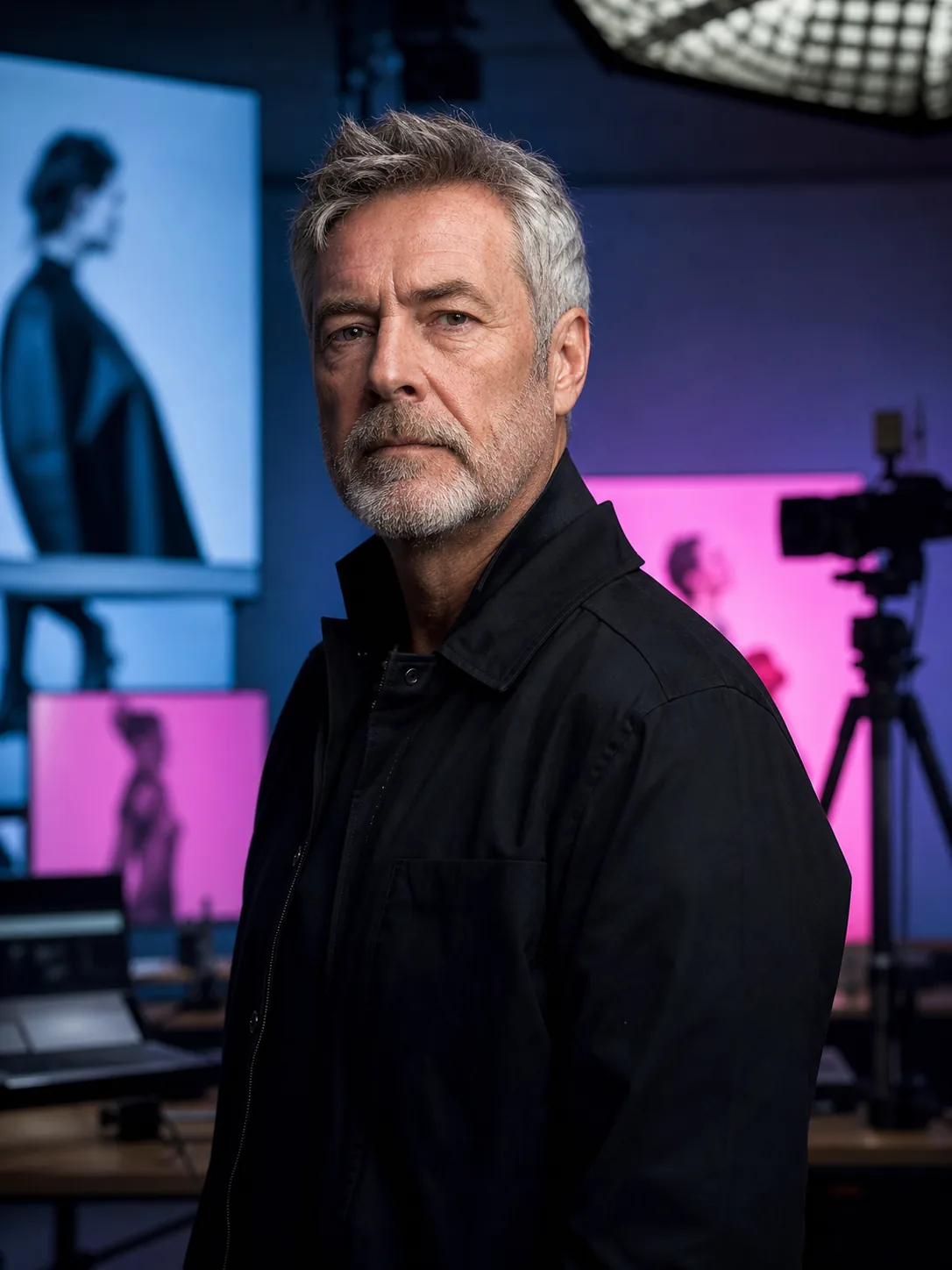
Knight made the fashion image independent of one camera: documentary photography, livestream, film, CGI, 3D scanning, sculpture and AI become different states of one process — an attempt to see fashion as something alive.
Editorial thesis
Nick Knight matters not because he was first to try every new technology. His significance lies elsewhere: he consistently refuses to treat photography as a final object and turns image-making into an open process in which the medium changes with the question. 1
Reader question
What connects Skinheads from 1982, Yohji Yamamoto catalogues, Alexander McQueen, SHOWstudio, 3D scanning and AI — and why does all of it remain one authorial practice?
Short answer
They are connected by an interest in how clothing, body, technology and media transform one another. Knight does not defend the boundaries of photography; he chooses the tool again for each project and makes the production of the image itself visible. 1
1. Before fashion: why everything begins with Skinheads
Nick Knight entered photography not through glossy idealisation but through subculture. His early Skinheads work grew from direct involvement with the British scene of the late 1970s and early 1980s rather than an attempt to reconstruct it afterwards. Knight's official site identifies Skinheads as his first book of photographs and dates its publication to 1982. 1
For VANSMITHLAB this is essential: before Knight worked with high fashion, he already understood image-making as a way to enter a social group and reveal codes of clothing, behaviour and belonging. Fashion appears first not as luxury but as a visual language of community.
2. 1982: a documentary book as the first visual position
Skinheads matters not only as an early book but as a statement of position. Knight does not separate hairstyle, boots, jacket and posture from social identity. Clothing functions as a sign of belonging, while portraiture becomes a document of the relationship between person and group. 1
That sensitivity to dress as code later moves into high fashion. Even Knight's most technologically complex work keeps asking what clothing does to body, status and self-perception.
3. From photographer to image-maker
Knight consistently prefers the term image-maker to photographer. His own site describes him this way, and in interviews he has said that he never regarded himself as a classical photographer. 1
This is more than a title. An image-maker can move between camera, scanning, CGI, film, live stream, print, sculpture and AI. For Knight the medium is secondary to the task: if an idea requires abandoning the conventional camera, photography must not become a limitation.
4. Yohji Yamamoto: when the catalogue becomes a laboratory
Work with Yohji Yamamoto in the late 1980s became one of Knight's central laboratories. His official biography names Yamamoto among his defining long-term collaborators, and later retrospectives repeatedly return to those catalogues as a formative body of work. 1
Yamamoto's clothes required another image regime: not simply showing a garment but communicating volume, movement of black fabric, asymmetry and an almost architectural relation to the body. The catalogue stopped being an appendix to the collection and became an autonomous visual object.
5. Marc Ascoli and the new role of the art director
Art director Marc Ascoli was a major figure in this period. His role shows why fashion image-making is almost always collective production. The art director determines not only typography and layout but the cultural frame through which photography is read. 1
The Ascoli-Yamamoto-Knight relationship reveals a modern model of authorship: designer creates clothing, art director builds a communication system, photographer constructs the image. The strongest result appears when the roles amplify one another rather than compete.
6. The body as a field of beauty rather than a standard
Knight has returned for decades to questions of body and the norm of beauty. SHOWstudio emphasises his interest in people who do not fit traditional fashion standards, while Knight himself has spoken about a desire to look at different forms of the human body. 18
This does not mean the industry automatically becomes inclusive. But in his practice the body stops being a neutral hanger for clothing. It becomes a visual argument capable of contradicting the familiar idea of the 'correct' model.
7. Fashion-Able: Aimee Mullins and a changed idea of the model
In 1998 Alexander McQueen invited athlete and model Aimee Mullins, who uses prosthetic legs, to appear in Fashion-Able for Dazed & Confused, photographed by Knight. SHOWstudio treats the story as an important expansion of whom fashion can regard as beautiful and powerful. 18
The key gesture is the rejection of pity. Mullins is not presented as an exception requiring explanation but as a full subject of fashion image-making. That changes not only representation but the structure of looking itself.
8. Alexander McQueen: collaboration as shared risk
Knight's collaboration with Alexander McQueen was built on shared willingness to take risks. SHOWstudio's retrospective of their work shows projects in which body, clothing, print, video and digital manipulation constantly change one another's status. 18
McQueen did not need a photographer who merely documented collections. Knight, in turn, did not treat clothing as an object that must remain visually untouched. Both used image-making as an extension of design.
9. Visionaire and Devon Aoki: the digital body before social media
One of the most recognisable images from their collaboration is Devon Aoki for Visionaire 20 in 1997: a fantasy, almost cyborg-like face with digitally constructed injury and flowers. SHOWstudio later included the image in exhibitions on Knight and McQueen. 18
Today it can look like a product of social-media post-production culture. Yet it appeared when digital intervention was not an everyday user gesture. The important point is not the technique alone but the freedom to alter anatomy in service of an image idea.
10. Blade of Light: photography as event
Blade of Light from 2004 demonstrates how Knight thinks about photography through event. Working with McQueen's clothing and choreography by Michael Clark, the impact of light becomes a constructed scene in which movement, fabric and body happen simultaneously. 1
The final photograph is only one form of the result. Behind it lies performance, moving bodies and technical staging. Photography stops being merely the final picture and begins to depend on a produced event.
11. Why movement became more important than the still frame
Knight has long argued that fashion cannot be understood only through the still frame. Fabric moves, models breathe, music changes behaviour, and a creative team unfolds through time. His interest in moving image grows directly from this observation. 1
A traditional magazine had to compress movement into one frame. The internet made it possible to preserve process itself rather than reduce it to a single final photograph.
12. SHOWstudio: 2000 and the idea of showing the process
Knight launched SHOWstudio in 2000. His official site states its original aim clearly: to show the entire creative process from conception to completion. 18
This changed the role of fashion media. Instead of publishing only the polished result, SHOWstudio made conversation, fitting, error, live performance, interview, editing and incompletion visible. Process became content and cultural record.
13. Live broadcast: fashion becomes real-time media
Live broadcast became one of SHOWstudio's central tools. Knight wanted audiences to see fashion at the moment it happened rather than after the event. This disturbed the traditional hierarchy between closed industry space and mass audience. 18
Today livestreaming feels like an obvious platform function. In the early 2000s the gesture was radical: fashion opened part of its backstage logic and accepted the unpredictability of real time.
14. Plato’s Atlantis: the show the internet made global
Alexander McQueen's Spring/Summer 2010 Plato's Atlantis show was streamed through SHOWstudio. The Met explicitly notes the live transmission as an attempt to make fashion an interactive dialogue between creator and consumer. 18
The event showed that a runway was no longer limited to a physical room. Fashion show, film, website, celebrity attention and global audience became one media system — an early prototype for the way cultural events are launched today.
15. Fashion film as an autonomous language
For Knight, fashion film is neither backstage video nor an advertising photograph set in motion. From its beginnings SHOWstudio positioned moving image as an autonomous fashion medium. 18
Film gives clothing duration: we can see material resist the body, a train lag behind movement, or light change a surface. Meaning is produced not only through frame composition but through time, sound and editing.
16. Ruth Hogben and a new grammar of editing
Director Ruth Hogben worked as Knight's assistant and edited fashion-film projects at SHOWstudio. Her later practice became one example of how the platform not only published a new medium but helped form specialists within it. 18
Editing in fashion film can behave differently from conventional advertising: rhythmic, bodily, almost musical. Clothing stops being an object for display and becomes part of movement.
17. Peter Saville: typography, identity and the digital stage
Knight's relationship with Peter Saville highlights the role of graphic design in digital fashion. Since 2000, SHOWstudio has built not only a flow of images but a recognisable system of interface, typography and identity. 18
If fashion film becomes a new language, it requires a frame for reading. Type, navigation, project covers and digital layout create an architecture comparable to the magazine spread.
18. The mobile camera: why the iPhone does not destroy professionalism
Knight has actively used mobile photography and publicly defended new tools as legitimate forms of serious image-making. SHOWstudio connects his iPhone experiments to a broader habit of working at the edge of accessible technology. 18
Professionalism is not determined by camera size. What matters is understanding light, body, time, editing and why a particular tool serves the idea. A mobile camera changes speed and the physical distance between author and subject.
19. Flora and Plant Power: botany as a field of experimentation
Flora grew out of the Plant Power project for London's Natural History Museum in 1993. SHOWstudio describes it as a long-running series of plants and flowers in which the botanical object stops being neutral illustration and becomes expressive form. 18
This matters because it shows Knight outside the fashion body. He applies similar strategies of magnification, fragmentation, light and colour to plants, finding almost bodily drama in botanical structure.
20. Roses from My Garden: an image between photography and painting
Roses from My Garden continues Knight's work with flowers while moving even farther from classical photography. SHOWstudio presents the series as a border zone between still life, digital processing and an almost painterly surface. 18
The camera is no longer required to function as proof of reality. A flower becomes material for an image just as model or fabric does — a starting point rather than a final limit.
21. 3D scanning: the body leaves the flat image
In the early 2020s Knight worked extensively with 3D scanning. For the project with Michaela Stark, Dodo Potato and Jade O'Belle, bodies were scanned spatially, assembled digitally and then printed as physical forms. 1
The technology changes the question of viewpoint. Traditional photography selects one angle; a 3D scan captures volume and allows the camera to appear later, inside the digital model.
22. Fashion sculpture: the digital model becomes an object
These experiments produced what Knight called fashion sculpture — a physical object generated from digital scanning and 3D printing. SHOWstudio described the 2022 work as an attempt to connect fashion's transience with the permanence of sculpture. 18
It is a logical extension of Knight's career: once the image no longer has to remain flat, boundaries among photograph, avatar, sculpture and installation become practical rather than theoretical.
23. ikon-1: avatar, digital fashion and NFT as a research environment
The 2022 ikon-1 project with Jazzelle was built as a digital fashion environment: hundreds of traits involving hair, make-up and virtual clothing combined into a collection of digital images. SHOWstudio framed it as an investigation of fashion identity in a Web3 context. 18
Historically, the modular identity matters more than the NFT mechanism, which may date quickly. A character becomes a system of variables that can be assembled, changed and transferred across digital contexts.
24. CGI and the virtual campaign
Knight and SHOWstudio have long used CGI not merely as post-production but as a production environment in its own right. In Burberry projects, virtual characters and digital sets became part of campaign language before generative models became widely popular. 18
CGI is especially useful to fashion because it can separate clothing and body from the physical set. But freedom brings a risk of sterility: if digital possibility is not supported by an idea, the image quickly becomes a demonstration of software.
25. AI: a research tool rather than a ready-made style
In recent years SHOWstudio has experimented with artificial intelligence and generative imagery. Knight approaches AI within the logic of his entire career — as another way to see what a conventional camera cannot show. 18
For VANSMITHLAB this distinction is essential: AI should not become a ready-made aesthetic. A technology matters when it changes research, expands the type of image or creates a new production process.
26. Sleeping Beauties: museum, technology and the sensory image
For The Met's 2024 exhibition Sleeping Beauties: Reawakening Fashion, Nick Knight served as Creative Consultant while SHOWstudio developed technological activations. The exhibition catalogue included new Knight photography of historic and contemporary garments. 18
Here his long interest in technology meets a museum problem: how can clothing too fragile to wear regain a sense of movement, sound, texture and bodily presence without damaging the original object?
27. Authorship in the age of large teams
Knight's work makes the collective nature of fashion image-making especially clear. Designer, stylist, art director, hair, make-up, model, choreographer, developer, editor, 3D artist and sound designer may all be equally important to the result. 1
Authorship therefore does not disappear; it changes. A strong image-maker does not have to perform every task personally. The role is to build a system in which specialists work toward one idea while remaining visible as contributors.
28. Why Knight keeps changing medium
Knight keeps changing medium not because novelty itself is the goal but because each tool enables a different conversation with fashion. In an interview he described the transition from one medium to another as one of the central lines of his career. 1
This position is especially contemporary: professional identity no longer has to coincide with one device. A photographer can think photographically while working with livestream, 3D scan or a generative system.
29. The ethics of beauty: widening the norm and the limits of provocation
The expansion of beauty standards is one of Knight's strongest and most complicated themes. Fashion-Able, his work with varied body types and his interest in unconventional characters genuinely widen visibility. Yet every image still exists within commercial and editorial systems. 1
Ethics therefore do not end with choosing an 'unusual' model. We must ask who makes decisions, how the person is represented, what control they have over their image, and whether difference has simply become a new visual fetish.
30. The main legacy: the image as a living process
Nick Knight's main legacy is the transition from photography as a finished object to image-making as a process. Skinheads, Yamamoto, McQueen, SHOWstudio, fashion film, livestream, 3D scanning, CGI, AI and museum activations look radically different but share one idea: the image must remain alive and capable of changing form. 18
For photographers and art directors the useful lesson is not to imitate Knight's extreme processing. It is methodological: first understand what must become visible, then choose the medium that reveals it most effectively.