photographer profile
William Klein
City, grain, fashion and cinema
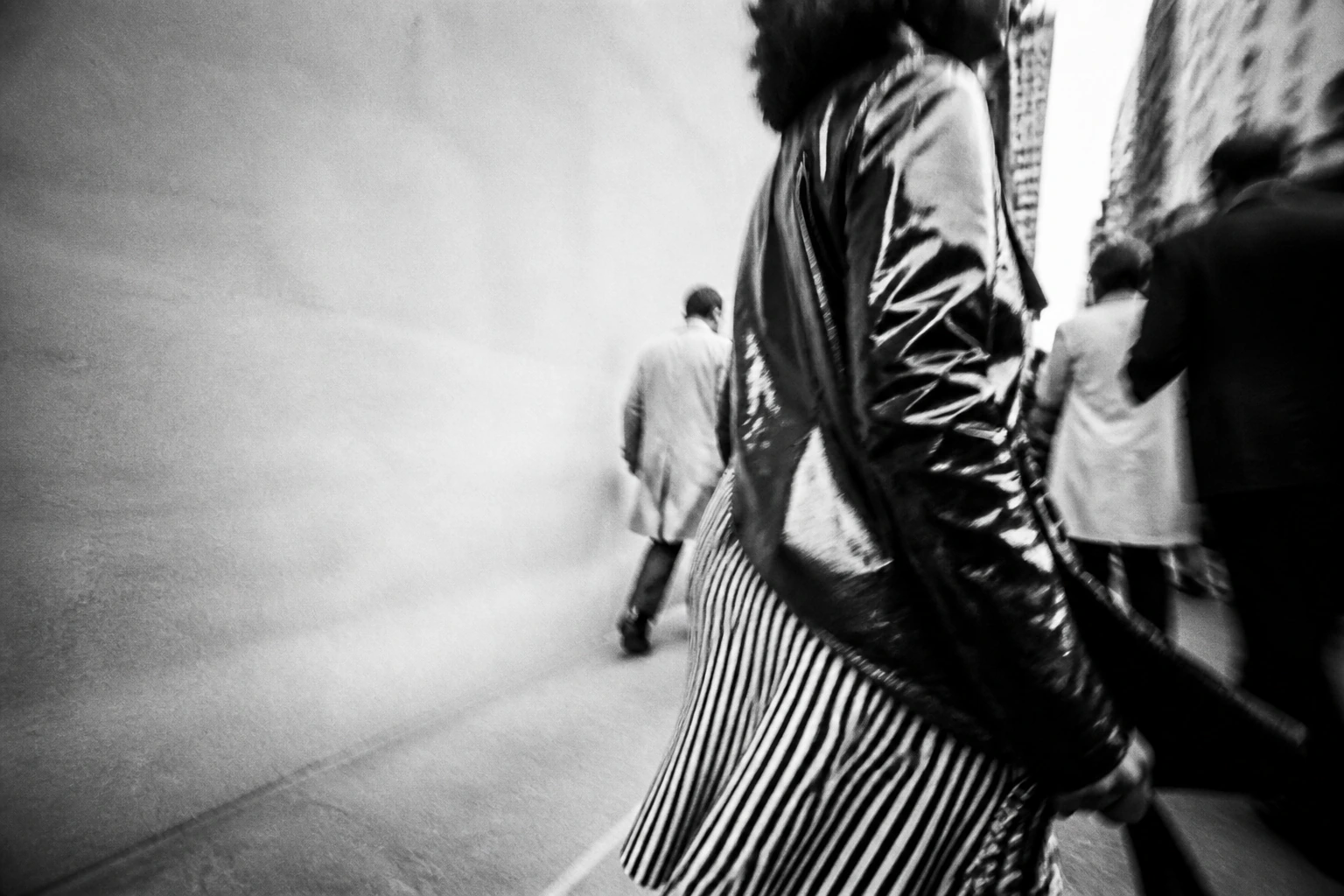
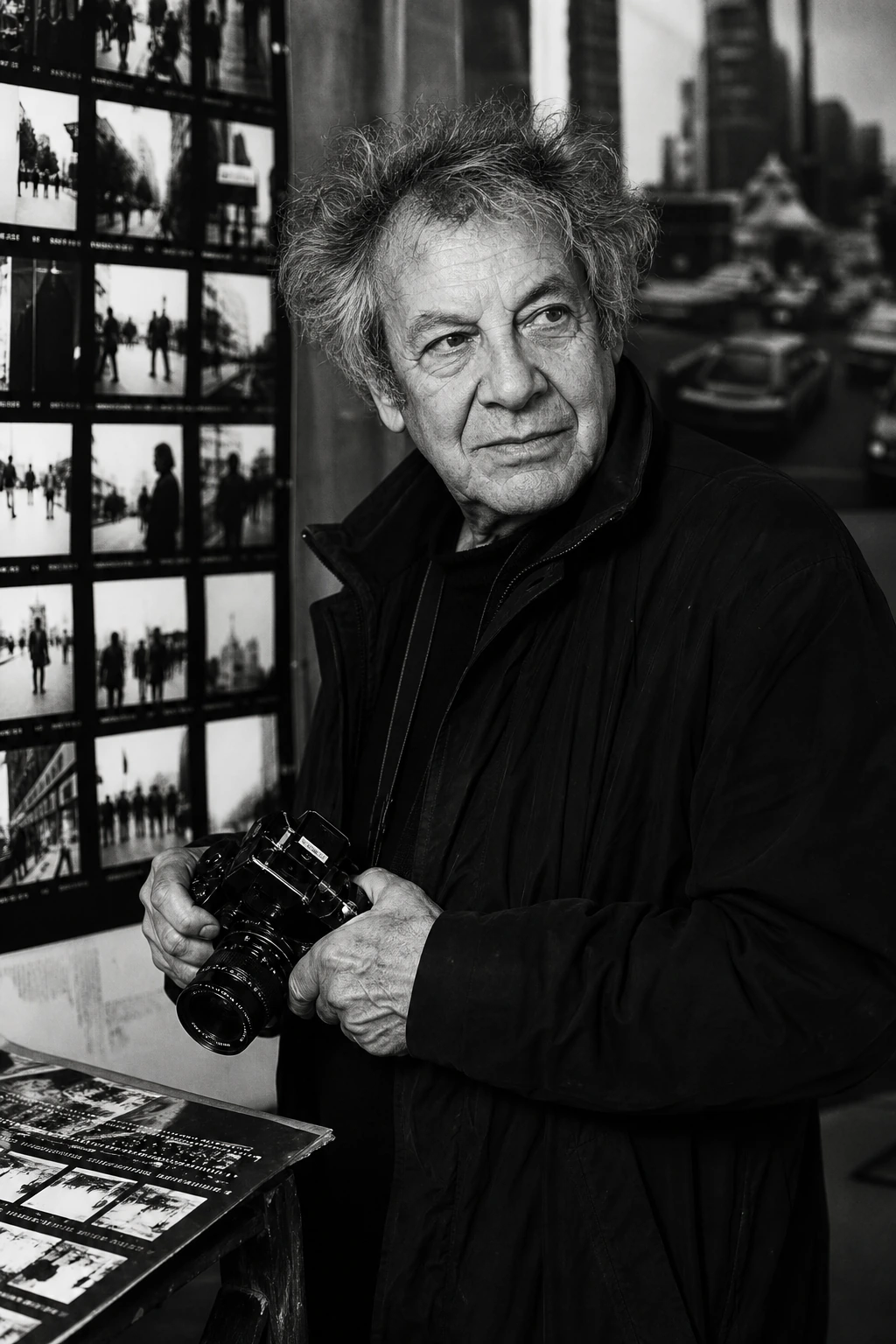
Klein turned what had been treated as photographic errors — grain, blur, proximity and abrupt cropping — into a language of the city, then carried that energy into Vogue, photobooks, graphic design and cinema.
Editorial thesis
William Klein matters not as the author of one “dirty” street style but as an artist who linked photography, the printed page, fashion and cinema through one energy of collision. He proved that an image can be technically imperfect and intellectually precise at the same time. [source]
Reader question
How did one photographer change street photography, fashion imagery, the photobook and cinema — and why do his “mistakes” still look contemporary?
Short answer
Klein did not defend the borders of a genre. He used wide angle, grain, blur, graphic montage, the real street and provocation as tools of proximity and rhythm, then transferred the same way of thinking from still photography into print and moving image. [source]
1. New York, 1926: an artist born inside visual noise
William Klein was born in New York in 1926 and grew up near Harlem. ICP's later retrospective stresses this urban biography: Manhattan museums fed his early fascination with the European avant-garde, while the city itself taught him to live inside visual overload. [source]
For his later photography this matters more than the romantic idea of an innate street eye. Klein formed between two conditions — museum culture and urban noise — and would eventually collide them inside the same image.
2. Postwar Paris: painting, Fernand Léger and freedom of form
After military service Klein settled in Paris and studied painting, including a period in Fernand Léger's studio. ICP describes his early practice as a move from figurative painting toward abstraction and then into the photographic darkroom. [source]
Léger matters less as a ready-made style than as permission to think in bold form beyond academic respectability. Klein was not yet a photographer, but he was already learning to build images through collisions of mass, rhythm and direction.
3. Abstraction before the street: light, movement and photography without subject
In the early 1950s Klein experimented with abstract photographs generated from his own forms and moving surfaces. Some appeared on the covers of design magazines including Domus. [source]
Grain, light trails and graphic distortion in his later city pictures were therefore not accidental sloppiness. Before the street, he had already treated photography as material: light could be stretched, form disrupted, and technical failure turned into composition.
4. Alexander Liberman: an invitation to Vogue as an accidental turn
Alexander Liberman, art director of American Vogue, noticed Klein's work and invited him to the magazine in 1954. ICP emphasises the improbable detail: Klein had no fashion-photography experience, but Liberman recognised a strong visual intelligence and an appetite for problem solving. [source]
It is a useful example of fashion absorbing not a genre specialist but an artist with an existing system of seeing. Vogue gave Klein resources and assignments, but it did not turn him into an obedient fashion photographer.
5. Returning to New York, 1954: the native city as foreign territory
Returning to New York in 1954, Klein photographed his native city almost as someone who recognised and failed to recognise it at the same time. The Met links the pictures to his return after years in Europe; ICP presents the project as a personal body of work developed alongside magazine assignments. [source]
That double position gives the book its tension. It is neither calm local observation nor tourist fascination. The camera reacts quickly, nervously and sometimes aggressively.
6. The camera enters the crowd instead of observing from a distance
Klein deliberately refused the role of invisible observer. In ICP materials, curator David Campany emphasises that he interacted with people, provoked responses and entered the situation himself. [source]
The street therefore stops being a theatre photographed from a safe seat. People see the photographer, answer him, play, become irritated or laugh. The relationship between both sides becomes part of the picture.
7. Wide angle, grain, blur and high contrast as a working language
His 1950s photographs turned qualities then treated as defects into strengths: grain, blur, high contrast, aggressive wide angle and abrupt cropping. ICP describes them as cultivated choices rather than accidental failures. [source]
The lesson should not be reduced to “shoot dirty.” In Klein, broken convention intensifies proximity, speed and urban pressure. A formal defect has to serve the meaning of the scene.
8. Gun 1: the photographer provokes the scene and becomes part of it
Gun 1, New York is a famous example of the photographer's active presence. The Met notes that Klein asked two boys to pose, after which one pointed a toy gun at the camera and intensified his expression of rage. [source]
That factual detail matters ethically. The picture is not a purely found moment. It was partly produced through interaction. The force of street photography here comes not from the myth of invisibility but from acknowledging the author's role in the event.
9. New York: the photobook as montage, typography and page impact
Life Is Good and Good for You in New York: Trance Witness Revels appeared in 1956 and was far more than a portfolio. Klein selected the pictures and designed the layout, cover and typographic structure himself. [source]
Photography therefore exists beyond the frame. Scale on the page, image sequence, black and white space, and the speed of turning pages all become forms of authorship. The photobook behaves almost like film editing.
10. Why American publishers rejected New York
ICP records that American publishers did not want to release New York; the book appeared abroad and later became canonical. [source]
The rejection matters not as a romantic story of a misunderstood genius but as evidence of conflict between prevailing ideas of “good photography” and an image of the city that felt too rough, dense and visually unresolved.
11. Rome: a city read through people, gesture and cinema
After New York, Klein continued making city books. Rome was not an architectural guide but a portrait of people, streets, cars, gestures and postwar Italian culture. ICP places it among the central sequence of his city books. [source]
Rome also reveals his growing relation to cinema: the city is read as a series of scenes where a character may matter more than a monument and a random group more than a perfectly constructed perspective.
12. Moscow: photography between curiosity and political image
Moscow extended the method to a city Western audiences often encountered through political imagery. Klein looked beyond official monumentality toward everyday movement, faces, sport and street life. Centre Pompidou holds, for example, Ping pong, Moscou from 1960. [source]
The photographic interest works against one grand idea of the city. A private gesture fractures the ideological facade into multiple human situations.
13. Tokyo: not exoticism but a collision of speeds and signs
Tokyo became another major city book and pushed collisions of signage, crowds and graphic density to an extreme. ICP includes Tokyo 1964 among Klein's key photobook sequence. [source]
He does not reduce Tokyo to exoticism. The interest is visual overload: advertising, movement, ritual, faces, lettering and urban speed become equally important elements of the frame.
14. The city as co-author: four books instead of one style
New York, Rome, Moscow and Tokyo prove that Klein did not impose one city template. What repeats is not composition but a mode of entry: close, fast, interested in people and in the future printed form of the book. [source]
The city book is therefore a research system rather than a collection of postcards. Each place requires its own density, rhythm and page sequence.
15. Vogue: fashion photography leaves the safe studio
At Vogue, Klein quickly stopped behaving according to studio conventions. ICP describes him taking models into the street, using movement and real urban backgrounds, and working collaboratively with models rather than through rigid control. [source]
Fashion stops being an isolated world of perfect surface. The city, passer-by, car, advertisement and accident enter the frame. Clothing has to survive contact with reality.
16. Models in the street: the real city breaks the perfect pose
Works such as Nina and Simone, Piazza di Spagna, Rome place models inside actual urban movement. ICP cites the image as characteristic of Klein's fashion innovation. [source]
The point is not merely “shooting outdoors.” The street introduces uncontrolled scale, motion and social background. The model is no longer the only reason the image exists.
17. Mirrors, movement and optical play
Klein repeatedly worked with mirrors, reflections and multiplied figures. MoMA's Evelyn, Isabella, Nina and Mirrors, New York, 1962 shows fashion photography becoming an optical construction. [source]
The mirror is not decorative complexity. It destabilises viewpoint: the viewer is no longer certain where the body is, where reflection begins, or which fragment should dominate.
18. The graphic designer inside the photographer
Klein's experience as painter and photobook maker makes him resemble a graphic designer working with a camera. His images depend on bold contrasts, lettering, signs, light marks, cropped figures and forceful frame edges. [source]
Looking only at subject matter is therefore insufficient. Much of the energy comes from the way photographic chaos becomes a flat printed structure.
19. Fashion as play, irony and criticism of its own industry
Klein's attitude toward fashion was simultaneously professional and ironic. ICP describes his approach as play, while Criterion later called him one of American Vogue's most subversive fashion photographers. [source]
That distance allowed him to show clothes while questioning the machinery of prestige. A Klein fashion image can be luxurious and suspicious of luxury at the same time.
20. Broadway by Light: neon becomes cinema
Broadway by Light from 1958 is an early Klein film about neon and commercial light. ICP recalls Orson Welles describing it as a film that genuinely needed to be in colour. [source]
Cinema grows directly from his photographic interest in sign and light. New York advertising stops being background and becomes a moving abstract image.
21. Who Are You, Polly Maggoo?: fashion removes fashion’s mask
Who Are You, Polly Maggoo? from 1966 was Klein's first fiction feature and a sharp satire of haute couture, media and the production of female imagery. Criterion explicitly connects the film to his years inside Vogue. [source]
The criticism comes from within the industry. Klein knows fashion production well enough to turn it into grotesque theatre without losing visual pleasure.
22. Mr. Freedom: pop imagery as political satire
Mr. Freedom moves from fashion satire into politics. Criterion describes it as an intentionally excessive pop lampoon of American imperialism during the Vietnam era. [source]
The visual language remains connected to advertising, comics and fashion: a seductive surface is repurposed to expose the construction of propaganda.
23. Muhammad Ali: documentary film and the charisma of a public figure
Klein's documentaries about Muhammad Ali show another side of his cinema. ICP includes Cassius the Great and Muhammad Ali the Greatest among major parts of his filmography. [source]
Sport is only part of the subject. The camera studies how a public figure is made through voice, gesture, press, politics and crowds — many of the same forces that create a fashion icon.
24. 1965: leaving Vogue and giving priority to film
In the mid-1960s Klein ended regular work for Vogue and for a long period gave priority to film. ICP records the end of his contract in 1965 and the subsequent retreat from still photography. [source]
This was not a conventional career change. His interests in sequence, movement, montage and public performance simply found a more suitable medium.
25. Returning to photography in the late 1970s
By the late 1970s Klein began working with still photography again; ICP gives 1978 as the point of his partial return. [source]
The return is revealing because the photographer had already passed through cinema. Later images and archival reworkings become less dependent on the myth of a decisive instant and more connected to series, printing and re-editing.
26. Painted Contacts: the contact sheet becomes a work in itself
In Painted Contacts, Klein transformed contact sheets into large autonomous images, marking selected frames with coloured paint and making the physical logic of editing visible. Howard Greenberg Gallery describes Contacts as a collection of his reworked and over-painted contact sheets. [source]
A contact sheet normally hides the photographer's working process. Klein reverses that hierarchy: selection, error and neighbouring frames become visible parts of the work. Editing itself becomes an image.
27. In and Out of Fashion: a career as a montage of media
In and Out of Fashion from 1994 existed as book, film and ICP exhibition. ICP's obituary describes it as Klein's own account of his career presented across several media. [source]
It is an unusually accurate autobiographical form: his career cannot be explained as a linear sequence of fashion assignments or street photographs. It is itself a montage of image systems.
28. William Klein: YES — a retrospective without one label
In 2022 ICP opened William Klein: YES; Photographs, Paintings, Films, 1948–2013, a major retrospective containing nearly 300 works. The exhibition intentionally joined painting, photobooks, street, fashion, cinema and graphic work instead of dividing them into separate careers. [source]
The title YES fits Klein's method: significance through openness rather than specialisation — entering a new medium whenever it offers another way to construct an image.
29. Influence: from Daido Moriyama to contemporary fashion street photography
Klein's influence is especially visible in postwar Japanese photography: Tate explicitly lists his New York as an important reference for Daido Moriyama. But the impact is broader, with grain, blur, wide angle and the invasion of real streets entering the vocabulary of many later photographers. [source]
In fashion, his legacy lies less in copying a single picture than in allowing the model to exist inside the real world rather than only inside perfect scenery.
30. The main legacy: an error can become a method when it is intentional
William Klein's central lesson is not simply that rules should be broken. He shows that a violation must produce new meaning: grain intensifies pressure, blur conveys speed, wide angle produces proximity, abrupt crop creates conflict, and photobook montage creates rhythm. [source]
An “error” becomes a method only when the author understands why it is needed. Klein turned technical imperfection into an intellectual tool and expanded the definition of what a good image could be.