photographer profile
Sølve Sundsbø
Technology, transformation and the fashion image without a fixed style
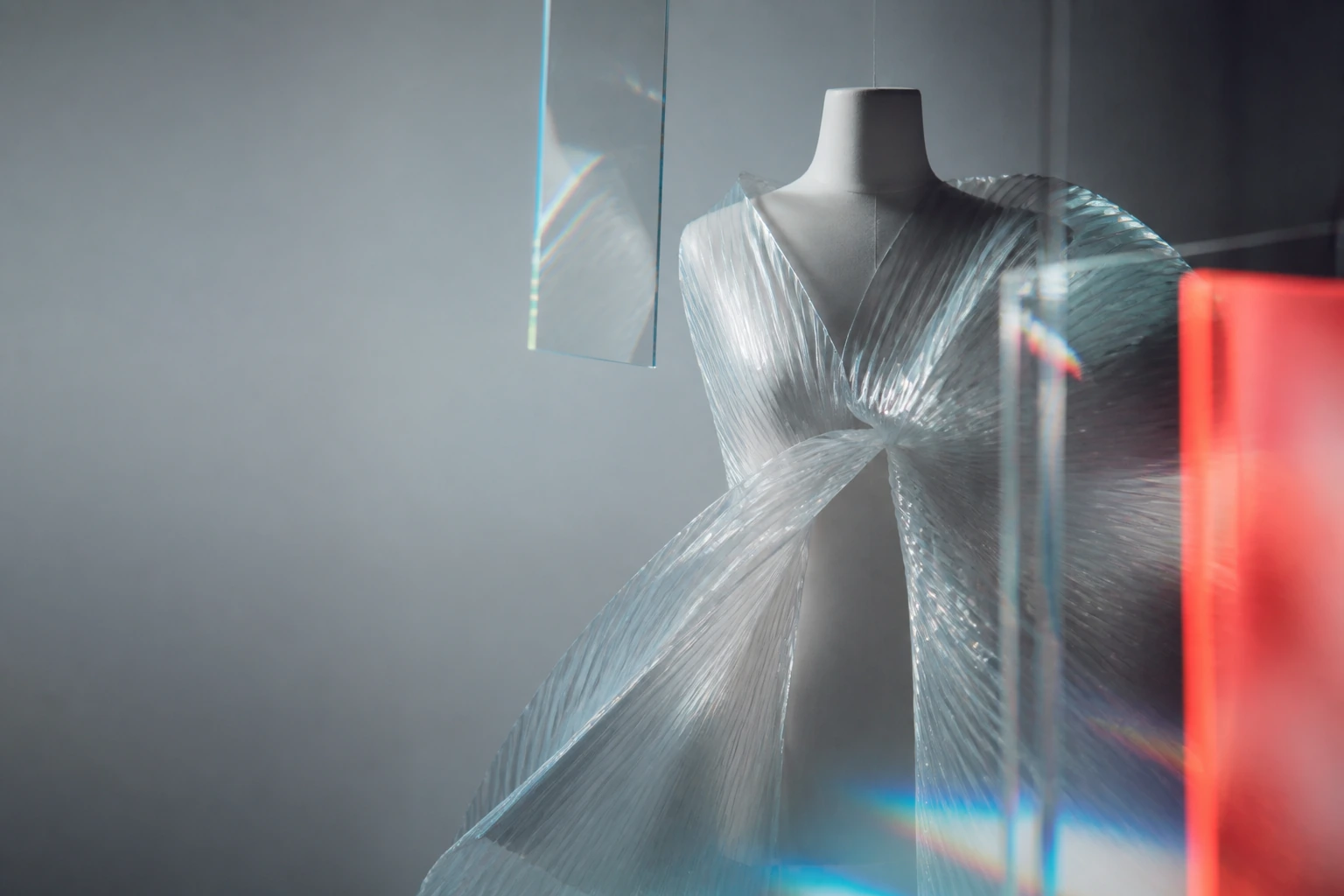
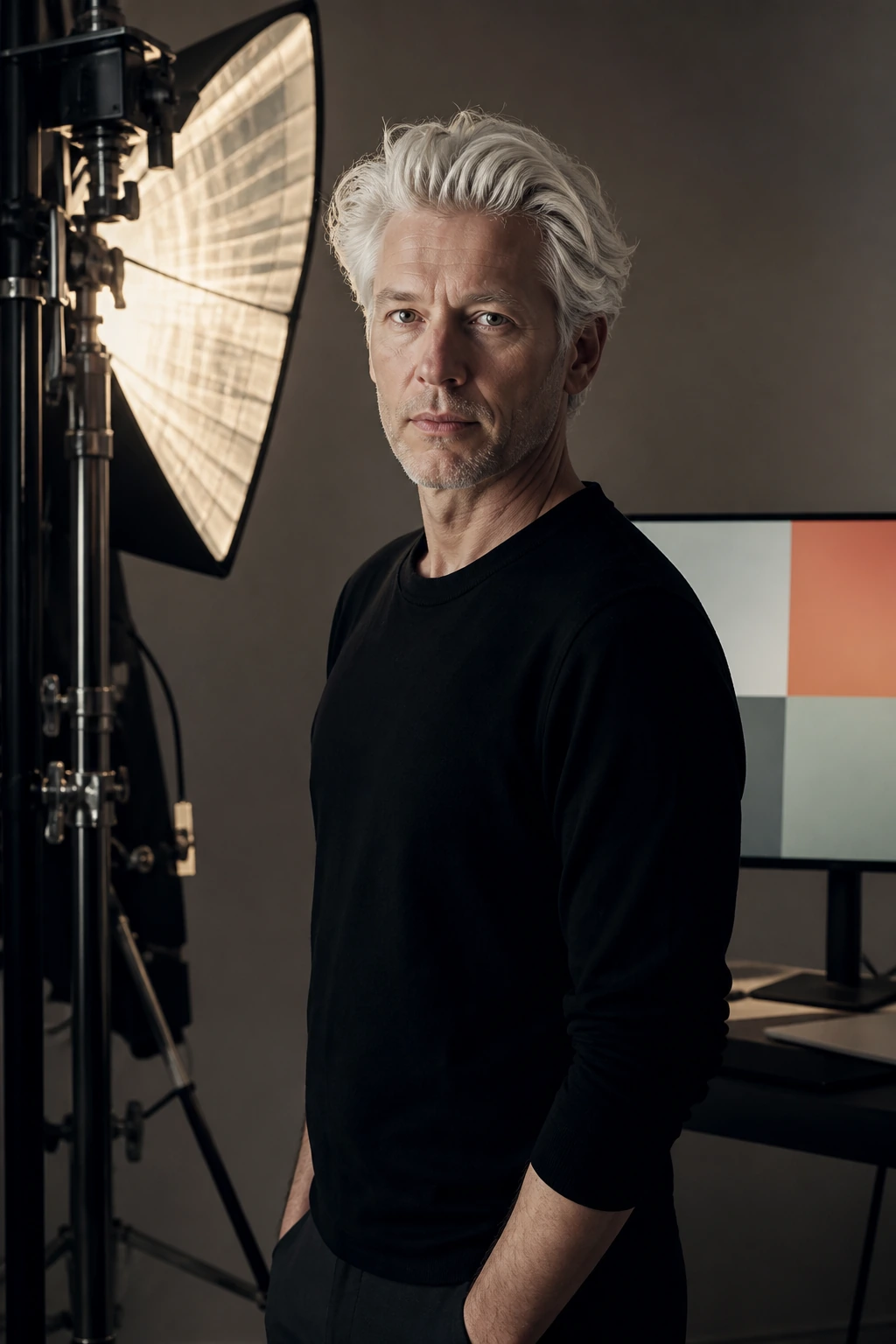
Sundsbø made technical changeability part of authorship: X-ray, 3D scanning, hand-painted retouching, thermal imaging, film and virtual production do not form one effect; they allow each project to decide again what kind of image it needs to become.
Editorial thesis
Sølve Sundsbø matters not as the photographer of one recognisable look but as the author of a method of continual recalibration. Technology becomes powerful not when it advertises itself, but when it changes how body, garment, face or space can be seen. [source]
Reader question
How can a photographer remain recognisable while deliberately avoiding one fixed style and changing cameras, techniques and media from project to project?
Short answer
Sundsbø's recognisability lies not in a preset but in a research logic: craft → question → tool choice → transformation → precise fashion image. Curiosity remains constant; surface effect does not. [source]
1. Norway, 1970: before fashion came curiosity about images
Sølve Sundsbø was born in Norway in 1970 and now works across photography and film from London. Art + Commerce and the National Portrait Gallery identify him as a Norwegian photographer whose international career is defined by continual shifts in technique. [source]
For VANSMITHLAB, the important point is not biographical exoticism but an initial attitude: Sundsbø has rarely defended one form of photography as the 'real' one. His practice begins with curiosity about how an image might be made differently.
2. London, 1995: four months that replaced a degree
In 1995 Sundsbø moved from Norway to London and enrolled at the London College of Printing. Vogue Italia records the almost legendary turn: after roughly four months, the course gave way to work as Nick Knight's assistant. [source]
This is not a story about education being unnecessary. School was immediately replaced by another school — real fashion production, where light, technical failure, deadline, retouching and editorial idea operate at the same time.
3. Nick Knight: an almost medieval apprenticeship
Sundsbø worked with Nick Knight for nearly four years. In interviews he compared the apprenticeship to an almost medieval model in which the student gives himself fully to a master and receives an equally intense return of knowledge. [source]
The relationship matters because Knight himself refused rigid boundaries around photography. In that studio Sundsbø saw that an image-maker could use emerging technology not as special effect but as a normal thinking tool.
4. The central lesson: rules can be broken only after craft
The central lesson of those years was simple: craft has to be understood deeply enough for rules to be broken deliberately. Vogue Italia recounts Sundsbø's belief that a young photographer must find a personal way of seeing the same things everybody else can see. [source]
His experiments are therefore not technical gambling. X-ray, 3D scan or complex post-production work only because composition, light, material, body and knowledge of fashion remain underneath them.
5. 'If I have a style, it is that I have no style'
One of Sundsbø's best-known lines is that if he has a style, it is that he has no style. The Independent and later interviews repeatedly return to the phrase. [source]
It should not be read literally. There are recurring qualities: clarity of form, bodily strangeness, controlled artificiality and fascination with surface. What he resists is turning any one technique into a compulsory signature across every assignment.
6. Fashion photography as a laboratory rather than a genre cage
Fashion photography provides an ideal laboratory because the industry continually changes clothes, faces, brands, editorial contexts and media. His portfolio includes Vogue Italia, i-D, LOVE, V, W, Perfect, Re-Edition and other publications. [source]
Instead of protecting one look, he uses each assignment as permission to alter the method. One editorial may be cold and digital, another almost classical, a third built from an optical or physical experiment.
7. Old and new: technology does not have to look technological
Sundsbø's official site emphasises the union of traditional techniques with technological innovation, from hand-painted retouching to 3D scanning. [source]
This breaks the simple chronology in which analogue belongs to the past and digital automatically means progress. An old technique can produce a more futuristic result than new software, while a complex digital system can create an image that feels quiet and material.
8. Hand-painted retouching: a digital effect before digital habit
Hand-painted retouching is particularly revealing. Before digital retouching became an almost automatic stage of commercial photography, an image could be physically reworked by hand, layer after layer. Vogue Italia explicitly lists the technique among Sundsbø's methods. [source]
The process reminds us that retouching does not have to mean correcting a defect. It can become a drawing stage in its own right, with photography functioning as source material for a new object.
9. X-ray: clothing and body become structure
Sundsbø has used X-ray photography alongside conventional cameras and post-production. Vogue Italia describes X-ray as one of the older techniques he combines with newer technologies. [source]
X-ray changes the hierarchy of the image: the garment surface may disappear while internal construction becomes the subject. That is especially productive in fashion, where design often hides structure, fastening, seam and the relationship between fabric and body.
10. 3D scanning: the camera stops being the only point of view
3D scanning removes the requirement for one fixed viewpoint. Art + Commerce and Sundsbø's official site both identify 3D scanning as a characteristic part of his technical vocabulary. [source]
Once scanned, the body exists as digital volume and a virtual camera can be positioned later. For fashion image-making this is a major shift: the photographer does not only choose the moment in front of a lens but constructs point of view inside a data model.
11. Thermal imaging: temperature becomes portrait information
Sundsbø has also experimented with thermal imaging, a camera system that records heat distribution rather than ordinary visible light. Accounts of his collaboration with Giles Deacon recall one such image as an almost abstract thermal portrait. [source]
Thermal imaging turns physiology into visual code. Face and clothing become difficult to read conventionally; colour describes energy rather than fabric. The technique is strongest when attached to a concept rather than used as a ready-made science-fiction filter.
12. Transforming the body: beautiful, strange and almost nonhuman
Many Sundsbø images approach the uncanny valley: the body remains recognisably human but appears slightly impossible. Vogue Italia describes his figures as almost alien, with technology used to disturb familiar human form. [source]
The strangeness does not always come from digital distortion. It can grow from lighting, shooting through material, retouching, scanning or unusual chromatic logic. The key effect is simultaneous recognition and uncertainty.
13. Editorial experiment: Vogue Italia, i-D, LOVE, V and W
Editorial culture gave Sundsbø room to test methods faster than a long-term advertising system normally could. His official biography records regular work with Vogue Italia, i-D, LOVE, V and W. [source]
A magazine is an experimental space: a result does not have to become a brand language for years. One visual world can be built for ten pages, tested, and abandoned in the next issue.
14. Giles, Sølve, Katie: a long dialogue among designer, photographer and stylist
The book GilesSølveKatie brought together roughly two decades of collaboration among designer Giles Deacon, photographer Sundsbø and stylist Katie Grand. Vogue presented it as a history of an extended creative relationship rather than a catalogue of campaigns. [source]
The partnership demonstrates why fashion image-making rarely belongs to one individual. Designer produces form, stylist builds conflict and character, photographer chooses technology and space. Authorship emerges between roles.
15. Alexander McQueen: Savage Beauty — the archive receives a body again
For The Metropolitan Museum of Art's Alexander McQueen: Savage Beauty catalogue, Sundsbø made new photographs of McQueen's archival garments. The Met specifically highlights those photographs as a defining component of the book. [source]
The task was more complicated than ordinary object photography. An archival garment needed accurate documentation, yet McQueen designed clothes for living bodies and dramatic motion. Sundsbø needed to restore presence without turning a museum catalogue into runway imitation.
16. Live models as mannequins: museum documentation becomes an image
A later Met account reveals the method: live models were covered in white body paint and altered in post-production so that they approached the appearance of mannequins. [source]
The result is a strange compromise between archive and body. Clothing falls naturally because a living person supports it, while the person visually recedes so as not to compete with the object. Museum documentation becomes an autonomous fashion image without losing its research function.
17. A Rush of Blood to the Head: a fashion photographer creates a music icon
Sundsbø created the cover of Coldplay's A Rush of Blood to the Head, one of the clearest examples of experimental fashion language becoming a mass-cultural music icon. Art + Commerce lists the work among his album covers. [source]
Its power lies in not requiring a literal band portrait. The distorted digital head functions almost like a logo and shows that technology can produce an image of extreme visual simplicity.
18. Portrait and collection: Twiggy and Kate Moss at the National Portrait Gallery
The National Portrait Gallery holds works by Sundsbø, including a 2008 portrait of Twiggy and a double image of Twiggy with Kate Moss. [source]
These works are a useful counterpoint to elaborate technical experimentation. Sundsbø can also work with the cultural memory of a face: two periods of model culture meet as a new portrait rather than as a historical lecture.
19. Moving image: photography acquires duration
Sundsbø has long worked with moving image and describes himself as both photographer and filmmaker. His official biography lists films for fashion and brands alongside still photography. [source]
Movement provides what the still frame cannot: material changing through time, facial behaviour, transformation and montage. For an author preoccupied with change, film is not an extra service but a logical continuation of photography.
20. 14 Actors Acting: film as a series of micro-portraits
14 Actors Acting for The New York Times Magazine was built as a sequence of short performance studies in which well-known actors inhabit concentrated emotional states. Art + Commerce and the British Journal of Photography identify it as one of Sundsbø's defining moves into film. [source]
The title explains the method: not actors posing, but actors acting. The camera observes gesture developing through time, and portraiture becomes temporal structure.
21. Emmy 2011: experiment recognised by television
In 2011, 14 Actors Acting received an Emmy in a category devoted to new approaches in news and documentary programming. The award is recorded in Sundsbø's agency biography and in material surrounding Beyond the Still Image. [source]
The significance is institutional rather than merely competitive. A hybrid format by a fashion photographer was recognised in a field where photography, performance, digital publishing and short film met.
22. The Ever Changing Face of Beauty: the face as a system of transformations
For W Magazine, Sundsbø created The Ever Changing Face of Beauty, a film and set of stills built around a continuously transforming face. W describes the project as a collision of different gendered, cultural and bodily signs within one mutable figure. [source]
Technology becomes content rather than decoration. Morphing is used to show the instability of beauty standards; the face stops functioning as a fixed identity.
23. Beauty, gender and technology: where effect ends and idea begins
Any technological transformation of the body requires critical reading. If a face can be endlessly mixed, stretched and reconstructed, does the process broaden our idea of beauty or create another ideal that no physical body can inhabit? [source]
Sundsbø's stronger images often destabilise the norm rather than perfect it. A contemporary image-maker must nevertheless remember that digital freedom does not remove the power of casting, retouching and commercial context.
24. Beyond the Still Image, 2018: exhibition confirms the hybrid method
In 2018, Palazzo Reale in Milan presented Beyond the Still Image as part of the Vogue Photo Festival. Sundsbø's official biography and the British Journal of Photography describe a presentation joining photography, film, projection and technological experimentation. [source]
The title is an efficient summary of the career. The still image does not disappear, but it stops being the only possible final form; it can extend into motion, installation or data-based representation.
25. The commercial campaign: technique should serve the brand, not the reverse
Sundsbø has made still and moving work for Chanel, Cartier, Hermès, Gucci, Prada, Louis Vuitton, Armani, Guerlain and many other brands. [source]
Commercial work is a strong test of the 'no fixed style' idea. A brand does not need somebody else's preset laid over its identity. Sundsbø selects technique according to the problem: jewellery requires one kind of precision, beauty another, fashion film another again.
26. Why one tool cannot become an authorial signature
When one technique becomes a compulsory signature, it quickly turns into an effect a client can buy separately from an idea. Sundsbø deliberately resists that position. [source]
His recognisability exists at a deeper level: a willingness to find an unfamiliar way of seeing an object, plus enough technical freedom to realise that choice. The method stays consistent; the result does not.
27. Pirelli Calendar 2026 — Elements
The 52nd Pirelli Calendar, The Cal 2026, was photographed by Sølve Sundsbø under the title Elements. Pirelli describes earth, water, fire, wind, ether, sky, flowers and nature as its visual forces; participants include Tilda Swinton, Venus Williams, FKA twigs, Gwendoline Christie and Isabella Rossellini. [source]
After decades of fashion assignments, the calendar gives him a rare single format in which one concept must hold radically different figures together. The elements operate less as décor than as a way of joining body, emotion and symbol.
28. Virtual production: nature constructed inside a technological studio
The paradox of Elements is that its meditation on nature was produced inside a highly technological virtual-production environment. Pirelli describes ultra-high-resolution screens, digital environments and physical sets working together to construct water, fire, earth and air. [source]
It is almost an ideal Sundsbø problem: nature is not positioned against technology. Technology is used to construct a condition that the viewer experiences as physically convincing.
29. Pirelli 2027: from a single author to multiple photographic voices
In May 2026 Pirelli announced that the 2027 Calendar would focus on India and, for the first time in the project's history, combine the work of two distinct photographers: Sølve Sundsbø and Raghu Rai. Following Rai's death, Pirelli and his family stated that his part of the project would be brought to completion. [source]
For Sundsbø this is another shift: after the author-led Elements, the next calendar is structured through multiple viewpoints. A large cultural subject is deliberately not entrusted to one visual voice.
30. The main legacy: constant style replaced by constant research
Sølve Sundsbø's main legacy is not X-ray, 3D scanning, thermal imaging or digital morphing. Any of those tools can become obsolete or widely available. [source]
The lasting lesson is that technical fluency should free an author from their own habitual style. If every project requires a fresh decision about how the image should exist, photography can still produce surprise after the technology itself stops being new.