photographer profile
Sarah Moon
Fashion as memory, fiction and the disappearing image
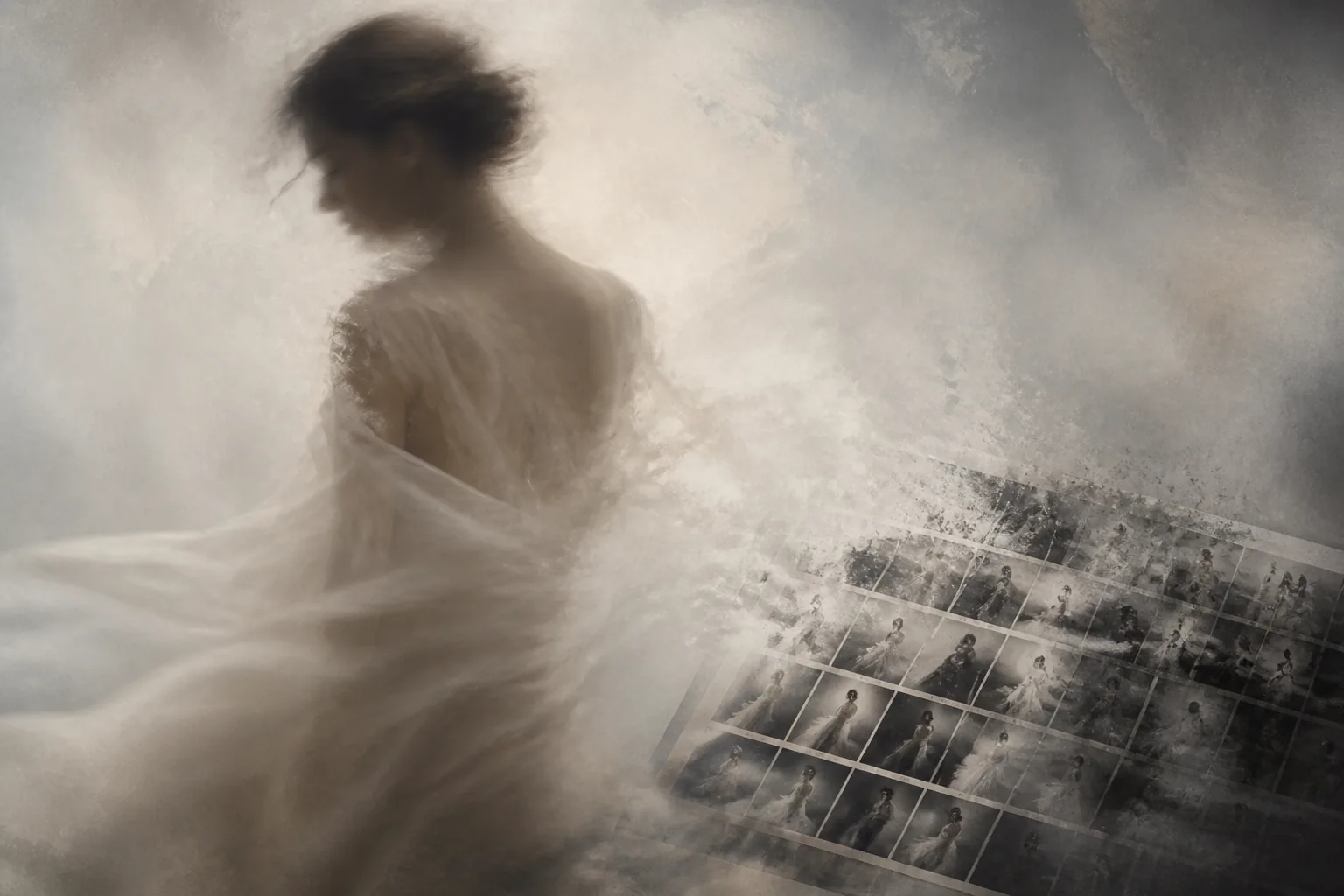
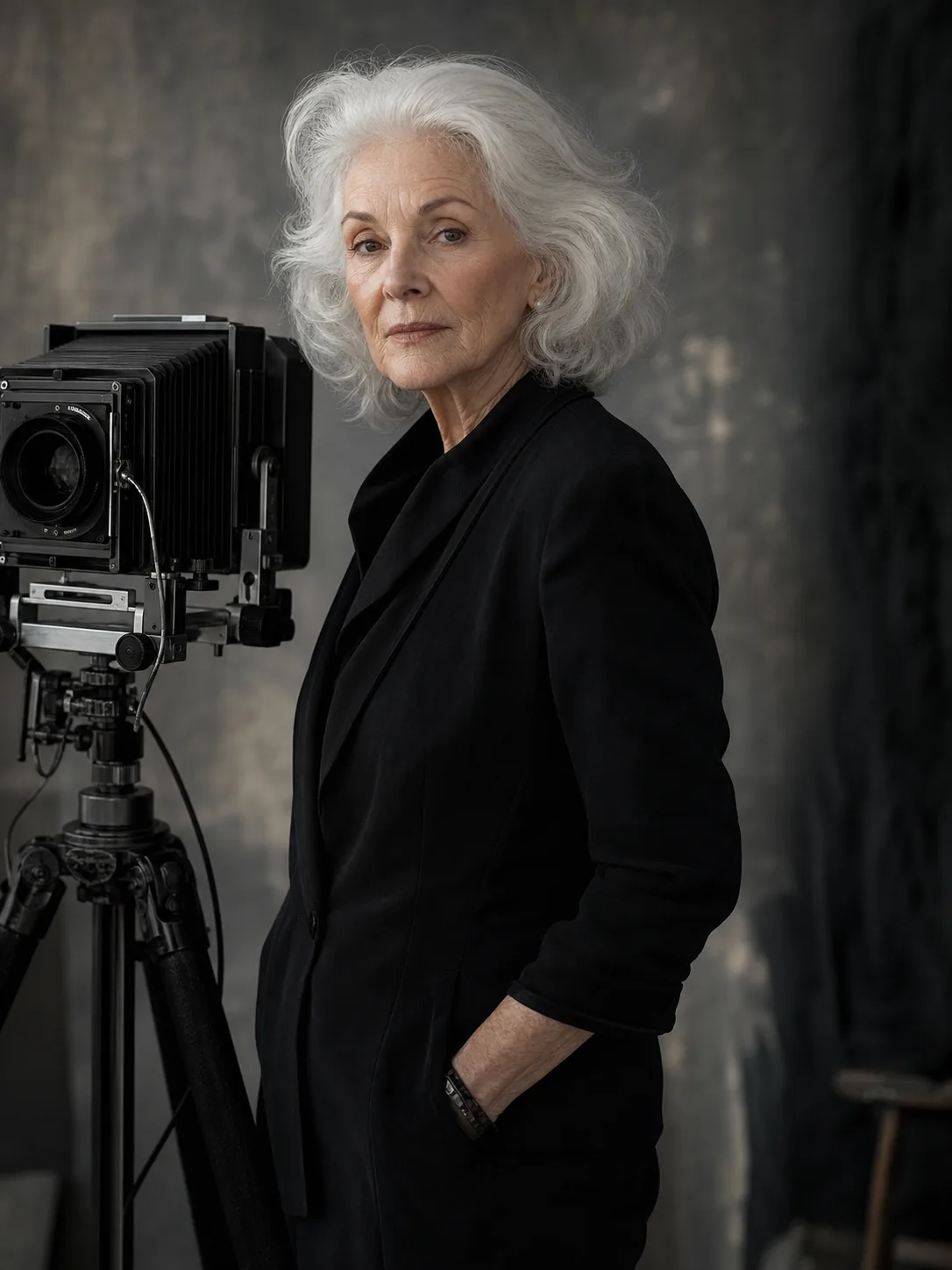
Sarah Moon turns the fashion image into a memory of an event that may never have happened: movement blurs, colour becomes unreliable, and the model keeps a secret instead of belonging completely to the gaze.
Editorial thesis
Sarah Moon matters not as the author of merely “dreamy” fashion photography but as a photographer who made uncertainty a structural principle. Her images do not promise exact reality: they show how memory, time, fiction and the materiality of the print alter what the camera is supposedly meant to register. 1
Reader question
Why do Sarah Moon’s images feel like old memories even when we know they were carefully staged for fashion, advertising or a contemporary art project?
Short answer
Because Moon builds photography not around proof but around loss of information. Blur, movement, deep shadow, incomplete narrative and altered colour place the frame between document and fiction. Fashion does not disappear; it becomes part of the image’s psychological time. 1
1. 1941: a biography begins with rupture and displacement
Sarah Moon was born in 1941. Her Jewish family left France during the war, and her childhood was spent in England. She later returned to France and built a life across several cultural contexts. 1
This early displacement should not be turned into a simple biographical key that explains every image. Yet rupture, unstable belonging and memory of what has disappeared clearly resonate with her later language. A Moon photograph rarely behaves like proof of the present moment. It often looks like a memory formed at the very instant of exposure.
2. Model in the 1960s: experience from the other side of the camera
In the 1960s Moon worked as a model. This gave her an unusual professional education: she knew the fashion set not as an observer but as someone who had stood in front of the camera, waited for direction, felt clothes on the body and understood how artificial a supposedly natural pose could be. 1
When she moved behind the camera, that knowledge became an advantage. Her models often refuse frontal display. They turn away, disappear into shadow, move, cover the face, or seem absorbed in thought. The fashion image stops being a one-way act of observation.
3. 1968: Corinne Sarrut, Cacharel and entry into the profession
The Musée d’Art Moderne de Paris links Moon's professional breakthrough to 1968, when her collaboration with Corinne Sarrut on the Cacharel image attracted attention within a male-dominated international fashion scene. 1
It matters that Moon did not enter the profession through a cult of technical mastery. She was largely self-taught and learned through real commissions. Her early language therefore formed inside a productive tension: the clothes and brand had to remain legible, yet the photograph had to survive beyond its advertising function.
4. Cacharel: advertising stops looking like advertising
The Cacharel work became one of those rare cases in which commercial photography shapes a brand's cultural memory for decades. Moon photographed less a product than a sensation: youth, slowed movement, unstable gesture and fabric that already seemed to belong to the past. 1
That is why an image can keep working long after the season and garment have vanished from shops. Advertising starts to resemble a found family photograph — except the family archive never existed. For a brand, this can be stronger than direct product display: it receives not a description but a myth.
5. Biba and fashion as the ghost of another era
In the 1970s Moon also worked with Biba. Historical styling in these images never becomes a tidy retro reconstruction. Vogue has described them as impressionistic scenes with an Art Deco haze, but without simple nostalgia. 18
Moon uses the past as material for emotional distance. Clothes may recall the 1920s or 1930s, yet the picture never claims that the viewer has returned to that era. Instead it stresses the impossibility of return. Fashion becomes a way to feel history as loss rather than historical accuracy.
6. Magazines: Vogue, Elle, Harper’s Bazaar and the international scene
By the late 1960s and through the 1970s Moon had entered the international magazine system. Howard Greenberg Gallery lists Vogue, Elle, Harper’s Bazaar, Marie-Claire, Graphis and Life among the publications that carried her work. 16
The magazine matters not only as distribution. A spread allows rhythm between close and distant view, face and emptiness, fashion and apparently incidental detail. One photograph creates atmosphere; sequence turns atmosphere into a world. This helps explain Moon's natural movement from editorial work toward books and cinema.
7. The woman in the frame: not a display object but an inner character
Twentieth-century fashion photography often treated the female body as a surface designed for an external gaze. Moon does not escape the fashion system or commercial context, but she changes the psychology of the image. The woman in her frame often appears to have a life beyond the assignment. 1
She may be beautiful, elegant and carefully styled, yet she does not have to be completely available to the viewer. Eyes turn away, hair hides the face, the figure becomes silhouette. Partial inaccessibility creates subjectivity: the character never belongs entirely to us.
8. A fiction of one second: what Moon does to reality
The Académie des beaux-arts describes a central Moon principle as turning photography into a brief fiction. An event is not explained but suspended at the point where a gesture or gaze suggests an entire invisible narrative. 14
This is a useful way to read her work. Instead of asking only what is happening, notice how much information has been withheld. Who has just entered? Why has the figure turned away? What happened one second earlier? Fashion becomes a narrative trigger: the clothing remains visible, but it is no longer the sole subject.
9. Blur: the error that becomes meaning
Blur in Moon's work does not behave like a technical failure to be corrected by greater sharpness. It functions as a refusal of full access to the subject. Contour moves, a face loses precision, space dissolves — and the photograph begins to resemble memory rather than an optical report. 1
For contemporary image-makers this is an important lesson. Image quality is not identical with maximum detail. Sharpness is useful when it supports meaning. If the task is disappearance, dream, anxiety or distance, a measured loss of information may make the image more precise emotionally.
10. Movement and exposure: the body does not have to stand still
Moon often allows movement inside the exposure. The figure is not frozen like a mannequin: fabric shifts, hands fail to stop completely, a face may pass through slight blur. The body becomes temporary. 1
For fashion this is paradoxical. The industry often wants to preserve the garment clearly, yet clothing exists precisely through movement. Moon chooses sensation over complete cataloguing. We see not only the shape of a dress but the fact that one second later the shape will already be different.
11. Black and white: memory rather than neutral registration
Moon's black and white is not neutral classicism. It intensifies uncertain memory: whites can burn toward absence, blacks fall into void, while grey carries much of the emotional range. 1
Monochrome removes everyday specificity. Fabric, skin, wall and mist can enter the same tonal system, slowing the viewer's impulse to classify objects. The photograph moves closer to memory, where exact colour often disappears before the overall scene does.
12. Colour: why plausibility does not interest her
Moon uses colour without accepting the obligation to be plausible. Interviews and critical texts around her practice repeatedly note her attraction to altered or "untrue" colour, especially where Polaroid and printing distance the image from literal reproduction. 1
Colour may feel too cold, sickly, faded or almost painterly. It does not tell us the objective colour of the garment. It tells us what state that garment has become inside the image. This is another kind of accuracy — emotional rather than catalogue-based.
13. Polaroid, grain and the materiality of the imperfect image
Polaroid matters to Moon not as a symbol of vintage aesthetics but as an image with its own material behaviour: unpredictable colour, softness, grain and a narrow border between success and loss. The Académie notes that she has moved freely among reflex camera, Polaroid and cinema. 1
That changes the status of error. Digital workflow seeks reversibility: balance, sharpness, skin and background can all be corrected. In Moon's work some expressiveness appears precisely where the image cannot be fully returned to "normal". Imperfection becomes part of authorship.
14. The stage: curtain, window, mirror and empty space
Windows, curtains, mirrors, doorways, shopfront glass and empty rooms recur throughout Moon's images. They are not merely decorative sets. Each creates a boundary between viewer and character. 1
A curtain can hide part of a body, glass can add reflection, a window can turn the street into a distant stage. Instead of direct display, several layers of reality appear. The fashion image starts to operate architecturally: what matters is not only what is visible, but through which barrier it is seen.
15. Disappearance: when absence works harder than presence
One of the strongest sensations in Moon's work is disappearance. A character may sit on the edge of the frame; sometimes an empty chair, dark room or landscape where the person has already gone matters more. 1
Absence seems risky in commercial photography because the client pays for visibility. Moon demonstrates the opposite: withholding can intensify attention. When viewers are given less, they construct more. This is one reason her images remain memorable — they do not close the question.
16. Fashion as a story without a beginning or an ending
Fashion photography normally knows its context too well: collection, season, designer, magazine, product. Moon behaves as if that context is insufficient. Her characters seem to arrive from a story that began before the shoot and will continue after the page. 1
Fashion stops being the endpoint. A dress becomes a clue: it speaks about age, time, character, weather and expectation. This is one of the most useful principles in editorial image-making — an object should not merely occupy the frame; it should activate imagination.
17. 1985: personal work becomes a second line of practice
The Musée d’Art Moderne links a stronger personal line in Moon's practice to 1985, after the death of her assistant Mike Yavel. Commercial commissions continued, but independent work around memory, chance, loss and time became increasingly important. 1
This should not be reduced to the myth of an artist who "left advertising for art". Moon continued to work between worlds. The balance changed: personal photography became an autonomous field, while commercial experience continued to feed her sense of staging, rhythm and visual economy.
18. Time as the main invisible protagonist
Time in Moon's work rarely feels like a precise date. It thickens: a new photograph can look old, while a historically styled image can remain strangely contemporary. The Académie des beaux-arts describes photography and film in her practice as ways of struggling with time as it carries the visible away. 14
This explains her attention to traces: the space after an event, a face already leaving the frame, a flower beginning to fade. Photography does not stop time completely. It shows that every stoppage is temporary.
19. Nature, animals and objects: a world after the human figure
Beyond fashion, Moon increasingly photographs plants, animals, architecture, landscapes and objects. Yet the language changes less than the subject: an object can still behave like a character with a secret and its own temporality. 1
This is a useful test of authorial method. If a style works only with a beautiful model and expensive clothing, it may be a production condition rather than a real visual language. For Moon, a flower, elephant or empty facade can carry the same psychological intensity as a fashion portrait.
20. Alchimies: the natural-history museum as photographic laboratory
In 2013 the Muséum national d’Histoire naturelle in Paris presented Alchimies. Moon made new work in the Ménagerie and museum collections and combined it with earlier photographs of nature. 5
A natural-history museum normally classifies: species, type, origin. Moon does the opposite. She returns uncertainty to the object. Living and taxidermied, plant and stone, specimen and fairy-tale character enter the same visual universe.
21. The book as a form of authorial editing
Moon has always treated the book as an autonomous form rather than a warehouse for greatest hits. Howard Greenberg and Fotografiska list titles such as Improbable Memories, Vrais Semblants, Photopoche, Coincidences and 1,2,3,4,5. 1
A book controls pause. The page turn replaces a cut; white space becomes silence; two photographs begin to argue. For an author who values uncertainty, this is an ideal medium: sequence can imply narrative without becoming a literal script.
22. Little Red Riding Hood: the fairy tale becomes a photographic system
Little Red Riding Hood from 1986 shows how naturally Moon connects photography and fairy tale. She does not illustrate the story through a schoolbook equation of one scene to one picture; the familiar narrative becomes an atmosphere of anxiety, childhood and unclear threat. 1
Fairy tale is useful because the viewer already knows it. Structure does not need to be explained from zero. Moon can alter tone, remove the obvious and leave a trace. Collective memory becomes raw material for a new visual work.
23. Cinema: Mississippi One and the expansion of the still frame
Moon has worked with moving image since the late 1970s; the Académie des beaux-arts describes her as a director since 1978. Her feature Mississippi One appeared in 1991 and represents a major extension from still photography into cinema. 14
Cinema does not cancel her photographic eye. It adds what the still lacks: duration, sound, waiting and movement between states. Her films value not narrative speed but the possibility that an image may remain for one more second — and become more disturbing because of it.
24. Circuss, The Red Thread and the dark side of the fairy tale
The Musée d’Art Moderne included several Moon films adapted from popular tales in PastPresent: Circuss, The Red Thread, Little Black Riding Hood, The Barn Owl and Where Does the White Go? 1
She approaches fairy tale not for decorative fantasy but for its underlying darkness. Old stories contain fear, loss, prohibition, death and unstable morality. Moon removes the safe children's wrapper and restores those elements. Her fashion pictures can therefore feel like stills from tales that should not be trusted completely.
25. Henri Cartier-Bresson: a photographer films a photographer
In 1995 Moon made a film on Henri Cartier-Bresson. For a photographer whose relation to the decisive moment seems so different, the dialogue is especially interesting. Howard Greenberg lists the film among the important works of her cinema practice. 1
Cartier-Bresson is often associated with the precision of a caught structure; Moon with ambiguity, blur and staged fiction. Yet both practices value the unrepeatable configuration of a moment. The camera never captures the whole world — only one arrangement already disappearing.
26. Robert Delpire: publisher, art director and a long dialogue
Robert Delpire was Moon's companion for nearly five decades, as well as publisher, designer and a major figure in French photographic culture. The Musée d’Art Moderne devoted space within PastPresent to his books, posters and films. 1
The relationship reminds us that a photographic career is not built alone. A publisher determines book scale, paper, sequence and rhythm; an art director helps shape the public language of an author. In Moon's work the printed object often becomes an extension of photography rather than its container.
27. PastPresent: why the retrospective refuses chronology
PastPresent at the Musée d’Art Moderne de Paris ran from 2020 into 2021 and deliberately rejected linear chronology. Moon mixed eras, subjects, fashion work, films and personal photographs. 1
This is an exact curatorial strategy for her practice. Arranging the work by decades might accidentally turn it into a history of changing technique. Moon instead foregrounds recurring states: disappearance, mirror, animal, female figure, flower, road, fear. Time is not a line but a system of echoes.
28. Dior by Sarah Moon and Dialogue with Yohji Yamamoto
In 2022 Delpire & Co published Dior by Sarah Moon, a major edition in which Dior history passes through Moon's own visual language rather than neutral archival reproduction. The publisher later continued this collaborative logic with Dialogue, created with Yohji Yamamoto. 19
Both projects reveal a mature form of fashion collaboration. Moon is no longer simply the commissioned photographer of a campaign. She enters into dialogue with a house or designer's legacy and translates it into her own language of memory, shadow and incomplete visibility.
29. 2024–2026: On the Edge, the Grand Prix and From Nature
In 2024 Howard Greenberg Gallery presented On the Edge, surveying more than four decades of work. In 2025 the Académie des beaux-arts awarded Moon its Grand Prix in photography. In 2026 the Normandie Impressionniste festival included her From Nature project. 15
The sequence matters because Moon is not only a historical figure from 1970s fashion. Her practice continues to expand and to be institutionally reread through museum, gallery, book and new work with nature.
30. The main legacy: the fashion image as memory of something that never happened
Sarah Moon's main legacy is not soft focus or a "dreamy aesthetic". Those signs can be turned into a filter and lose their meaning instantly. Her real method is the construction of an image that knows it is not identical with reality. 1
Fashion becomes memory of an event that may never have happened. The model becomes character, clothing becomes a temporal sign, technical imperfection becomes psychological distance, and a commercial assignment becomes a small fiction. For contemporary photographers the lesson is not an effect but the right to leave part of the image unknown.