stylist profile
Melanie Ward
Construction, Character and the Making of the Modern Stylist
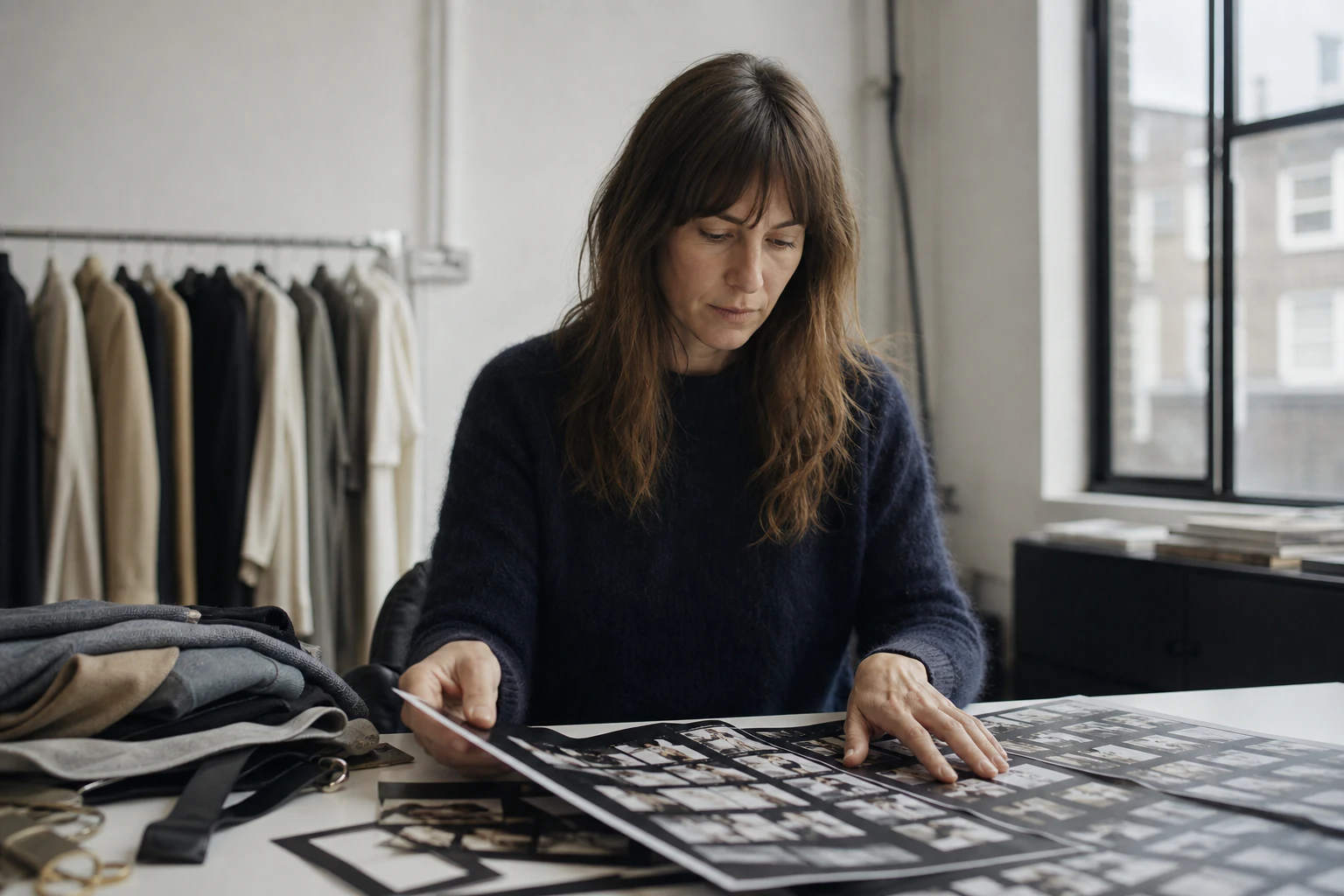
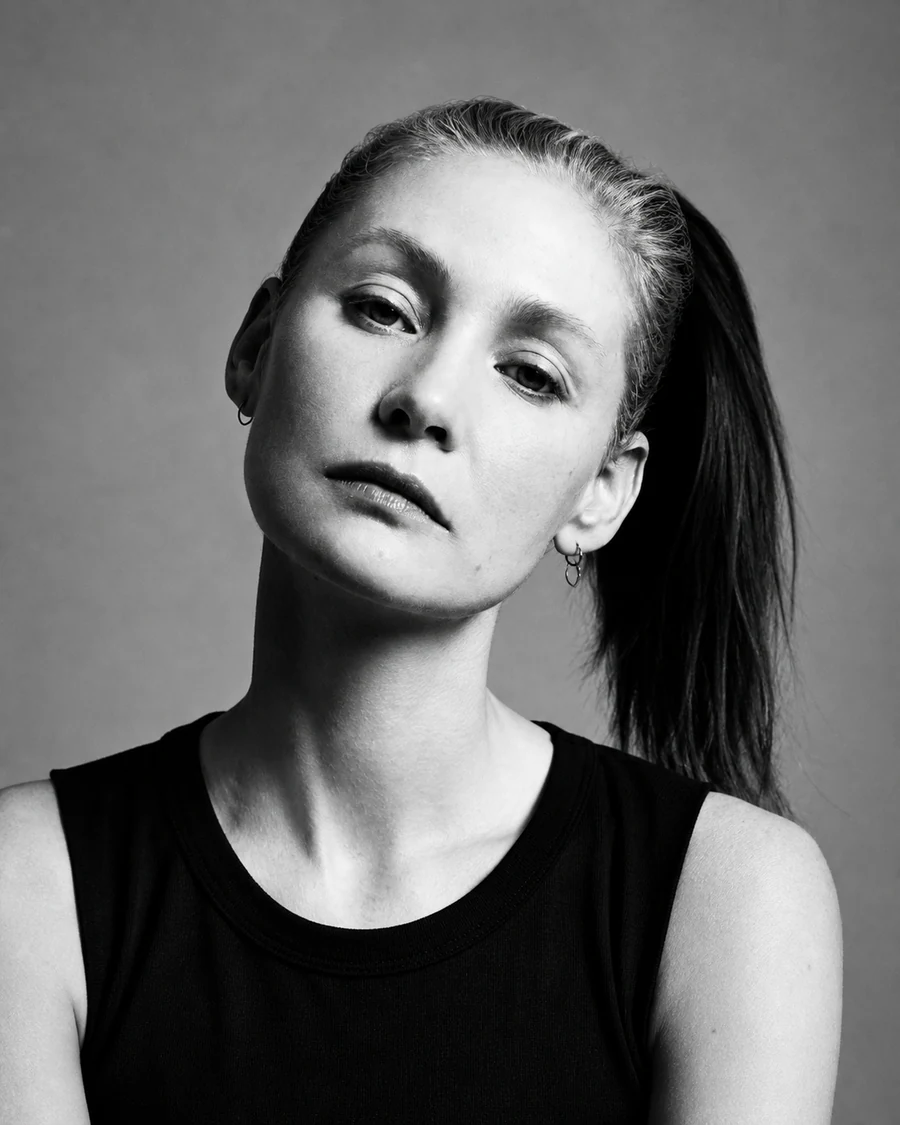
Ward transformed styling from hidden service labour into an authored practice: know how clothes are made, see the person before the brand, mix street and luxury, alter garments by hand and build a system of relations among designer, photographer, model and image.
Editorial thesis
Melanie Ward matters not as the creator of one grunge look. Her contribution is a professional model of the modern stylist: construction knowledge, character-driven imagery, freedom to mix high and low, and the ability to work from independent magazine to global fashion house without reducing styling to runway reproduction.
Reader question
Why do Ward’s early combinations of vintage, school uniform and “stylist’s own” still feel current after fashion has commercialised grunge, minimalism and street style?
Short answer
Because her method was not a trend recipe but a way of looking. A garment was chosen for what it did to person, proportion and character; the brand was one source, not the owner of the image.
1. Whitechapel, 1961: style begins outside luxury
Melanie Ward was born on 17 June 1961 in Whitechapel. Her father worked in retail and her mother was a headteacher; Ward connected her love of clothes to her mother and to an early habit of making and altering garments. [source]
The geography matters. Her eye formed inside a London mixture of second-hand clothing, school uniform, music, markets and practical invention. That would later become an alternative to the polished glamour of the 1980s.
2. Politics and Languages: another profession existed before fashion
Ward earned a London University degree in Politics and Languages. In her own interviews she remembered imagining a diplomatic career while sewing clothes at night. [source]
The dual path helps explain her profession. Styling requires negotiation among designer, photographer, magazine, model and commercial system. Ward herself joked that fashion does indeed require diplomacy.
3. Central Saint Martins: one year of fashion training and knowledge of construction
After university Ward studied fashion at Central Saint Martins for a year and won a daywear award. The detail matters because later collaborators repeatedly stressed that she understood how clothes were built, how fabric moved and what could be changed directly on the body. [source]
Her styling was therefore never only a selection of finished runway looks. She cut, reconstructed, tied, built details and understood clothing from the inside.
4. A man’s jacket becomes a mini-dress: a profession starts in her own wardrobe
Ward recalled wearing a customised man’s jacket as a mini-dress at a party. A woman asked where it came from and offered her a styling job, even though Ward barely knew what a stylist was. [source]
Her first professional resource was literally domestic: her own wardrobe and her mother’s clothes. That is a key origin of her method—an object matters less for where it comes from than for what can be done with it.
5. 1989: Nigel Shafran and the first story for The Face
Ward recalled meeting David Sims and Corinne Day in 1989; that year her first story appeared in The Face, a “suburban space” project with Nigel Shafran. They visited shopping centres and asked ordinary people to wear fashion-house pieces with their own clothes. [source]
The principle later described as character-driven styling is already present: the person does not disappear beneath the garment. Fashion enters reality, and reality changes fashion.
6. Teenage Precinct Shoppers: documenting without erasing the person
Ward’s work with Nigel Shafran on Teenage Precinct Shoppers centred on teenagers and shopping environments rather than an ideal fashion set. Ward said she loved dressing people while keeping them themselves. [source]
It is not documentary photography in a strict sense because clothing and circumstance are staged. Yet the image preserves an existing life—an extravagant version of reality rather than a glossy replacement for reality.
7. The Face, July 1990: 3rd Summer of Love
In July 1990 The Face published 3rd Summer of Love with Kate Moss, photographed by Corinne Day and styled by Ward at Camber Sands. The Guardian and Corinne Day’s archive both document Ward’s central role. [source]
The story changed what could count as fashion imagery: cold beach, unironed clothing, vintage, personal garments, Birkenstocks and the smile of a young model opposed the era’s expensive polished fantasy. Fashion could look like life while remaining carefully constructed.
8. Kate Moss: character before the “ideal body”
Ward worked with Moss before the model became a global icon. In the early photographs height, glamour and perfection mattered less than character, movement and the feeling of wearing one’s own clothes. [source]
This is more important than a simple grunge aesthetic. Ward was interested in the subject. Clothes should intensify a person rather than replace them.
9. “Stylist’s own”: the most desirable thing may have no brand
In Ward’s early work the credit “stylist’s own” often identified some of the most striking elements. She collected second-hand, vintage, surplus and Portobello finds, and made or altered pieces herself. [source]
Status no longer equals price. A luxury jacket can work beside a charity-shop garment, while an unknown object can become the centre of the frame.
10. John Lewis schoolboy suits: uniform as ready-made
Ward bought grey schoolboy suits from John Lewis because she liked their proportions and photographed them on Rose, Kate Moss, Emma Balfour and others. [source]
This is styling as appropriation of an everyday system. School uniform moves from discipline into fashion imagery, yet its force remains in recognisable function and exact proportion rather than decorative exoticism.
11. Sex shops: material before social label
After early grunge, Ward and David Sims searched sex shops for PVC trousers, rubber straps and other elements that could be reconstructed into clothing. Ward stressed that the attraction was not simply bondage but a different styling resource. [source]
Her visual logic is to loosen the object from its fixed social label and test what it can do to body, line and attitude.
12. “Not minimalist, modernist”: forward motion rather than a visual formula
Ward resisted the label minimalist and preferred modernist. Modernity for her meant not becoming trapped inside an inherited aesthetic. [source]
That is why strict menswear, long gowns, vintage Saint Laurent, Helmut Lang, feathers, rubber and lace can coexist in her work. Unity comes from relation and attitude, not identical surface.
13. Corinne Day, David Sims, Glen Luchford, Mario Sorrenti: the group as medium
Ward described the early circle of collaborators as a family: Corinne Day, David Sims, Glen Luchford, Mario Sorrenti and others lived, worked and experimented in proximity. [source]
The period should not become a myth of one stylist. New fashion imagery grew from an environment in which photographer, stylist, model, makeup artists and friends influenced one another. Authorship was distributed.
14. Helmut Lang: a letter from the fashion system to someone outside it
After seeing Ward’s work in The Face, Helmut Lang contacted her and proposed collaboration. Their professional relationship lasted thirteen years; Vogue and Ward herself identify the period as central. [source]
The partnership worked through method as much as taste: both looked closely at garment, proportion and person rather than assembling a generic fashion look. Her role expanded beyond clothes toward casting and image logic.
15. Boy-tailored pants: school trousers enter the Helmut Lang language
The Guardian records a characteristic example: Ward brought Lang black schoolboy trousers from John Lewis as a reference to recut, and boy-tailored proportion became part of the house language. [source]
This is authorship without appropriation. The trousers do not become “a Ward design”; her contribution is to identify an existing proportion, bring it into dialogue with the designer and help the system find a new silhouette.
16. Helmut Lang as image system: show, casting, campaign, clothing
By the 1990s Ward had become one of Lang’s key creative partners. Harper’s Bazaar describes her influence across a wider system of shows, campaigns, casting and visual identity. [source]
Styling rises to brand level. When a stylist works with one designer over time, the contribution is not one look but a continuing way of seeing a person in clothes.
17. Calvin Klein: construction as a language of trust with a designer
Ward worked with Calvin Klein through the 1990s and early 2000s. Remembering her in 2025, Klein emphasised her knowledge of fabric, construction and her ability to understand what a designer was trying to say. [source]
That separates a strong stylist from someone who merely refreshes a collection. The conversation takes place through material and construction, not only moodboards.
18. 1995: Harper’s Bazaar and entry into the American centre
In 1995 Liz Tilberis invited Ward to New York as senior fashion editor of Harper’s Bazaar, where Fabien Baron was creative director. Ward remained at Bazaar until 2009. [source]
The move creates the paradox of her career: someone formed outside the system enters a major luxury magazine and brings in a visual language the system had previously considered too raw.
19. Liz Tilberis: the “bad girl” as editorial function
Ward remembered Tilberis wanting her to become Bazaar’s “bad girl.” This was not provocation for its own sake. The task was to introduce another kind of reality and another relationship to clothes inside a polished American magazine. [source]
Editorial freedom becomes an institutional role: a large magazine deliberately hires someone to disrupt its norm from within.
20. Go, Harper’s Bazaar, September 1997: clean image after grunge
Harper’s Bazaar singles out Go, photographed by David Sims for September 1997 and styled by Ward. Her Bazaar work could be far cleaner than the early London grunge while preserving emotional restraint and precision. [source]
Ward was not trapped in one historical look. She could remove visual noise without becoming formalist: person, fabric and attitude remained central.
21. Kate Moss + Inez & Vinoodh, 1999: a familiar face without repeating the old formula
For Harper’s Bazaar in December 1999, Ward worked again with Kate Moss, this time photographed by Inez & Vinoodh. [source]
Changing photographic language matters. A stylist should not reproduce a personal “signature shot”; the same model can be read again through another photographer and another editorial context.
22. Bazaar until 2009: an independent eye inside an institution
Ward remained a senior fashion editor at Harper’s Bazaar for roughly fourteen years. Across that period the magazine changed leadership while Ward simultaneously worked with fashion houses and advertising. [source]
The role becomes layered: editorial independence constantly meets brand relationships. Her strength was maintaining a point of view without turning every project into the same visual stamp.
23. Imperfect Beauty, V&A, 2000: the stylist receives museum credit beside the photographer
The Victoria and Albert Museum exhibition Imperfect Beauty examined fashion image-makers—photographers, stylists and art directors—and included Melanie Ward among the central stylists. [source]
This marks an institutional shift. Styling stops being invisible production labour and becomes part of the authored history of fashion photography. A credit line changes the history of the medium.
24. Karl Lagerfeld and other houses: the stylist as temporary internal optics
After Helmut Lang, Ward worked with Karl Lagerfeld, Chanel, Dior, Lanvin, Armani, Gucci, Versace, Prada and other houses. In 2010 she also recalled a brief period as creative director at Karl Lagerfeld. [source]
Each project requires a different mode: show, campaign or collection editing. It is a mistake to read every collaboration as a single “Melanie Ward style.”
25. Blouson Noir, 2009–2010: the stylist becomes co-designer
Ward and Graham Tabor launched Blouson Noir as a womenswear project. Interview documented the collaboration in detail in 2010, while WWD covered the Spring 2010 presentation. [source]
The project tests the boundary between professions. Ward had long made and altered clothes, but her own label introduced production, shipping, sales and manufacturing—systems styling normally does not carry.
26. Why Blouson Noir does not cancel the stylist role
Even while discussing her own collection, Ward returned to wearing, fabric, proportion and freedom of interpretation. She accepted that another stylist might wear a garment differently from its maker’s intention. [source]
The consistency is revealing: becoming a designer did not make her close the meaning of an object. Clothing remained an open system rather than an instruction for correct use.
27. Kim Jones: a new generation uses her as a senior collaborator
In her later career Ward became a regular collaborator of Kim Jones, from Louis Vuitton Men to Dior Men and Fendi. Vogue’s 2025 memorial assembled a series of show credits, while i-D had already described Ward as stylist of Jones’s Dior Men collections. [source]
Her experience operates here as contemporary practice, not 1990s nostalgia. She enters complex luxury houses where archive, production, art collaborations and global media require exact collective work.
28. Hermès and Nadège Vanhee-Cybulski: methodical design meets considered styling
Ward also consulted for Hermès alongside Nadège Vanhee-Cybulski. In W Magazine she praised the designer’s methodical, detail-oriented understanding of form, function and design. [source]
This shows Ward’s range. Early raw realism did not prevent work inside a system of extreme craft and control. The common denominator was attention.
29. 22 October 2025: death and the danger of posthumous myth
Melanie Ward died on 22 October 2025 aged 64 after cancer. Vogue, Harper’s Bazaar, Dazed and other publications gathered memories from collaborators. [source]
Posthumous canonisation can make a career too smooth. The history should retain fittings, hard work, compromise, production and collective authorship—not only a list of iconic pictures.
30. 2026: Always Now — the modern stylist as author through relationships
In February 2026 Perfect Magazine published Melanie Ward: Always Now, a major memorial project looking across her visual legacy through people and images from different periods. Models.com also records Perfect Issue 10 as a posthumous 2026 credit. [source]
Ward’s legacy is not the claim that she single-handedly invented styling. Her work demonstrates a mature form of the profession: know construction, see the person before the brand, mix sources, alter garments by hand, and build relations in which photographer, designer, model and stylist remain distinct authors.